South Rim

The past countless number of times I’ve been to the South Rim, I’ve always been engaged in something productive. We were on our way to Flagstaff for a dory trip down the river or coming back from a rim-to-rim hike with friends or on our way to and coming back from leading 50-mile, 10,000+ foot rim-to-rim-to-rim in one day hike for the Colorado Mountain Club. Spending time, seeing the sights and ogling the view was never on the agenda.

This time, in spite of hiking a quarter of the way down the South Kaibab Trail, we’re playing selfie-taking tourrhoids. Today, we drove out and hit every viewpoint from Desert View to Mather Point. Tomorrow we plan to do the same out to Hermit’s Rest, hiking and shuttle busing the entire route. It’s cool to listen to other tourrhoids explain the sites to their friends, getting 90% of the information wrong.

Yes, it’s a vacation.

Rain, rain go away

Friends of ours have a 23-foot Airstream trailer on order that will have a john with a shower onboard. Our A-frame pop-up has neither. That means that by the time this trip is over, we will have spent 29 days using communal restrooms and showers. Without exaggeration, it would be easier to join the mile high club on a commuter jet than it is to get dressed in the phone-booth size shower stalls here at the Grand Canyon.

Today was a miserable day with a happy ending (nothing to do with the mile high club). We were going to hike the Rim Trail from Hermit’s Rest but due to wind, rain, hail and biting cold temperatures, we took the shuttle bus both ways instead. When the weather then cleared, we headed out to an overlook and shot some interesting pix of the play of light and shadows on the canyon walls. Nothing award winning, but still nice.

Tomorrow, we head for Natural Bridges National Monument where the vacation ends and the work resumes. For a Denver Post assignment, I’ve got to do an adventure piece covering the long hike between the bridges. It’s a repeat of a romp I first did 40 years ago with my step dog’s owner.

Back then, we showered Woodstock-style in the buff under a solar shower back at camp. This time Dianne and I will put up our privacy tent and use the outdoor hot and cold shower on the trailer. Thankfully, our privacy tent is bigger than the stalls at the Grand Canyon’s public showers.

Bunking in Blanding

Sometimes things don’t work out as planned. The idea was to drive to Natural Bridges National Monument, camp for the night and then hike the 8.6-mile bridge-to-bridge-to-bridge loop tomorrow.

From the Grand Canyon, under ugly gray skies, we headed across the Navajo reservation, up past Monument Valley and into the land of 3.2 beer. Beyond Mexican Hat, we dragged our A-frame trailer up the vertical, gravel switchbacks of the Moki Dugway. Let me tell you that nobody beats the Utah Department of Transportation when it comes to turning a perfectly smooth road to a mass of teeth-chattering washboards.

When we got to Bridges, we learned there were there no formal campsites to be had and the old overflow camping area, our planned bailout, no longer existed.  In addition, the weather for our hiking day would include rain and snow.

SNOW?

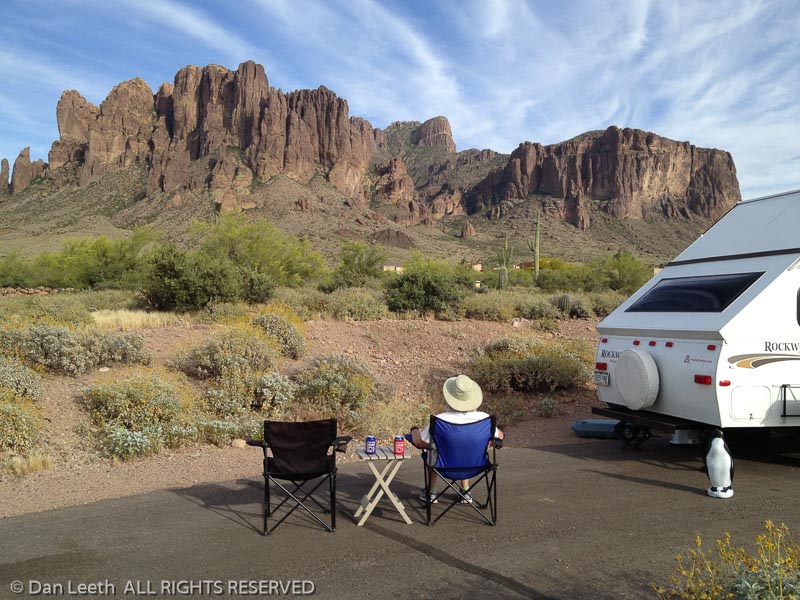
We were basking in air conditioned 90+ degree heat in the Superstition Mountain desert a week ago. I’m not hiking in no freaking snowstorm! If I wanted to do that, I could have stayed home.

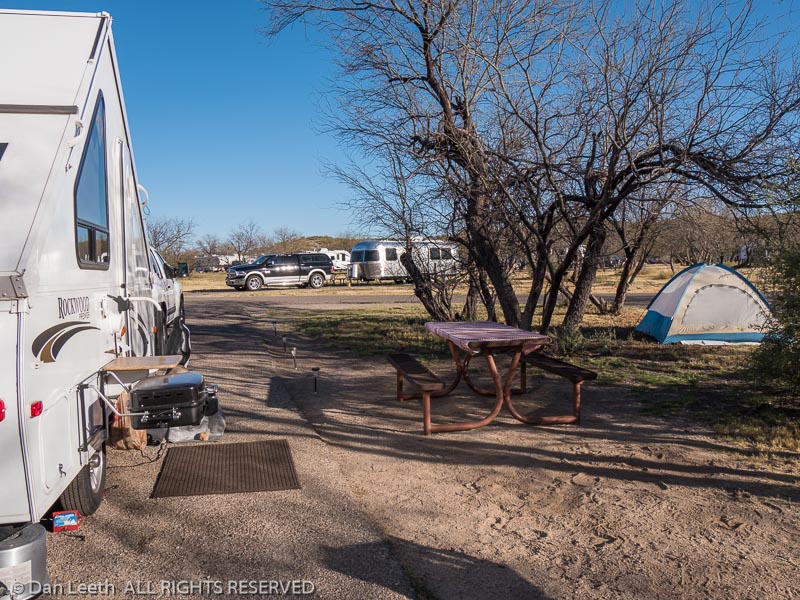
So bail we did. We’re now in Blanding, Utah, sitting in a commercial RV Park. The wind is howling, the rain pelting, but we’re snug, dry and toasty warm in our trailer with the heat-pump warming us up.

Okay, a casita at the Four Seasons Scottsdale at Troon North would be better, but this is pretty darn nice.

Dead Horse Point

After two heavy weather nights in a commercial RV park, we’re finally back to camping in the real world. This time it’s Dead Horse Point State Park in Utah. False advertising however. Fortunately, we’ve not seen a single dead horse out here.

The park sits atop a plateau peninsula near the Island in the Sky section of Canyonlands National Park. After parking the A-frame and getting everything set up, we did a short hike near the Dead Horse visitor center.

We then drove out to the end of the peninsula where sheer-walled canyons separated us from the Colorado River meandering far below. It proved to be a splendid place to watch Kayenta and Wingate sandstone walls glow in the setting sun. Don’t tell the Congressional Budget Committee, but if camera digits cost a dollar each, we shot enough photos to pay off the national debt.

Very first trip – learning opportunity number one

The trailer was loaded with 26 gallons of water, sleeping bags, hiking gear and the like.  The Xterra tow vehicle had the food, canopy and our clothes.  The A-frame was hitched up and we were off for a three-night camping adventure with friends in Colorado National Monument near Grand Junction.  I double-checked the hitch, fired up the engine and we began pulling out of the driveway.

Crunch.

It was the sound of metal on concrete.  Dianne gave me that look that bordered between concern and panic.

“Probably just the chains hitting the cement,” I assured her.  “After all, they are so long, they almost drag the ground.”

We heard it again when we crossed over a small speed bump going into our supermarket parking lot.  Chains again, I thought.

It finally occurred to me that it might be something more serious.  While Dianne ran in to mail a letter at the post office, I checked the hitch.  The sound we heard was the bottom of the front jack hitting cement.  I had only cranked it up part way.  I thought it was far enough away to clear the curb, but alas, it was not.

The bottom of the post had been scraped and instead of round, it was now oval.  I pulled out the caster wheel, and of course, it would not go on.  We now had a problem.

We immediately drove back home for redneck repairs.  I got out a hammer, and with blow after blow, I straightened it out to where the wheel would finally fit on.  I then cranked the post into it’s maximum up position and we took off again.  Lesson learned.

Back home after our trip, I ordered a new jack from Amazon.  It could have been worse.

Very first trip – learning opportunity number two

On the trip home from Colorado National Monument, we stopped in Clifton for fuel.  When we stopped there on the way out, we found a Sinclair station where fuel was a good 20 cents a gallon cheaper than anywhere else.  Of course, we wanted to stop there on the way back.

On our first visit, I simply pulled into the first outside pump, filled up and exited straight out.  Not a problem.

The outside pump was occupied on the second visit, but pumps on the inside were empty.  Unfortunately, that required me to make a U-turn to get in.  No problem.  Lots of room.  I pulled close to the first inside pump so that anyone else coming in could get around me and drive to the forward pump.  Tank filled, we fired up the engine and started to take off.

Crunch.

I looked back.  The trailer, which was still angled when we got to the pump, hit a post that the gas station people had wisely installed to keep people like me from hitting the pumps.  Although the Xterra cleared it with no problem, the turning angle of the trailer had kept it from clearing.   I now had red paint on the water heater panel cover and slight sheet metal damage.

I started to back the trailer up in an attempt to straighten it out and get out of there.

Crunch.

The Xterra bumper hit the post.  Fortunately, the bumper is rubber and the damage was limited to some minor scraping.

Now I had a problem.  I needed to back up the trailer without hitting the post, which was now nicely centered between the back of the car and the front of the A-frame.  With a few back and forth maneuvers, I finally got the job done and we were free of the pump post.

Back home with some paint thinner and fine steel wool, I was able to remove the red paint.  Now only a small square of slightly crinkled metal remains as a reminder of the incident.

Next time, I’ll hit outside pumps only, pull in straight and don’t pull in close unless everything is definitely in line.

Cheyenne Mountain

Dianne and I scored hard-to-get reservations for a full-hookup spot at Cheyenne Mountain State Park in Colorado Springs.  It seems someone had the spot reserved for the weekend, but suddenly cancelled after one day.  I went online at just the right time and was able to reserve it.  We had two nights, three days at the base of Cheyenne Mountain, home of NORAD’s big nuke-proof mountain cave and alleged target for a North Korean missile.

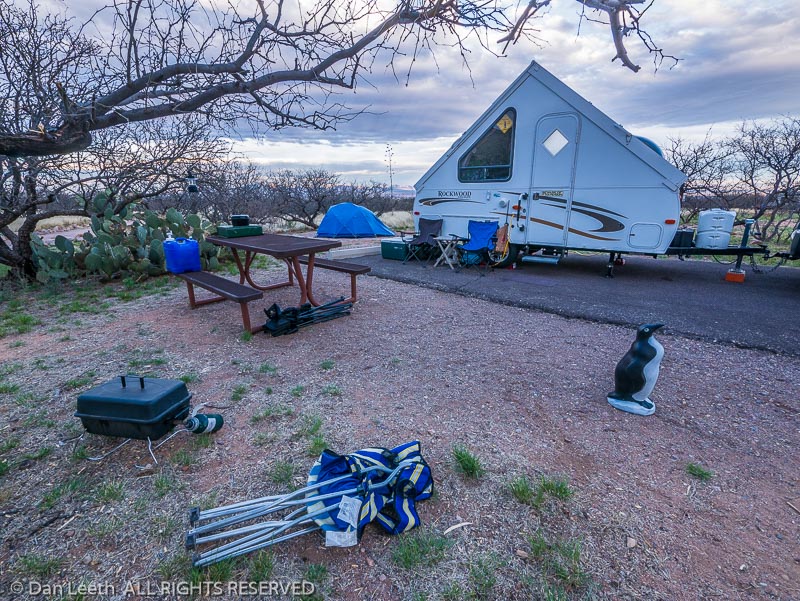
It’s a back-in site, which meant we got a little practice at backing in straight and on target.  Of course, we had an audience.  It seems that everyone else in the campground loop, about a half-dozen units, were having lunch at the neighboring site.  And presumably watching.

After about 10 minutes of trying, we made it.  It’s straight and close to the water/electric hookups.  It looks like a pro did it.  Best of all, I think the neighbors ignored us.

Side to side, the concrete pad we parked on was dead level.  We had the top up in 90 seconds.  Chocks placed.  Unhooked the car.  Front-to-back leveling took another minute or two.  Jacks down.  Water and electricity hooked up.  Gray water line and tank connected.  Car unloaded and stuff moved in.  About 15 minutes after arriving, we were at home.  If we were tent camping, we wouldn’t even have had the car emptied and tent unpacked yet.

After a bite of lunch, it was time to explore the neighborhood.  Across from us in the campground circle was a couple with a Trail-Manor lift-up trailer.  We chatted with them for an hour or so and got a tour of their unit.  Much bigger and fancier, but definitely more complicated to put up and take down.  It’s a matter of compromises.

We continued around the campground, visiting the other circles.  In the last one we discovered our neighbors who own a motor home.  I’m not sure who was more surprised.

One of the nice things I’ve always found about campgrounds is how friendly everyone is.  People talk to each other.  With a friendly hello, one can meet locals as well as other travelers.  You don’t get that in a motel.

A-Frame Pros and Cons

A few weeks ago, a reader asked if we would recommend buying an A-frame trailer.  In a long reply, I told him what I considered to be the pros and cons of this type of recreational vehicle.

PROS

The trailer tows flat, so it has less wind resistance and with many models, drivers can see over the top of the trailer through the rear-view mirror when towing.

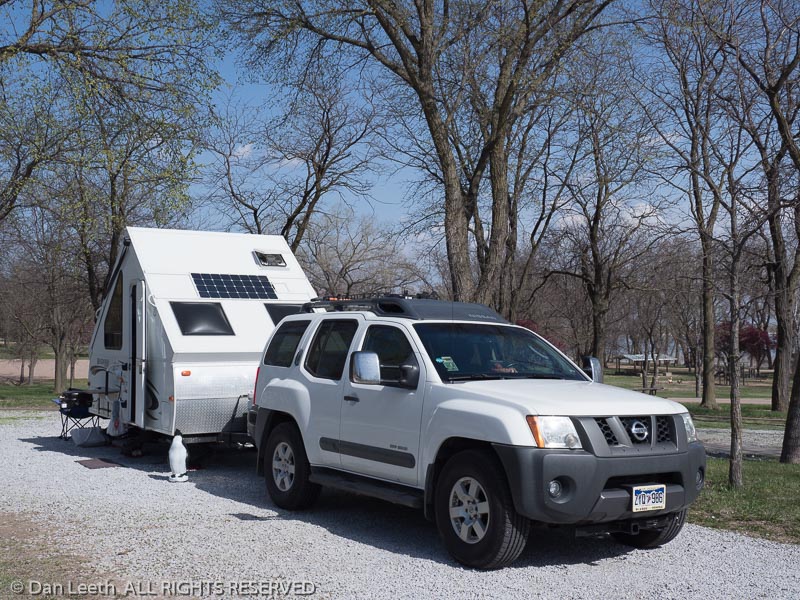
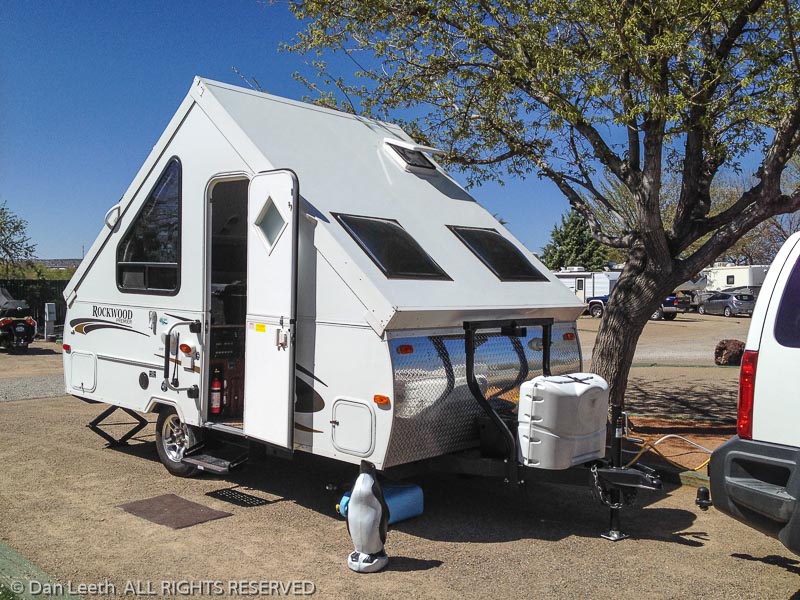
They’re relatively light, so owners don’t need a mega-tow vehicle. We tow ours with a Nissan Xterra, which has a 5,000-pound towing capacity.  The trailer is rated at 3,500 pounds maximum, although when fully loaded, ours only runs around 2,600 pounds.  Aliner brand has lighter-weight A-frame trailers that can be pulled by cars with less towing capacity.

They’re small enough to park in tight campsites, assuming there’s enough overhead space.

Unlike a tent trailer, this one goes up/down in about 90 seconds, a job easily done by one person. And doesn’t need to have the canvas dried out after a rainstorm.

They’re cheaper. Ours has a small fridge, three-burner stove, sink, 20-gallon water tank, six-gallon water heater, double bed, dinette, furnace, air conditioner and yes, even a microwave.  Even with all that, it cost far less than a conventional trailer.

CONS

They’re small.  The box is only 12 feet long and with the bed and dinette permanently set up, there’s not a lot of move-around room.  The only sitting space is at the dinette.

Inside accessible storage space is quite limited.

The refrigerator and microwave are below the counter, which can be a problem for folks with bad backs and knees.

Unless one buys a high-wall model, the countertops are lower than normal, which can be an issue for tall folks.

The bed on most A-frame trailers goes crossways so the person sleeping on the wall side has to crawl out over his/her sleeping companion. Companies are beginning to offer models with side-by-side twin beds to alleviate this issue.

While the dinette makes into a second bed, it’s not a great trailer to camp with the kids/grandkids (unless you put them out in a tent).

Because the trailer folds and unfolds, there needs to be some space between the wall and roof panels. The lack of a tight seal means some heated air can escape and small flying insects can sometimes find their way in.

Most A-frame trailers come with bubble windows over the dinette and bed areas, which over time can lose their seal and start to leak water. Proper repair requires removing the bubble and reattaching it to the trailer.  Most of us go the easy route and simply affix sealing tape around the bubble.

There’s no gray-water tank, so sink water needs to be collected in a bucket or portable tank and manually dumped if there’s no direct sewer hookup.

There’s no flush toilet and no black-water holding tank. Most A-frames come with cassette toilets, which require campers to empty the output in the campground restroom.  And very little privacy around the toilet area.

Very few models offer an inside shower option, although most have outside showers. We use ours with a privacy tent pitched next to the trailer, which requires that we collect the water residue and dispose of it with other gray water.

While some brands are better than others, the build quality is generally poor.  Screws come loose, and things sometimes rearrange themselves over the course of a long trip.

2012 – Strip Trip

Grand Canyon-Parashant entry sign, Arizona Strip, Arizona.
Hiking the Mokaac Trail off road 1069, Arizona Strip, Arizona.
Mokaac Trail sign beside road 1069, Arizona Strip, Arizona.
Cars along the roadway, Whitmore Wash Road, Grand Canyon-Parashant National Monument, Arizona Strip, Arizona.
Colorado River at Whitmore Canyon Overlook, Grand Canyon-Parashant National Monument, Arizona Strip, Arizona.
Sunset, Whitmore Canyon Overlook, Grand Canyon-Parashant National Monument, Arizona Strip, Arizona.
Colorado River at Whitmore Canyon Overlook, Grand Canyon-Parashant National Monument, Arizona Strip, Arizona.
Whitmore Canyon Road, Grand Canyon-Parashant National Monument, Arizona Strip, Arizona.
Whitmore International Airport sign, Bar Ten Ranch, Whitmore Canyon, Grand Canyon-Parashant National Monument, Arizona Strip, Arizona.
Petroglyphs, Nampaweap Petroglyph Site, Grand Canyon-Parashant National Monument, Arizona Strip, Arizona.
John “Mick” Sears on Hack Canyon Road, Arizona Strip, Arizona.
Vermilion Cliffs from US 89A, Arizona Strip, Arizona.
Cliff Dwellers Lodge, Arizona Strip, Cliff Dwellers, Arizona.

2006 – Ross Sea Antarctica

Sunset over Seebee Hook, Cape Hallett, Ross Sea, Antarctica.
Penguins on ice, mountains and the Kapitan Khlebnikov, Cape Hallett, Ross Sea, Antarctica.
Quark Expedition Leader Shane Evoy wears his penguin tuque, Cape Hallett, Ross Sea, Antarctica.
Adelie penguins on ice, Cape Hallett, Ross Sea, Antarctica.
Aerial view of the Kapitan Khlebnikov parked in the pack ice off Cape Hallett, Ross Sea, Antarctica.
Barbecue on the ice off Cape Hallett, Ross Sea, Antarctica.
Sunset over Seebee Hook, Cape Hallett, Ross Sea, Antarctica.
Outside Shackleton’s Nimrod Expedition Hut, Cape Royds, Ross Sea, Antarctica.
Doghouses outside Shackleton’s Nimrod Expedition Hut, Cape Royds, Ross Sea, Antarctica.
Inside Shackleton’s Nimrod Expedition Hut, Cape Royds, Ross Sea, Antarctica.
Kapitan Khlebnikov follows the Krasin through the ice, Ross Sea, Antarctica.
Mount Erebus, Ross Sea, Antarctica.
Outside Scott’s Discovery Hut, Hut Point near McMurdo Station, Ross Island, Antarctica.
Packing box inside Scott’s Discovery Hut, Hut Point near McMurdo Station, Ross Island, Antarctica.
Flags of original Antarctic Treaty nations fly at the Chalet, McMurdo Station, Ross Island, Antarctica.
Looking down on McMurdo Station from Observation Hill, Ross Sea, Antarctica.
Antarctic jacket, McMurdo Station, Ross Island, Antarctica.
Chapel of the Snows, McMurdo Station, Ross Island, Antarctica.
Looking down on Scott Base from Observation Hill, Ross Sea, Antarctica.
Signs inside the TAE (Trans Antarctic Expedition) Hut, Scott Base, Ross Sea, Antarctica.
Scott’s Terra Nova Hut, Cape Evans, Ross Sea, Antarctica.
Lab glass inside Scott’s Terra Nova Hut, Cape Evans, Ross Sea, Antarctica.
Sign, cairn and bamboo shaft at Scott’s Northern Party camp on Inexpressible Island, Terra Nova Bay, Ross Sea, Antarctica.
M/V American Tern follows the Kapitan Khlebnikov through the ice, Ross Sea, Antarctica.
Tabular icebergs and Mt. Erebus, Ross Sea, Antarctica.
Sculpted ice along the Ross Ice Shelf, Bay of Whales, Ross Sea, Antarctica
Walking across the Ross Ice Shelf, Ross Sea, Antarctica.
Ship’s radar shows the route as the ship aims for farthest south, Kapitan Khlebnikov, Bay of Whales, Ross Sea, Antarctica.
Zodiac at the point of farthest south, Ross Ice Shelf, Bay of Whales, Ross Sea, Antarctica.
“Iceberg” drink (Sambuaca, vodka and blue curacao), Kapitan Khlebnikov, Ross Sea, Antarctica.
Woman looks out ship window, Kapitan Khlebnikov, Southern Ocean, Antarctica.
Remains of Scott’s Northern Party hut built near Carsten Borchgrevink’s hut on Ridley Beach at Cape Adare, Antarctica.
Woman drawn on the ceiling, Carsten Borchgrevink’s hut, Ridley Beach at Cape Adare, Antarctica.
Helicopter over tabular iceberg, Southern Ocean, Antarctica.
Helicopter pilot Oleg Brezinsky at the controls, Kapitan Khlebnikov, Southern Ocean, Antarctica.
Aerial view of ice and icebergs, Southern Ocean, Antarctica.
Aerial view of the Kapitan Khlebnikov in the ice, Southern Ocean, Antarctica.
Water breaking at the bow, Kapitan Khlebnikov, Ross Sea, Antarctica.
Colleen Keith photographs king penguins on the beach, Sandy Bay, Macquarie Island, Australia.
Royal penguin on the beach, Sandy Bay, Macquarie Island, Australia.