In my experience, there are two types of travelers:
The good ones study their guidebook like it’s the Bible, outline all of the sites and museums they want to see and plot a route to cover them all in the time available.
When folks back home ask if they saw such-and-such, they can truthfully say yes, they did.
That, of course, is not my style. I’m a person who may glance at the guidebook to get a general idea of what’s available, then pretty much ignore it on site.
Instead of rushing off to hit all the tourist targets, I prefer to just wander around and get an intuitive feel for a place. That’s what we did in Lisbon.
We landed on Friday and did little more than walk around the hotel area. After dining at a sidewalk café (happy hour mojitos for 5€ each), we fought jet lag with a long night’s sleep.
I had prebooked four-day tickets for one of Lisbon’s hop-on, hop-off bus tours. The busses follow a fixed route with a number of predetermined stops where passengers can hop off, explore an area and then hop back on a follow-up bus.
There were several companies offering this service, and after careful consideration, I chose the Yellow Bus company, which offers two routes with a collective total of 25 stops.
Saturday was bus riding day. We would ride both routes, looking for neighborhoods we would explore over the following days. Riders are given earbuds, which we can plug in and get a narration about sights along the way delivered in a language of our choice. Not being fascinated by the names of the architects who designed various buildings, I found the audio somewhat boring.
Sunday would be a walk-around day. Our bus tickets also covered a ride up the Santa Justa lift, an outdoor elevator that opened in 1901. Located near our hotel, we decided to ride it up and explore the Carmo Square neighborhood above.
Up there, we went past the Carmo Convent…
…and wandered around a terraced park with sculptured busts missing from posts and walls sprayed with graffiti.
Graffiti, or tagging, is rampant in Lisbon. Abandoned buildings and walls sport ample amounts of paint, effectively ruining photo ops for those of us who want to capture clean views of historic structures. Even passenger trains have become the canvases for the graffiti “artists.”
Since Dianne’s new knee doesn’t like downhill walking, we left our lofty location on the Gloria Funicular (also included in our bus package)…
…back down to hotel level off Rossio Square. This open area features the usual European standbys such as statues and fountains…
…construction cranes…
…and locals out walking their dogs.
The cobblestones in Praça do Rossio are laid in a wave pattern that made it seem like we were walking on a rolling surface.
The day was young, so we decided to take a walk up Avenida da Liberdade, a broad, shady, park-like median between two streets we had traveled on our bus route. The route was packed with vendors peddling everything from footwear…
…to beer.
The avenue led to Edward VII Park, a long stretch of grass and hedges that led up a hillside flanked by cobblestone walkways. We headed up.
Near the top, we stopped at the Carlos Lopes pavilion, a building decorated in Portuguese tiles that was originally built for the International Exhibition of Rio de Janeiro in 1922. It was dismantled and brought to Lisbon ten years later.
The park ends at a spectacular overlook flanked by a pair of towering obelisks. This was stop number 5 on one of our bus routes. We waited for the next bus, got onboard and headed back down to a public square near our hotel.
That evening, we walked down to the waterfront where we caught a boat tour, which was also included in our package.
The boat ride give us a different view of some of the things we had seen from land, such as the Tower of Belem, a 16th century fortification…
…and the Monument of the Discoveries, a sculpture honoring the Portuguese sailors who forged new routes to Asia, the Americas and around the world.
We passed under the April 25 suspension bridge, its name commemorating the Carnation Revolution which overthrew the authoritarian government on that day in 1974.
Atop a hill on the far side of the bridge stands the Cristo Rei, Christ the King. The statue, looks quite similar to the Christ the Redeemer statue in Rio de Janeiro, Brazil.
Back on land, our evening walk back to the hotel was interrupted by guitar music coming from an al fresco restaurant on a side street. We found an empty table, ordered dinner and wine, and enjoyed a pleasant night dining with pleasant background music.
Sidewalk dining was one of the treats of Lisbon. It seemed like every street in the more touristy areas of Lisbon was lined with restaurants offering al fresco dining. We had three such eateries located in front of our hotel. Almost everywhere, the wait staff spoke English and offered menus with English translations.
On Monday, we took a tram car tour through the narrow, winding streets of the Alfama neighborhood of Lisbon. Although the tram was flaming red, it also was included in our Yellow Bus package.
After that, we got on the double-deck Yellow Bus and headed out to the Park of Nations neighborhood, which our audio guide referred to as the modern area of Lisbon.
It was here that Lisbon hosted Expo ’98.
We walked a cobblestone walkway along the waterfront…
…beautiful sculptures…
…and fountains…
…that sometime got overexcited…
We spotted a happy snorkeler in a pool outside the aquarium…
…and tried not to stare as we strode past the local nude beach.
Honoring Portugal’s seafaring past, a pair of tall buildings sported sails…
…and there was the Vasco da Gama tower, Lisbon’s tallest building.
We bought tickets, rode the elevator up and admired the view through some rather dirty windows.
For dinner that night, we headed for the Cervejaria Antartida, Portuguese for Antarctic Brewery. I couldn’t pass up a place with a name like that. They advertised tapas, steaks and seafood, and I was ready for a chunk of dead cow.
Instead of a Texas-style T-bone, I ended up with sirloin topped with mushrooms and smothered in a delicious sauce with fries on the side.
On the way back, we passed some local wildlife in the square…
…and lights illuminating some of the local monuments.
On Tuesday, we set out to explore another area of Lisbon we found inviting on our bus trip. This was the Belem area, home of the Tower of Belem and the Monument of the Discoveries.
Belem is known for its Pastel de Nata pastries, which originated at a shop here. We would have sampled the delicacies, but the line out front stretched for more than a block.
The line at the Museum of Archeology was longer, providing another good reason not to do museums.
Instead of standing in lines, we booked a hop-on, stay-on ride in a one-horse carriage.
Ride completed, we set out on foot, following a cobblestone walkway along the waterfront. We passed fountains that attracted birds in need of a shower.
We listened to a street musician playing an electric violin.
We checked out food trucks along the walkway, many offering a taste of international cuisine, including (to my wife’s delight) Mexican…
We stopped for some not too tasty margaritas.
As our friends all know, Dianne and I crave fine Canadian cuisine…
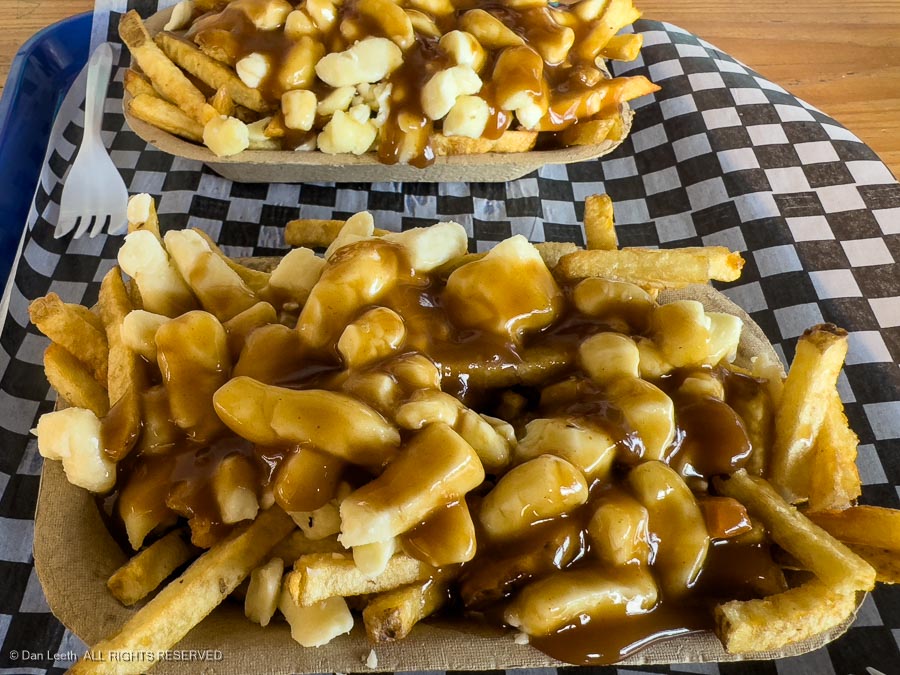
…so imagine how excited we were to find poutine available on this side of the Atlantic!
We continued past Portugal’s Monument to the Overseas Combatants…
…where a sailor posted guard.
[And yes, I did ask permission to take his photo. My rule is to never shoot anyone carrying a firearm without asking first.]
Catching a Yellow Bus, we returned to our hotel, showered up and headed down for dinner at Café Nicola, located just outside our hotel.
The restaurant began in 1787, and has long been a hangout for writers, artists and politicians. USA Today claims it’s one of the best restaurants in Lisbon, and the seafood we ordered was great.
Wednesday morning, we packed our bags, ate another delicious Portuguese breakfast…
…and arranged to meet the driver transporting us to the railroad depot. We would be taking the high-speed train to Porto, a 209 mile journey that will take less than three hours and cost about $27 in U.S. dollars for first-class seats.
The train offered comfortable seating…
…but traveling at 135 miles per hour, the views out the window could sometimes appear a bit blurry.
On Wednesday afternoon, we arrived in Porto a bit late (these are Portuguese trains, not Swiss Rail). With a bit of effort, we finally located our transfer driver outside the train station. After another realization of why we don’t drive in Europe, we arrived at our hotel, checked in and went up to our room…
…where we found a note along with a couple of candies waiting on the bed for us.
Now, that’s something we’ve never gotten at a Motel 6!
Our room overlooked an Italian-themed restaurant. We went down and ordered a lasagne. The waiter suggested a bottle of the Pacheca red wine. He’d apparently visited the winery and said that they have rooms for overnight guests built into some of the huge wine barrels used to make ruby port. We’ll book a night there on our next trip to Portugal, I assured him.
After dinner, we walked along the riverfront walkway. As we passed some folks dining on a narrow walkway above the river, Dianne heard them mention our travel agent’s name. Yes, they were also on our cruise.
We continued onward, watching as lights lit up the Monastery of Serra do Pilar across the river…
Our cruise didn’t board until Friday night so we had all day Thursday to wander around Porto on foot. We started the day with the hotel breakfast, which included the usual array of salad and sandwich fixings. Fortunately, for us Americans, there were also scrambled eggs, bacon and sausage weenies along with an array of Portuguese pastries.
After eating, we wandered down to the walkway along the riverfront where we watched tour boats haul tourists out for a cruise under Porto’s six bridges.
Above us, we watched a man along a wall cook fish on a pair of hibachis. We weren’t sure if it was for a restaurant or he was getting ready to host a fish feast.
Sidewalk shops line the riverfront walkway, offering great bargains on tons of things we don’t need and didn’t buy.
And, of course, there are restaurants and more restaurants. Nobody with a working credit card needs to go hungry out here.
We spent the day walking around, savoring the sights and snapping photos of things of stuff we just found interesting…
That night we had more Italian food, this time a pepperoni pizza from an al fresco restaurant across the street from the hotel.
Noting that we had previously purchased pizza in Lisbon, Dianne complained that we were becoming Portugal pizza people.
We don’t board our Douro River cruise boat until later this afternoon, so we had all day to wander more of the city. We decided to cross the Dom Luis I Bridge and check out Porto’s across-the-river neighbor, Vila Nova de Gaia.
The famous wine from here may be named Port for the port city of Porto, but the wineries that cellar this distinctive Portuguese beverage are all located in Gaia.
The grapes for this sweet, fortified wine grow in vineyards along the Douro River upstream. Before the advent of highways, railways and river-taming dams, barrels of the wine floated down the Douro in rabelo boats. A number of these classic craft line the riverfront in Gaia, each advertising a sponsoring brand of port.
Like Porto, Gaia lies on riverside hills. Instead of elevators and funiculars, Gaia offers a ski-style gondola to ferry folks from the river to a park near the hilltop Monastery. We’re skiers, so riding in a gondola on steel cables is no big thrill, so we chose to stay down today.
After unsavory sandwiches but bountiful brews at an outdoor café/bar, we wandered up a side street where we encountered a hare-brained sidewalk mural.
A short distance beyond, we came to the WOW, which we later learned is an acronym for World of Wine. After dodging a swarm of yellow-clad apprentice people meandering by…
we entered. We discovered this was a self-proclaimed “cultural district” filled with museums, shops, bars and restaurants.
At what is literally an openair fern bar on its top level deck…
…we ordered glasses of white port…
…and chatted with a man holding a Harris hawk, whose job is to scare away any seagulls that might think about pooping by.
The views from the fifth-floor deck were splendid.
The thing I liked most about the WOW was that every floor offered sets of restrooms that were close, convenient, clean and free.
Europeans, I figure, must have metric-sized bladders. While most restaurants have restrooms for customers, public restrooms around these parts are few and far between. That meant stopping at bars and ordering brews so we could use their restroom to deposit the last brews we ordered.
Our favorite two letters in Portuguese were WC,
In the afternoon, we recrossed the river and back at the hotel, watched our luggage being loaded into a van. We followed it down to the river where our cruise boat awaited. We boarded and headed to our cabin…
…turned off the TV…
…checked out the bathroom…
…then headed up to the lounge along with our 28 fellow passengers.
Douro river cruises do not travel after dark, so on our first night we would not leave the dock in Porto. After dinner onboard, we went out on the sundeck (moondeck?) and savored glasses of wine while admiring the beauty of the illuminated bridge, monastery…
We got up, enjoyed a buffet breakfast on the boat [it seems presumptuous to call this 210-foot vessel a “ship”] and boarded a bus for a tour of Porto. Our job was to march along, following our guide’s “lollypop.”
Now, I’m not a big fan of group tours. Yes, one can learn a lot from a knowledgeable, guide, but following along in a group segregates us from the locals. At least we only had 30 followers to trip over. I can’t imagine what it must be like on those river boats that hold 190 passengers.
This is Europe, so our first stop was the Porto Cathedral, a structure that dates back to the 12th century, or at least I think that’s what she said. I was at the back of the pack and didn’t catch everything.
Located high on a hill, the views of rooftops from outside the cathedral was stunning.
In a large open area in front of the cathedral, a young busker played her violin.
The music was lovely and the look on the young lady’s face suggested that she was enjoying playing it for us. Of course, I dropped a few euros into her tip jar.
Then it was back on the bus.
Next stop on our tour was the São Bento railway station, located in historic downtown Porto. The station’s lobby, which dates back to 1904, was covered with Portugal’s famous, blue and white tile murals.
Each tile mural tells a story about Portugal’s history, and the artwork was absolutely stunning.
Back in the bus, we headed off to our next stop, which lay across the river in Gaia. There, we took a tour of the Burmester port cellars.
A Burmester guide gave us a short tour of the facility and fully explained more than anyone needs to know about this fortified wine.
Now that we were fully educated, we got to sample some of their product. I bought a bottle to take with us.
We returned to the boat for lunch. My lovely wife opted for the seafood option, which was octopus. I’ve had octopus before, and I must say that when it comes to animal appendages, I prefer Buffalo wings to octopus legs. Needless to say, I chose the non-aquatic option.
While we were dining, the captain and crew fired up the engines and we began our upriver voyage.
There are five dams on the Portuguese portion of the Douro River. The first one was the Crestuma-Lever Dam, which we encountered mid-afternoon.
Being the first, most of us passengers ventured to the sun deck and watched as the boat slowly entered the lock.
With the vessel totally inside this square concrete canyon, the back doors of the lock close.
The water level in our little concrete box rises, and 45 vertical feet later, when it’s even with the water level upstream of the dam, the upstream door drops…
…and we continue onward.
One of my favorite joys of cruising (besides the food, wine and fact that I don’t have to actually do anything) is just sitting back and enjoying the views along the way.
I watched as we passed abandoned buildings along the riverside, wondering what they were once used for and why they still sit there crumbling away.
We passed numerous active vineyards, their vines growing on terraced hillsides.
We passed other vessels along the river, not all of which were cruise boats.
When we reached the village of Entre-os-Rios…
…we docked for the night.
After dinner (wine flowing freely)…
…a local Portuguese folk trio boarded the boat and provided an energetic evening of musical entertainment.
Even though we could not understand a word of their lyrics, the upbeat tempo (and wine) provided an excuse for passengers to turn the lounge into a dance party.
Unfortunately, my favorite wife, her new artificial knee covered by an ice pack, was not able to do the moves.