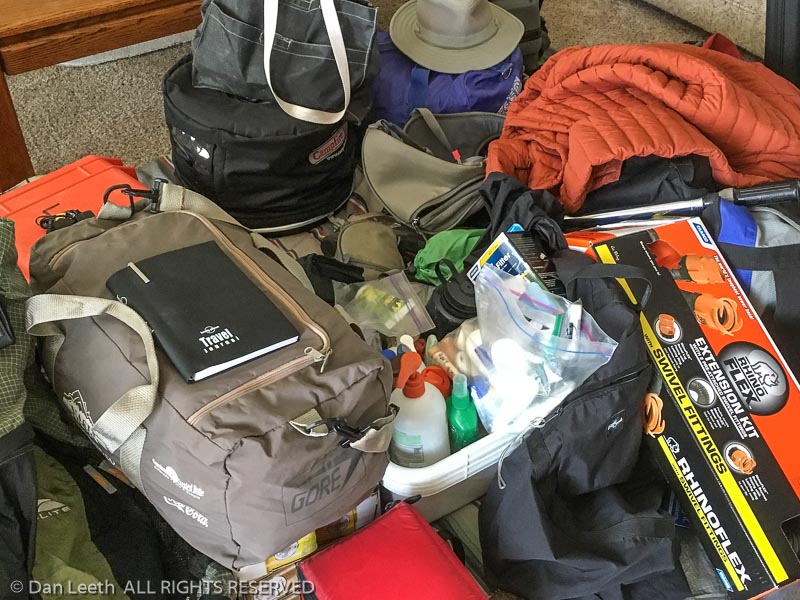
With the possible exception of a TSA groping, the worst part of travel is the packing.
It’s a short trip – just 25 days in Texas, Oklahoma, Louisiana, Arkansas, Missouri and since I’m boycotting Kansas over their requirement to provide a Social Security number for state park camping, we’ll probably come back via Nebraska.
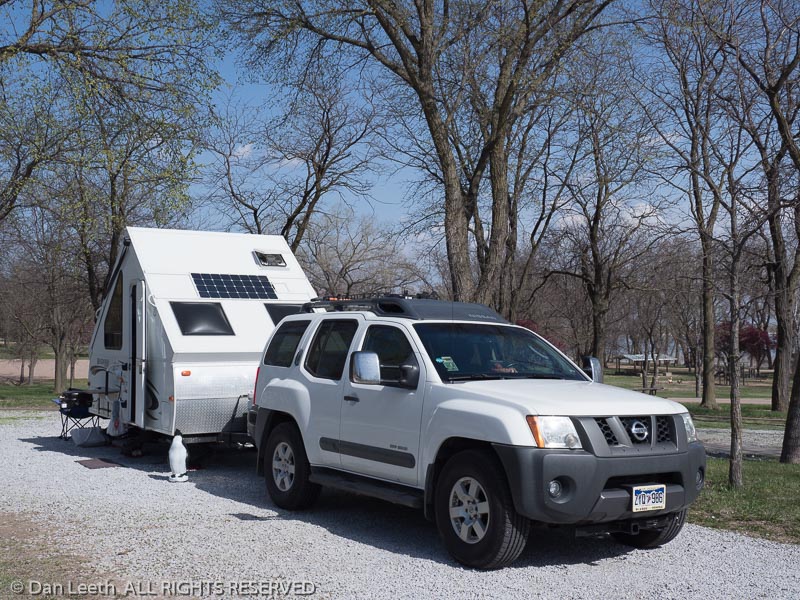
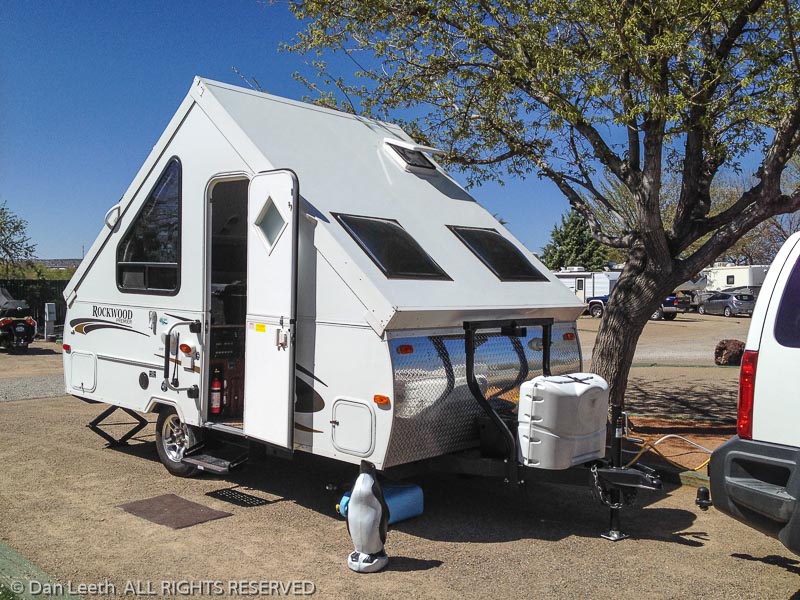
I spent most of yesterday prepping the trailer and all of today packing it full of what we’ll need to survive nearly four weeks in full-hookup wilderness.
Oh how I long for those glory days of yesteryear when Dianne and I spent three months Eurailing our way across Europe (where else would you Eurail?) with only small carry-on backpacks that could truly fit under the seat in front of us.
I’ve discovered something I never thought I would ever find again. Free camping in a National Park-administered site.
Amarillo was about the right distance for the first day’s drive on our trip to Belton, Texas. Camping choices around there included a commercial RV park in town, Palo Duro Canyon State Park south of town or the Lake Meredith National Recreation Area north of town.
Commercial campgrounds have less appeal to me than bunking with relatives and Palo Duro is a place where one needs to spend multiple days. That left Lake Meredith.
Now, Lake Meredith is not a lake, it’s a reservoir, and the land around it is administered by the National Park Service. They’ve built several campgrounds, the largest of which is a 51-site loop atop the canyon rim with a good view of the earthen dam. Each site has one or two new picnic tables shaded by canopies.
There’s a trailer dump station with fresh water. The restroom building features four individual, any gender you want to be private units with flush toilets and free showers. They were clean and well stocked with toilet paper.
Fortunately, it wasn’t crowded during our visit. Fifty-one camping families sharing four toilets with showers could lead to some soiled situations.
So, there we were, drinking wine while watching the sun set over the reservoir and realizing that we were getting all this for simply the money we pay in taxes.
I hate wind. I especially hate it when A-frame camping.
A stiff breeze, they say, can catch a half-opened roof panel and like the spinnaker on a sailboat, send it flying. Now, we’ve never had that happen to us, but according to the folks who sell aftermarket wind kits, it could.
The breeze wasn’t that bad when we packed up after a pleasant stay at our Chickasaw National Recreation Area campsite. We collapsed the roof and headed on our way south toward Belton Lake, halfway between Waco and Austin, Texas.
Rule number one of wind on the road. It will always be a headwind, or more correctly, a slightly angled wind blowing from both the front and side. The trailer towed like a duckling imprinted on its mother while the Xterra got belted around like a woozy prize fighter in the tenth round.
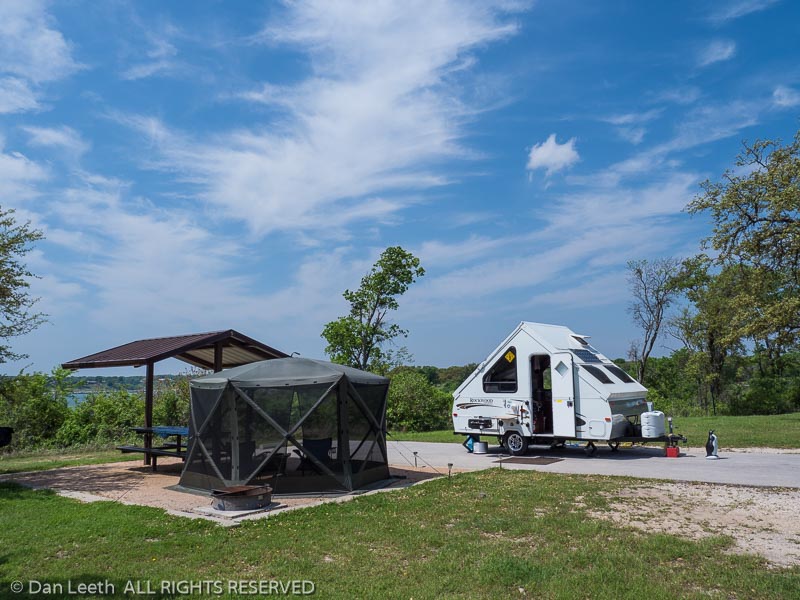
“Not much shade in campsite #1,” the gate agent advised us as we checked into the Live Oak Ridge Campground. Not only was there not much shade, there was nary a tree, bush or tall blade of grass to block the wind.
“This is going to be fun,” Dianne suggested as we set about setting up the trailer.
“No, it’s not,” I corrected her.
We leveled the trailer and prepared to open it up. About then, the wind relented and like a Viagra user before hour number four, the stiff breeze went limp. We got the trailer up without the roof blowing back to Dallas.
We tightened down our aftermarket wind kit and celebrated our feat the way all good campers do. With a beer.
What’s so difficult about equipping a flush-toilet bathroom?
There are four key components for a decent campground restroom, the most obvious of which is that it needs clean, usable toilets/urinals. Beyond that,there should be a sink or two for washing hands, a soap dispenser for cleaning them and either paper towels or a blow dryer for drying them off.
We’re camping in a string of Mid-America state and national parks, paying $25-35 a night partially for the privilege of having flush-toilet restrooms. At Hot Springs National Park (Arkansas) and Lake Bistineau State Park (Louisiana) there were no soap dispensers. At Petit Jean State Park (Arkansas) we found soap but nary a towel dispenser nor blow dryer.
I was thrilled to find that Table Rock State Park (Missouri) seemingly got it right. The men’s side had twin toilets, urinals and sinks with a soap dispenser. I happily used the facilities, washed my hands with foamy soap and walked over to the blow dryer.
I pushed the button. Nothing happened. It was broken.
I’m sure all of you Eastern RV campers know about these, but for those of us who have always camped in the West, Corps of Engineer (COE) campgrounds are a pleasant discovery.
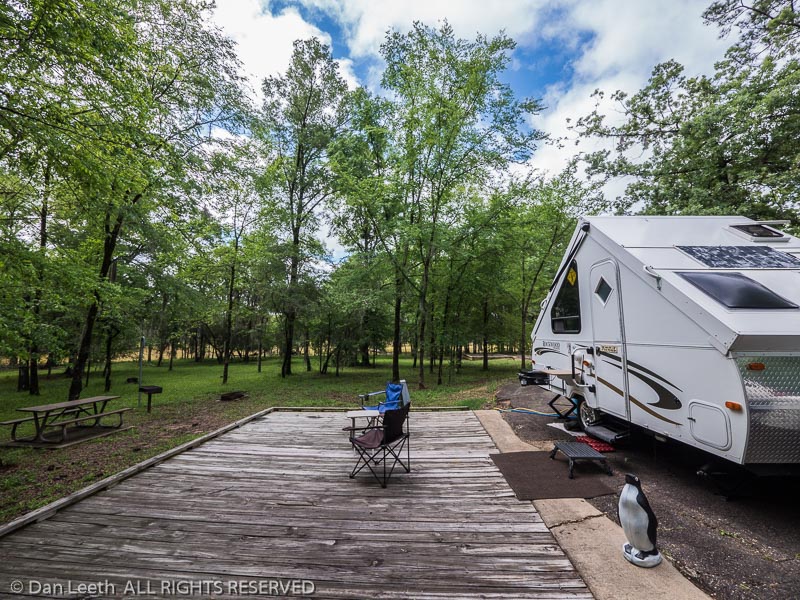
We stayed 10 nights at Belton Lake, a COE site in Texas, where we had 120-volt power and a city water hookup along with flush toilets and free hot showers. It only cost $11 a night with our government geezer pass.
Tonight on our way home, we’re at Harlan County Lake, a COE campsite in Nebraska (we’re boycotting Kansas). Because it’s low season, an electric-water site is only $5 for us geezers with free hot showers and flush toilets.
First of 28 nights on the road – this one at a KOA in Bernalillo, New Mexico. I love this KOA because right next door sits a small brew pub with some pretty good beers. All KOAs should be equipped this way.
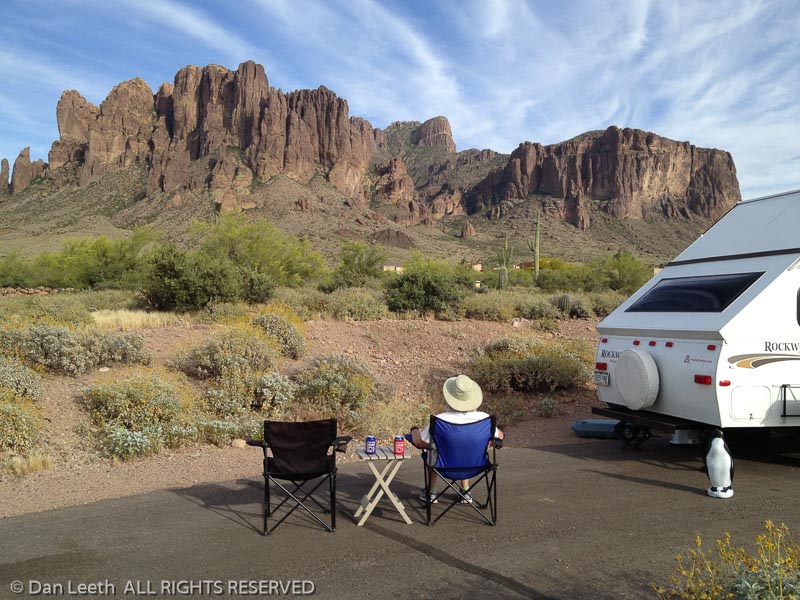
Next stop the Superstitions in Arizona where we will continue our search for the legendary Lost Dutchman mine.
As a travel journalist, it’s been a long time since I went on a pure “vacation,” and this feels good. Over the past 21 years, I’ve been to the Superstitions five or six times for a story. I’ve slept in my truck on the edge of nowhere and delayed dinners long past dark just to get sunset shots. I’ve spent hours hunting down experts and conducting interviews. I’ve taken hours of tape recorded notes and more notes.
Not this trip!
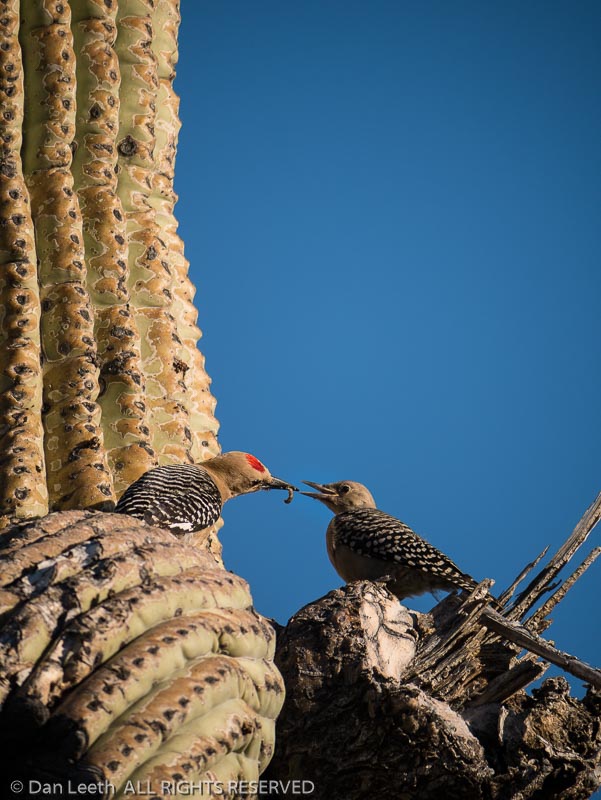
We spent the morning walking around the campground. This afternoon, I sat near the picnic table and shot shots of these food-sharing Gila woodpeckers atop an old saguaro. Then it was off for a guided sunset hike during which I took nary a note. (Okay, I did take a few dozen photos, but hey, that’s what I do for fun anyway.)
Tomorrow we’ll drive to the First Water Trailhead where we’ll hike into the wilderness, following much of the same route taken by Julia Thomas, the first of the Dutch hunters. If we don’t find the lost mine, we’ll head back to the trailer for beer and some old vine zin before steaks.
For those not familiar with the legend of the Lost Dutchman Mine, let me fill you in. Back in the 1870s, Jacob Waltz claimed to have found a fabulous ledge of gold in the Superstition Mountains east of Phoenix. Since he was German, I can only assume his “Dutchman” moniker came from some misguided love of Heineken beer. The “Lost” part is evident to anyone who has tried to follow one of those maps to his mine.
From the clues he gave on his deathbed in 1891, his treasure trove is supposedly located somewhere in the vicinity of Weaver’s Needle, a towering monolith of rock, which I assume was named for the ‘50s folk group that once featured Pete Seeger. Unfortunately, at age 81, he apparently forgot some of the details describing exactly how the mine could be found and where he put his mule keys. People have been searching for both ever since.
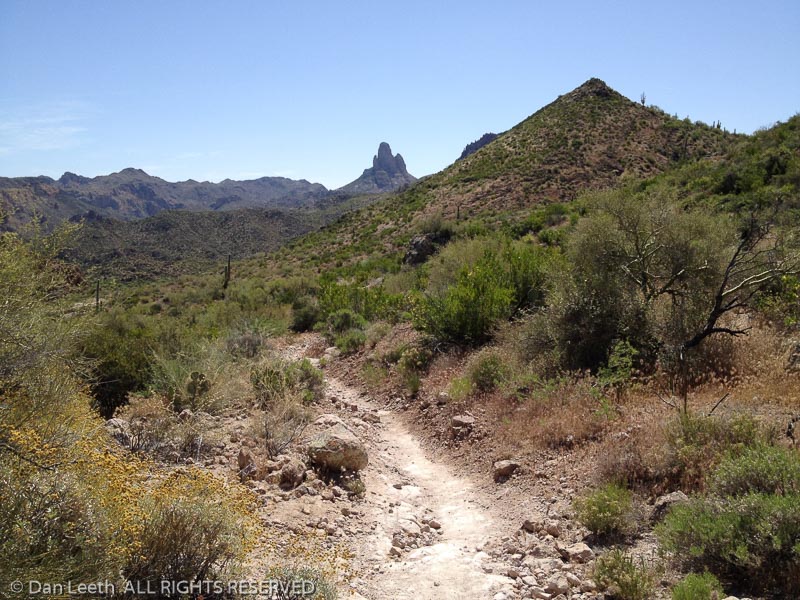
Using the reasoning powers I perfected while studying French at the University of Arizona, I figure that the Dutchman was probably a bit of an egotist and thus wouldn’t locate his mine on someone else’s trail. So today, on our first attempt to locate his diggings, we naturally followed “Dutchman’s Trail” from the First Water Trailhead. Other than a mother from Michigan hiking with her two daughters, we had the path to ourselves.
We hiked to the lofty summit of Parker Pass from which we had a great view of Weaver’s Needle. We did not however, find anything golden other than petals on scores of cactus blossoms. I can only assume the Michigan mother and her offspring carted the real gold out.
Those young girls looked awfully happy to be heading back towards their car.