We’ve made two big improvements and a pair of smaller ones to our front door.
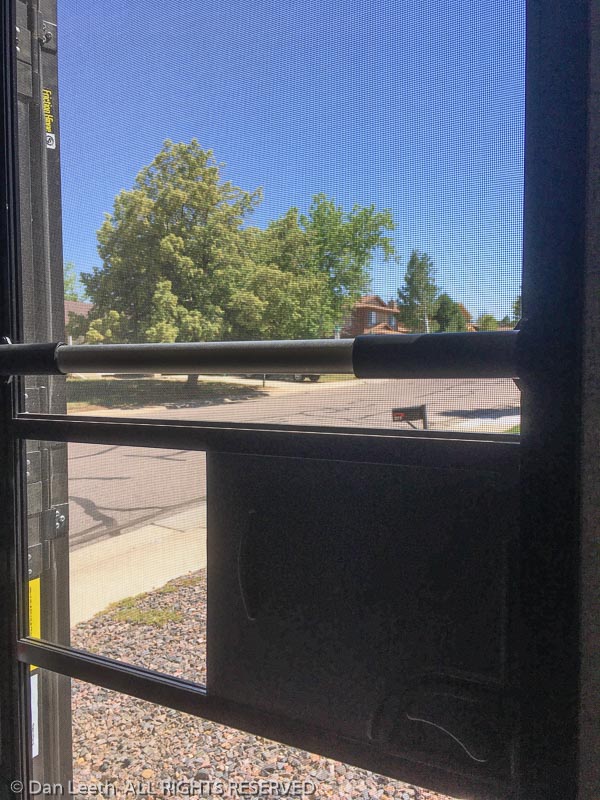
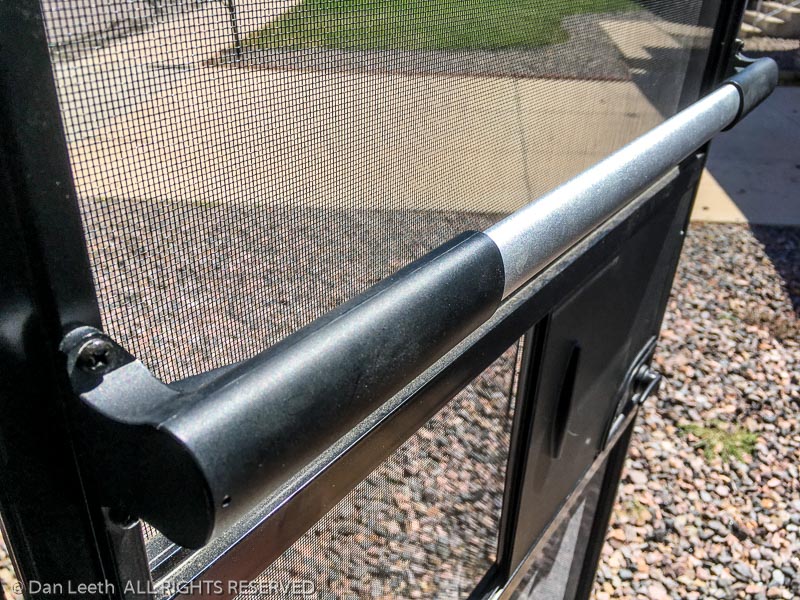
The first improvement was to install a Camco screen door bar, which cost about $15 from Amazon. The handle provides an easy means to close screen door when the outer door is open. It’s a very common fix that should have come as standard equipment.
The one-beer installation required drilling a few holes and screwing the bar into the door frame.
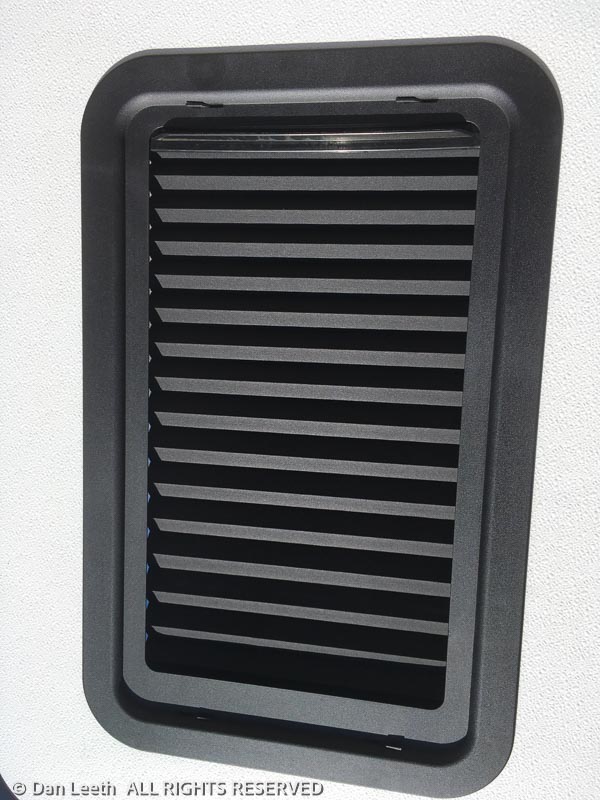
The second big improvement, a two-beer project, was to replace the stock door window with a Thin Shade window. We’ve been camped in places where the morning sun has come blasting through the front window, blinding us as we’re trying to eat breakfast or work on our computers.
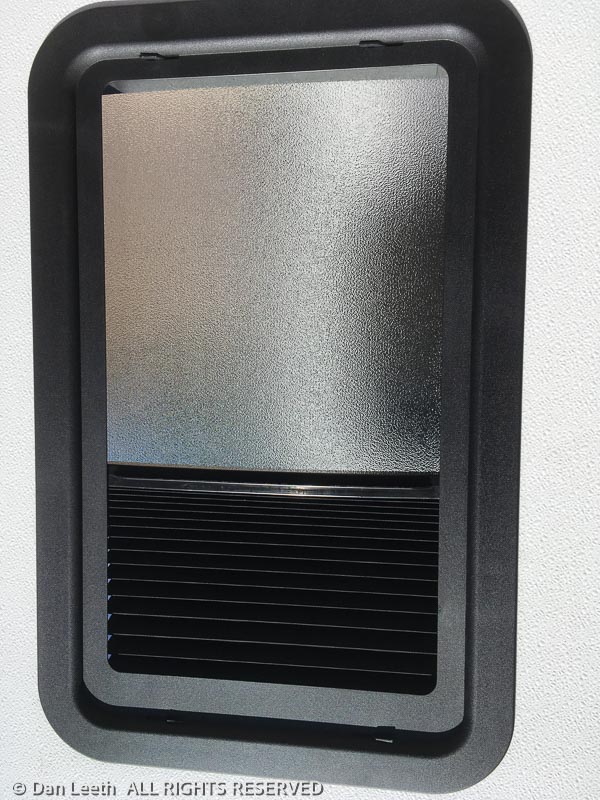
The Thin Shade window has a built-in blind that can be raised to block out all light from entering through the window. When not in use, it folds up into the window frame, totally out of sight.
There are two brands of Thin Shade windows commonly available. We went with the Lippert unit (about $100 on Amazon), which is the same brand as the original. The package included everything needed, including the clips one needs to remove the original window.
The AP Products brand unit is a few dollars cheaper, but one must contact the company to get the clips needed to remove the old window. While the Lippert replacement goes back on without screws, the AP shade uses screws. I like the clean look of the Lippert.
The Thin Shade comes with see-through tinted glass, which most people prefer. We happen to like the frosted glass for its privacy factor. Instead of using the tinted glass provided, we just reused the frosted original.
Two other two minor modifications were attempts to provide a means of keeping the door open on a breezy day in camp. The first was to install a door-holder clip (about $10 from Amazon). We used one of these on our old A-frame trailer with so-so results. On this trailer, the clip proved far too anemic to hold in even light winds.
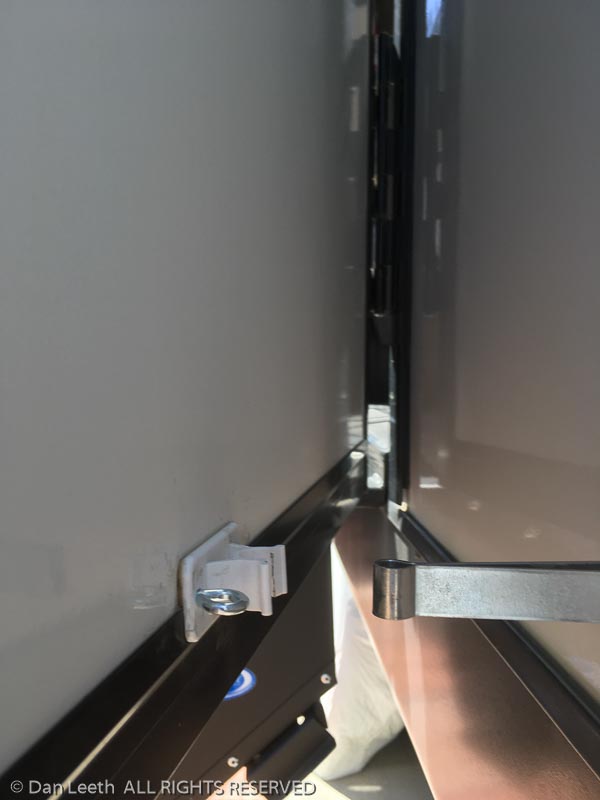
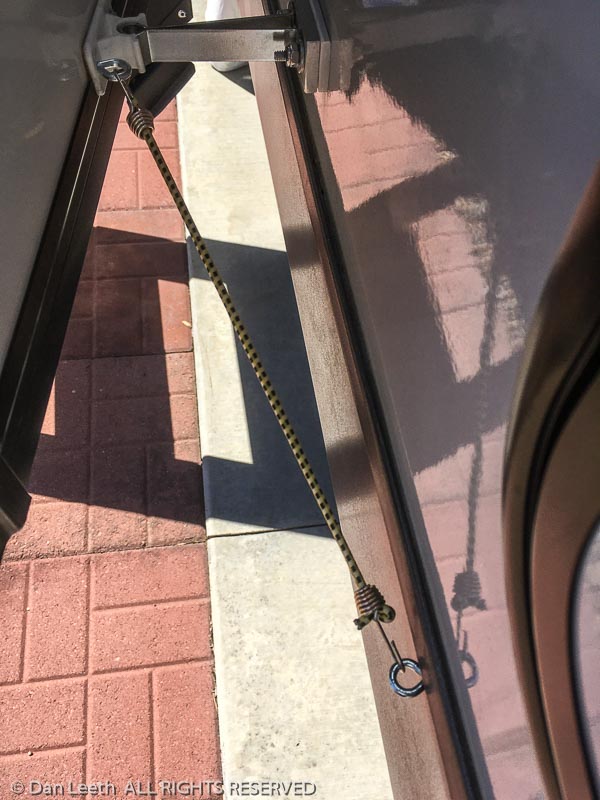
The latest thing we’ve tried to hold the door open is a bungee cord. I simply replaced one of the door-clip screws with a small, screw-in eyebolt and did the same with one of the trim screws on the side of the trailer. With an eight-inch bungee strung between the two, the door should stay open.
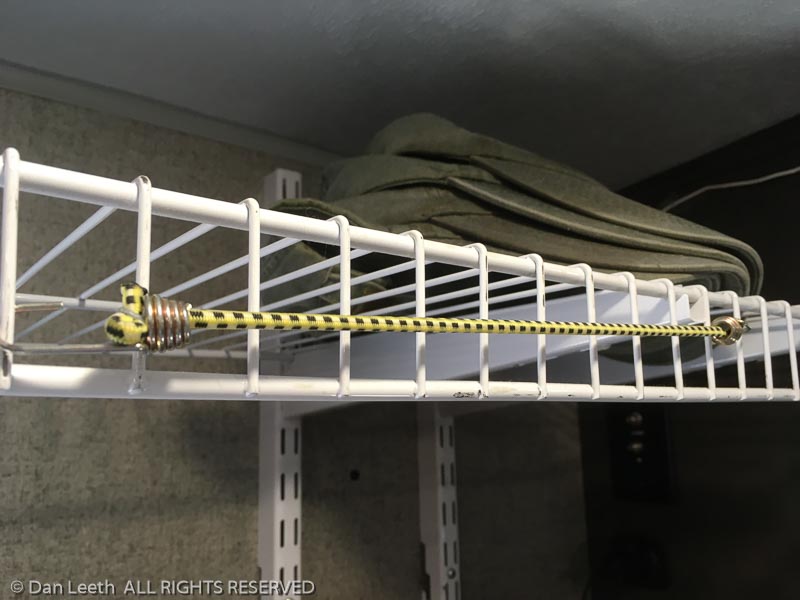
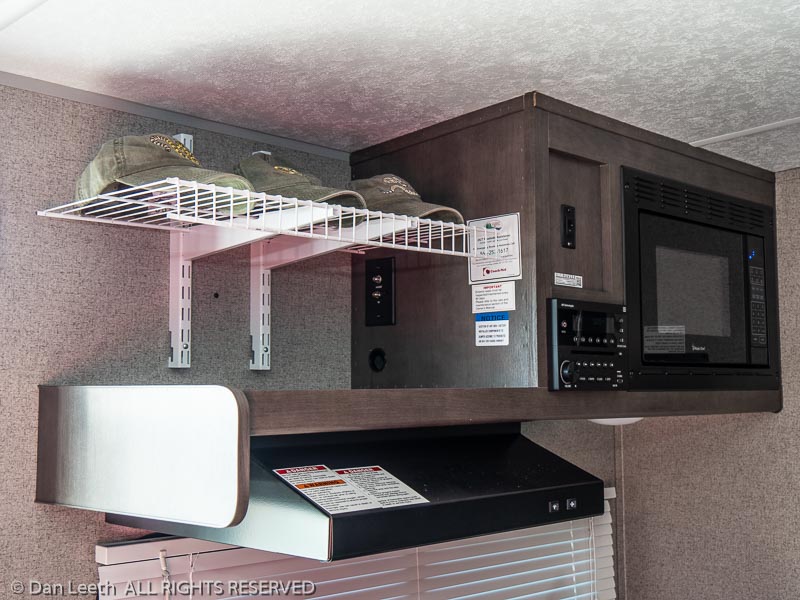
When not in use, the bungee clips on the wire rack, which we installed when we removed the TV.
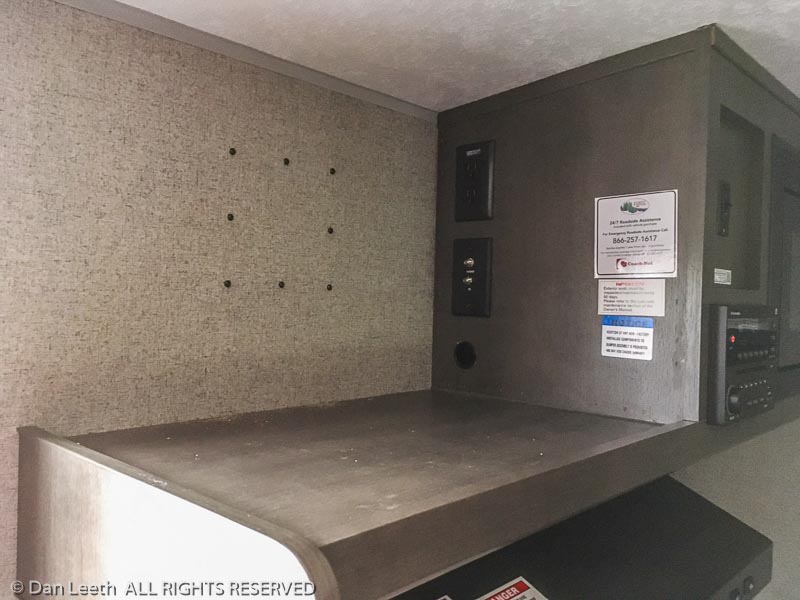
The very first improvement we made to our new Micro Lite trailer was to remove the television.
We go camping to be in nature. Instead of watching sitcom reruns, we’d rather sit by the fire, sip a glass of wine and gaze up at the stars. That’s why we rarely camp in RV parks, preferring instead to bunk down in state or national parks.
Removing the TV was an easy, one-beer job. The TV slid off its mount and eight screws later, the mounting bracket was off.
In place of the TV, we screwed in an adjustable, Rubbermaid FastTrack wire shelf bought at Lowes. We use it for hats and ballcaps in camp. The lower shelf holds coffee cups, wine glasses, a 12-volt clock, an indoor-outdoor thermometer and other odds-and-ends when we’re in camp.
Do we miss not having a TV? Never.
If we want to watch a video or stream something over the internet, we can do it on our laptops or iPads. And if it’s a sports event we want to see, we can always head for a sports bar or better yet, we’ll bring over a six-pack and watch it at your trailer.
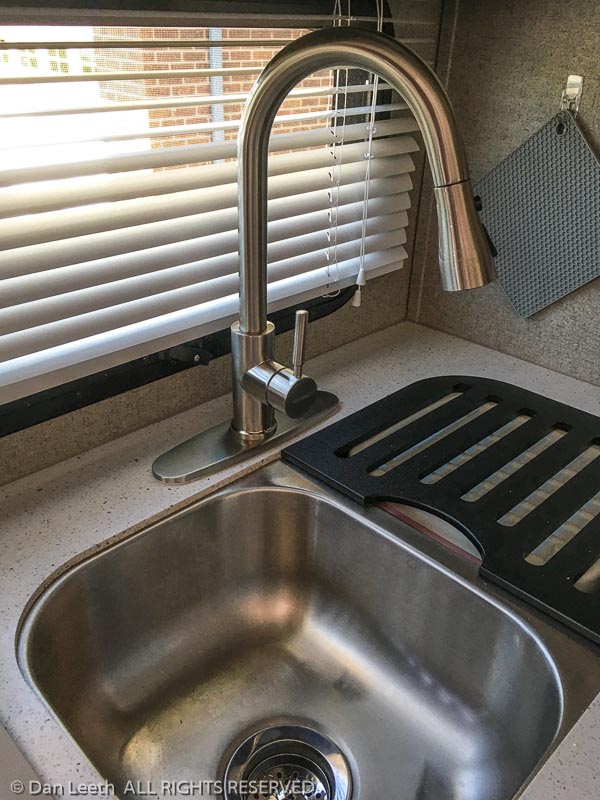
As the chief, on-the-road dishwasher in the family, I wanted to have a decent faucet with a pull-down sprayer and a single handle for setting temperature and flow. We went with a WEWE kitchen faucet in brushed nickel finish, which cost about $80 at Amazon. On this model, the faucet handle can be mounted in front or to the side. I chose a front mount to keep the handle from hitting the blind.
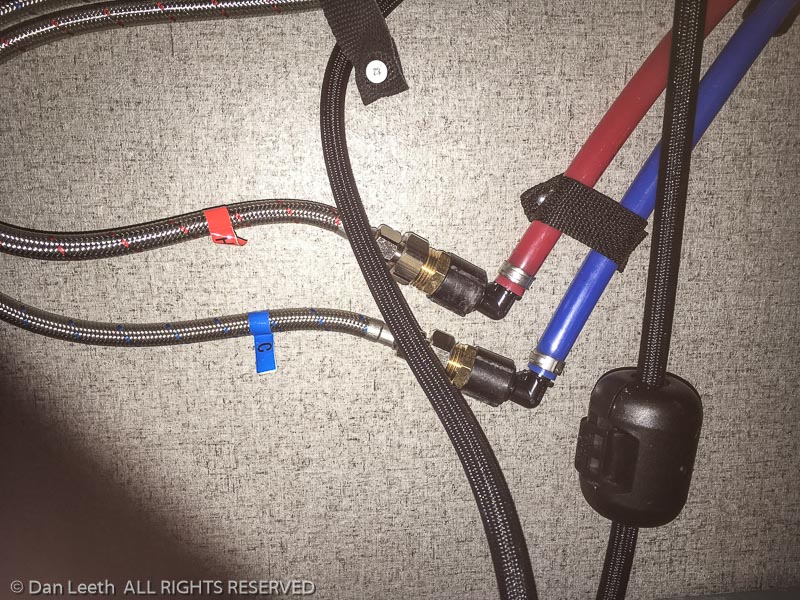
Installing the faucet was a fun, two-beer project on our trailer (Micro Lite 21DS = Mini Lite 2104s). Access under the sink comes through a drawer opening. Installation required removing the old faucet, cutting a center hole in the counter top for the new one, tightening everything down and connecting the water lines.
Instead of cutting lines and installing new connectors, I simply used nipples to connect the factory water lines to the new faucet. As a result, it takes a bit longer for the hot water to cover the extra distance from the tank to faucet. A few nylon straps keep the lines from bouncing around. So far, no leaks!
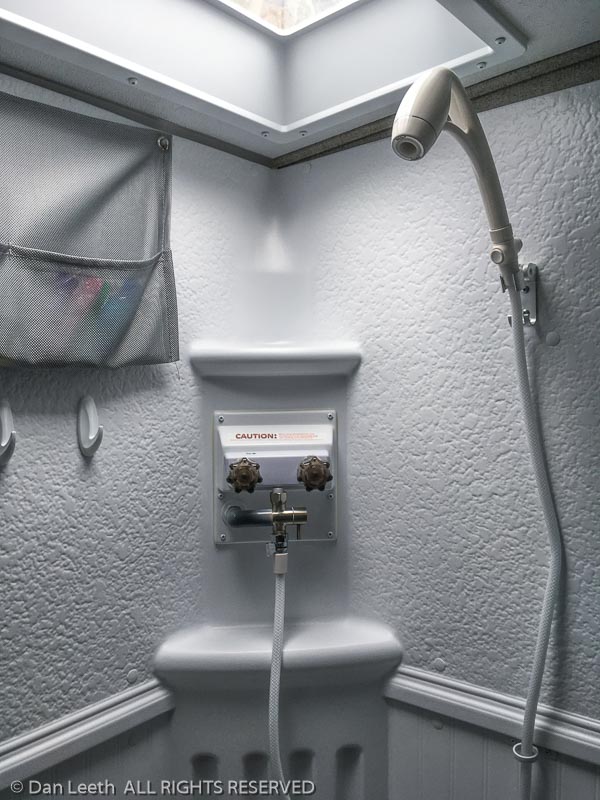
One of the big reasons we wanted to upgrade from our little A-frame folding trailer to a Micro Lite was so we would have an actual bathroom with a toilet and separate shower. Here are some of the improvements we’ve made to that shower.
One of our first upgrades was to ditch the origial shower sprayer.
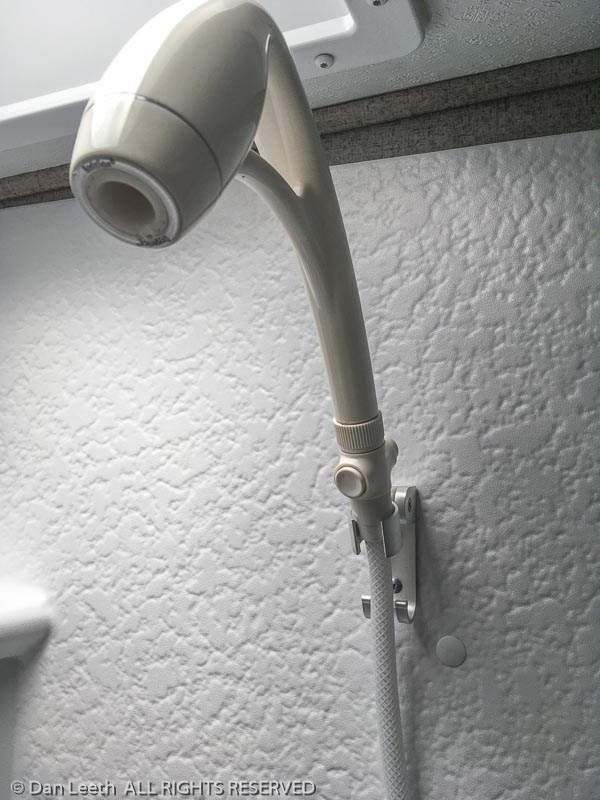
We replaced the stock spray head with an Oxygenics sprayer. We went cheap and installed the white standard model #26781, which cost about $40 from Amazon. It provides a much more pleasant spray and supposedly uses less water. Installation involves little more than unscrewing the old hose and screwing on the new.
If I had it to do over, I might opt for one of the more upscale Oxygenics sprayers, but this works fine.
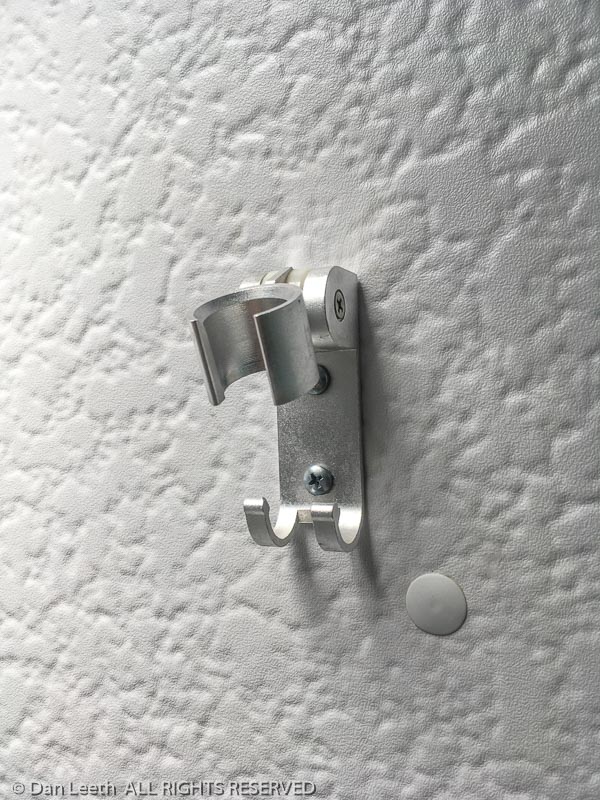
The cheap plastic clip provided with the Oxygenics sprayer would not hold the shower head in the desired position, so we replaced it with a rotatable aluminum bracket, which cost about $10 from Amazon. With it, the shower head stays nicely in position.
The Oxygenics shower sprayer has an on/off push button for use when taking sailor showers. It’s designed to allow a minor flow when closed, supposedly so the water temperature stays constant. That’s not an issue when camping with full hookups, but when boonie camping, that constant dripping is wasted water doing nothing more than filling the gray water tank.
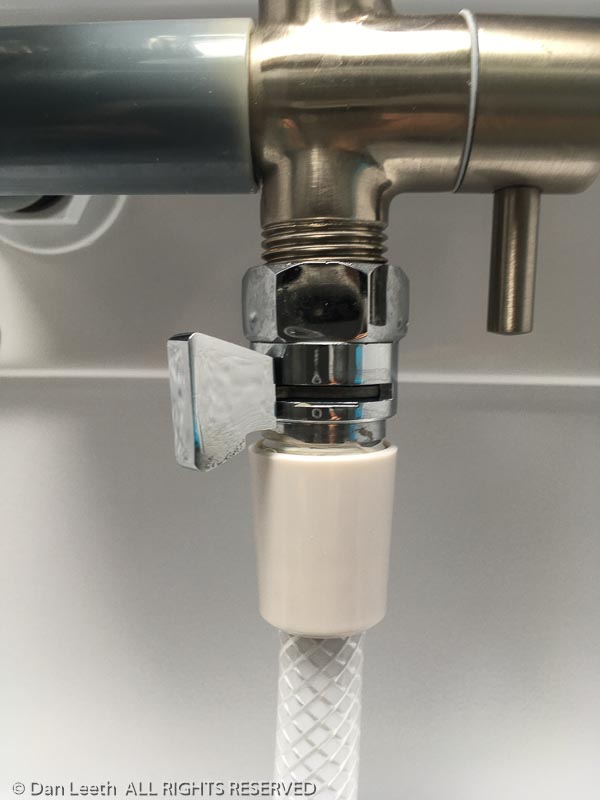
To cut down on water waste, we installed a KES chrome shutoff valve (about $11 from Amazon) on the shower line. Flip the lever to the left and no water flows through the pipe. Flip it all the way to the right and the flow is full. Anything in between moderates the flow to any desired pressure. We love this thing, and have never had an issue with water temperature not being constant.
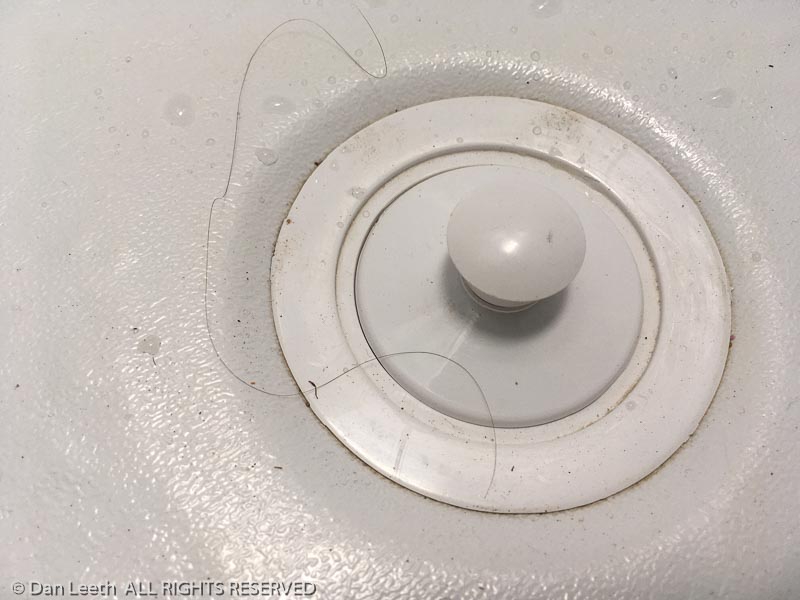
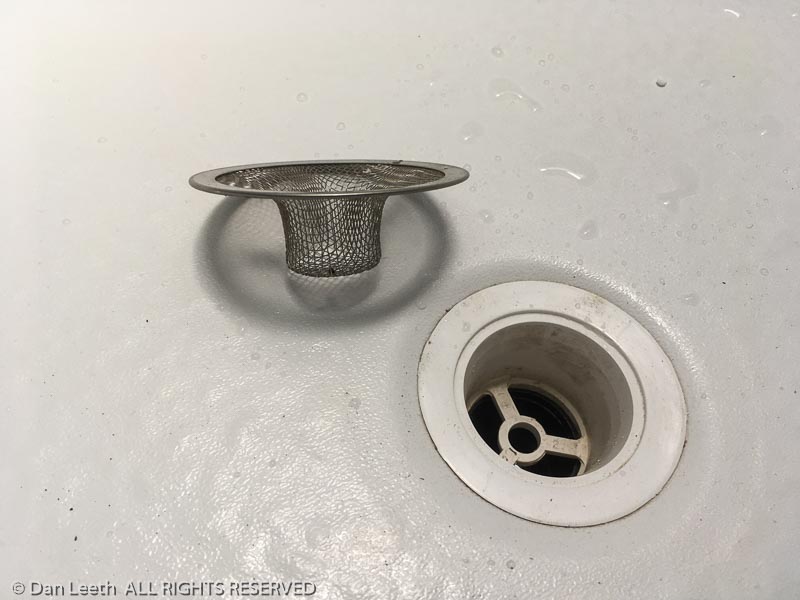
After the first few camping trips in the new trailer, we found we were collecting hair in the shower drain.
To solve the problem, we picked up a package of cheap drain strainers, probably from the Dollar Store. We leave the plug in the drain while traveling. When we get to camp, the plug comes out and the strainer goes in. No more hair in the drain issues.
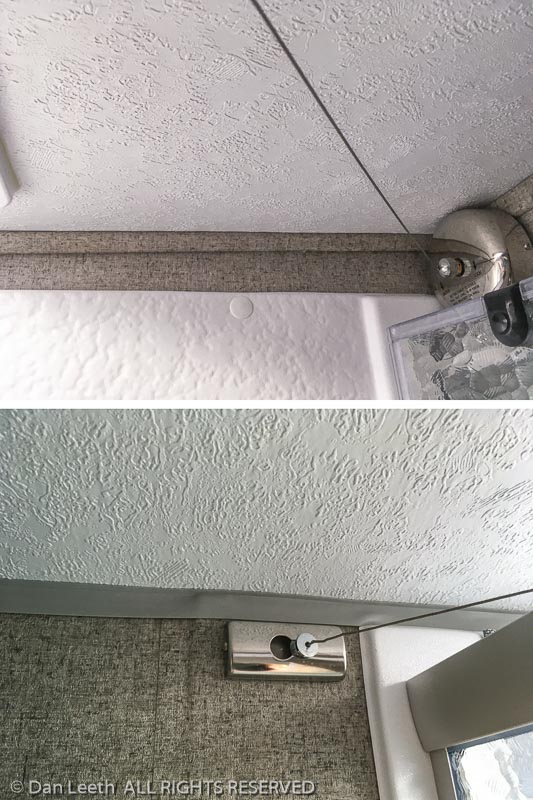
To provide a place to hang wet sox and dainties, the female half of the family wanted a retractable clothesline across the shower (about $15 from Amazon). It turns out this was pretty much a waste. Instead of pulling out the line, she has found it is more convenient to simply hang the wet items over the shower door.
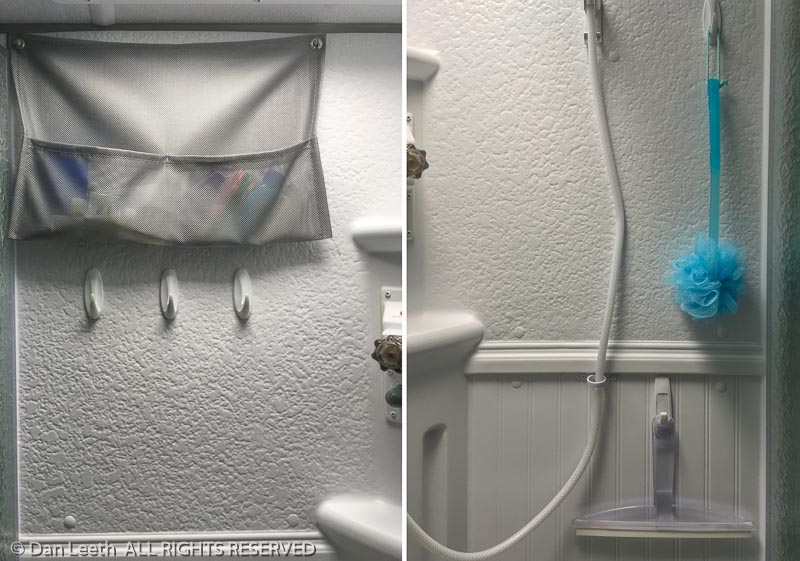
Finally, we added some command hooks to the shower stall walls for hanging wash cloths, a back brush and a shower squeegee.
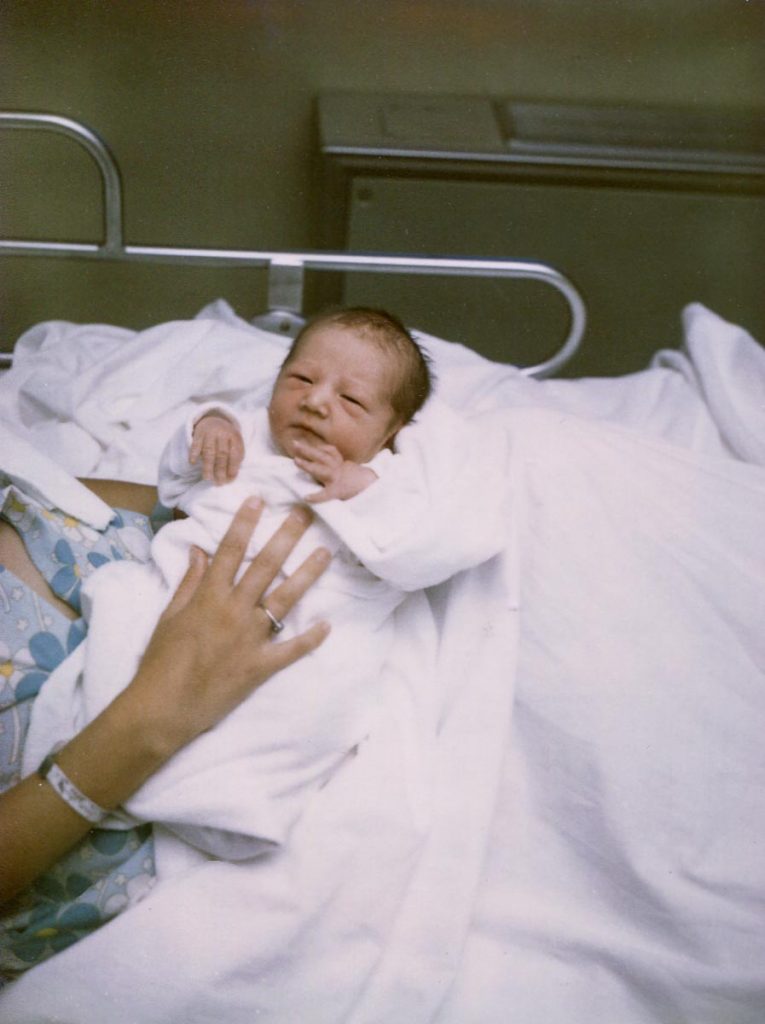
Photos are arranged in the order they appeared in the album, which I assume is roughly chronological order. Enjoy.
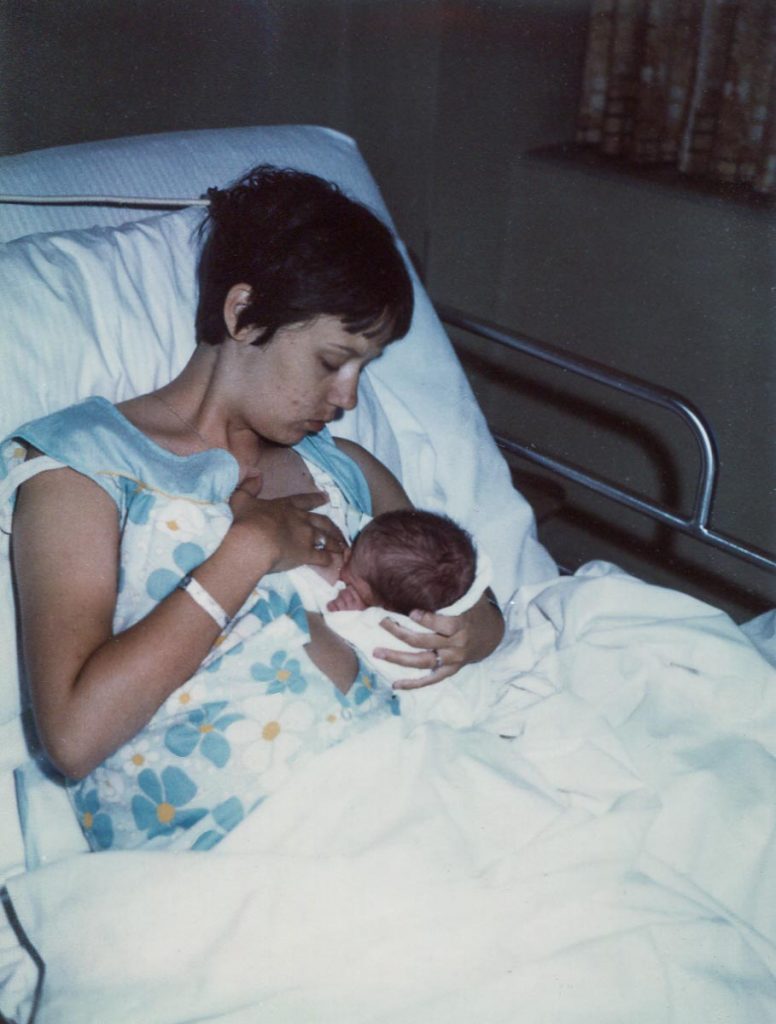
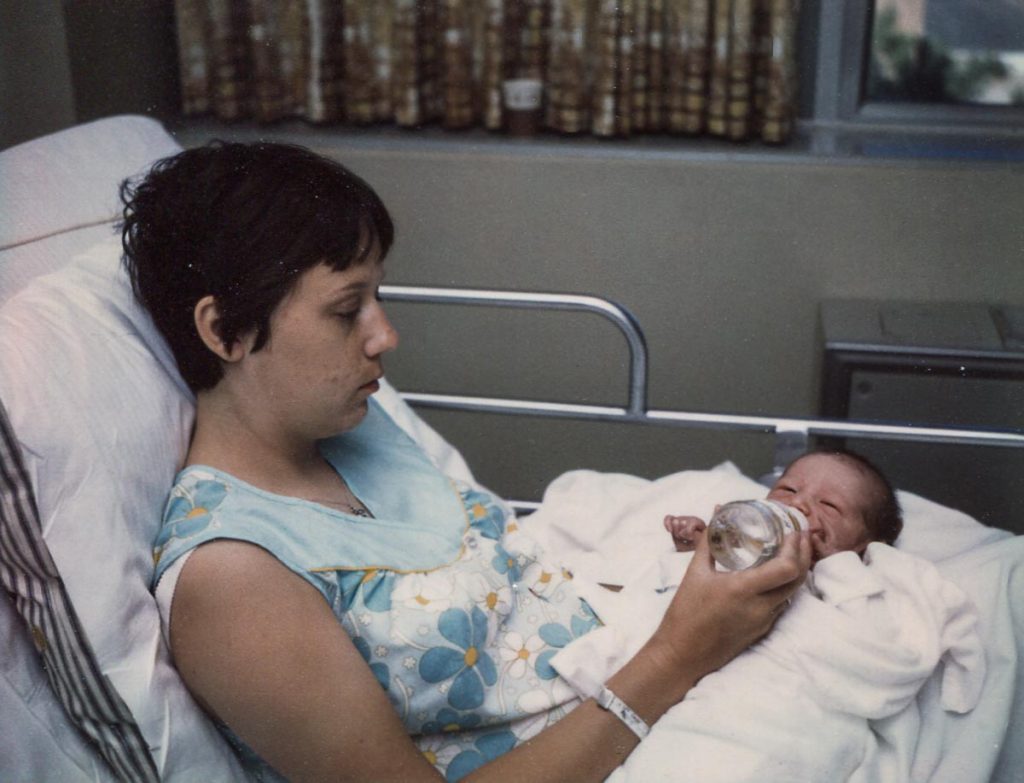
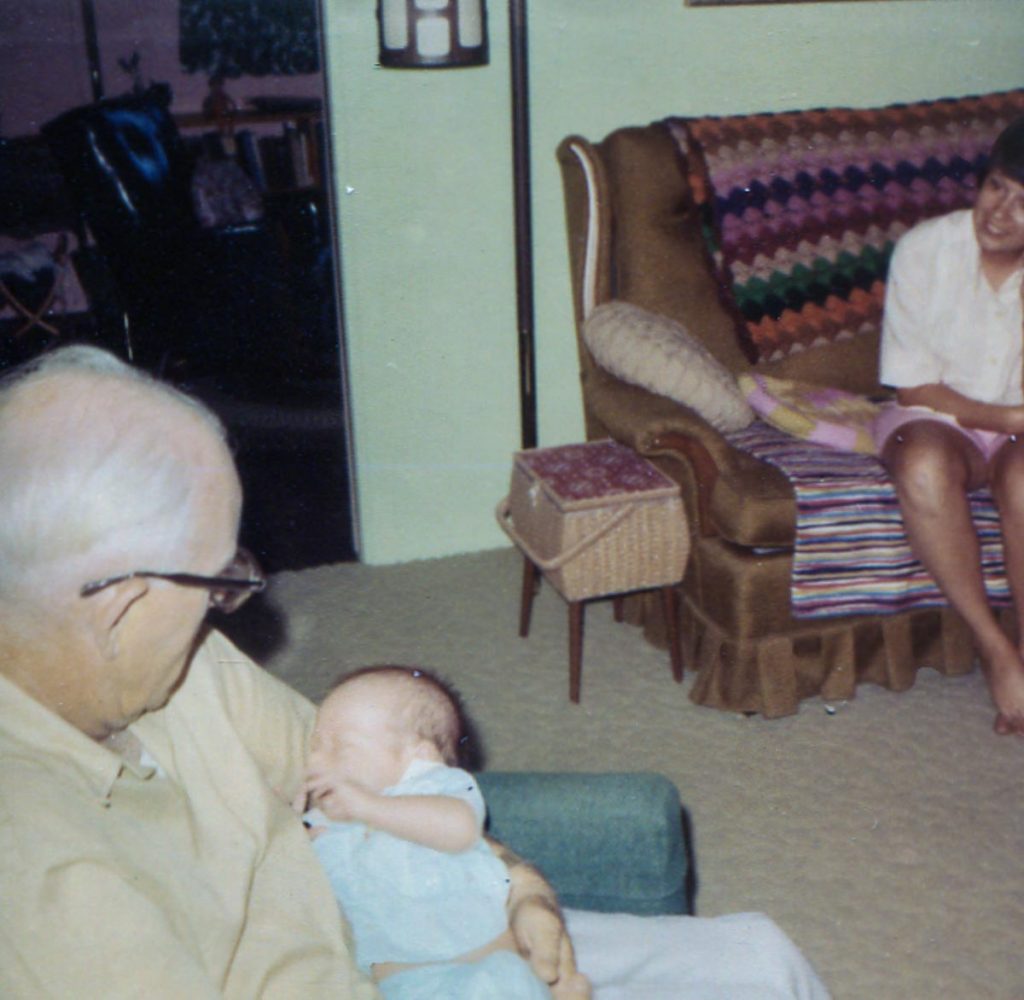
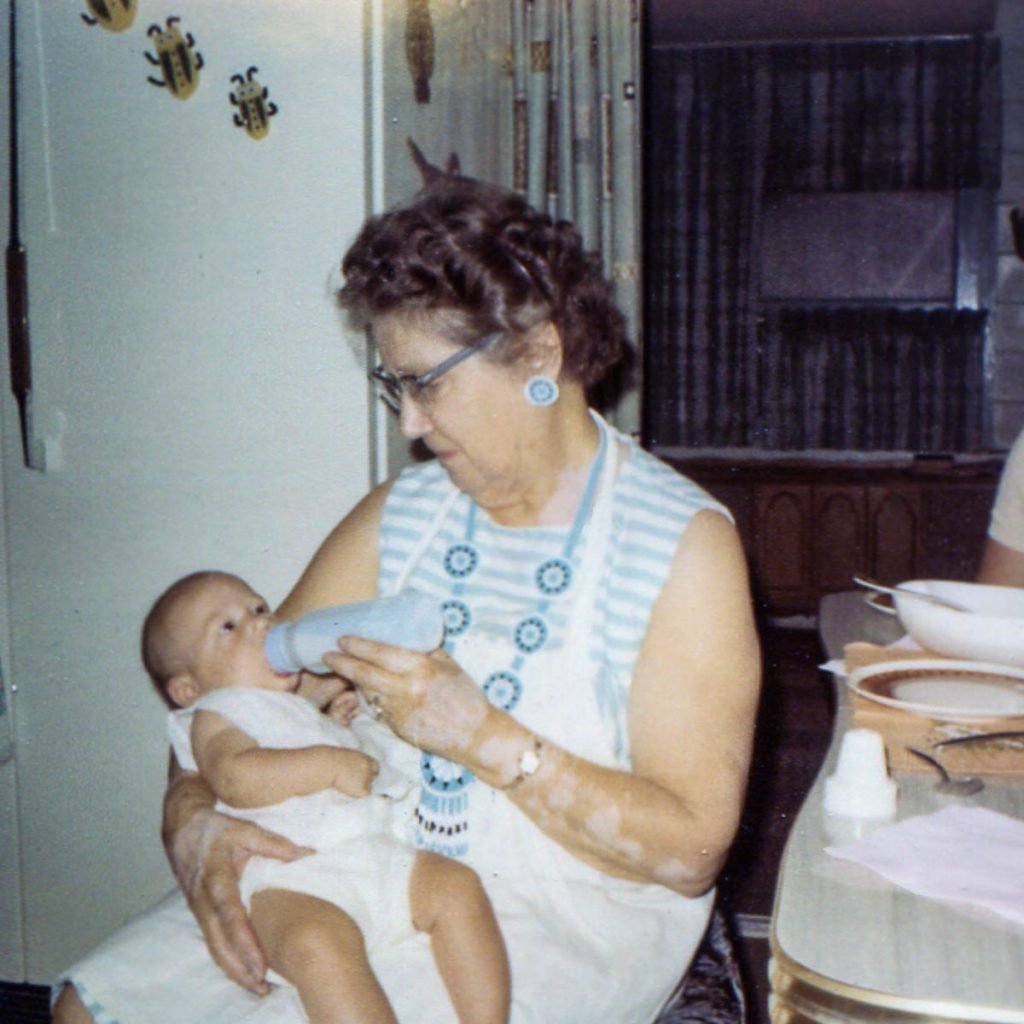
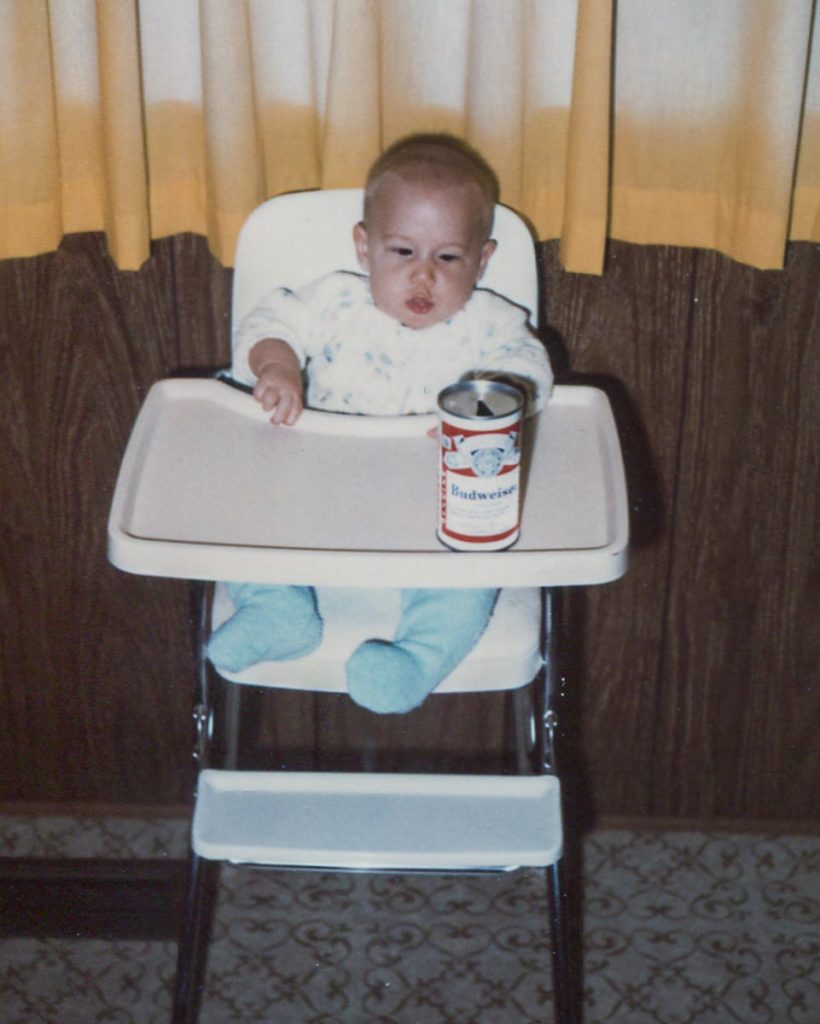
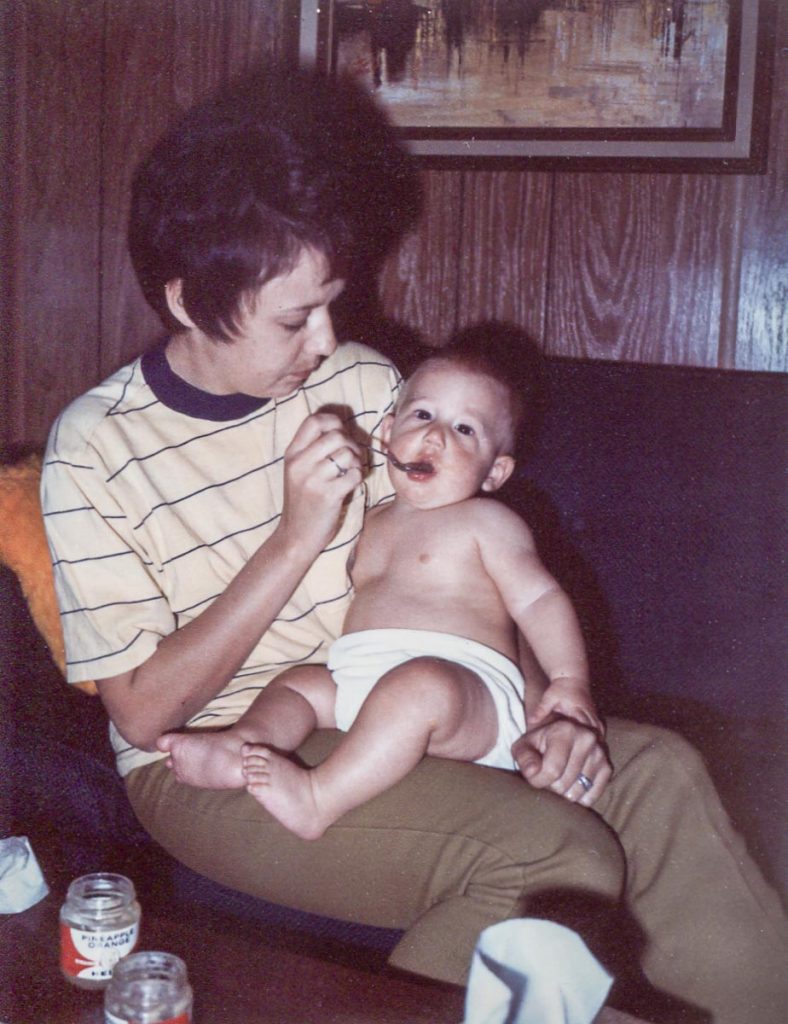
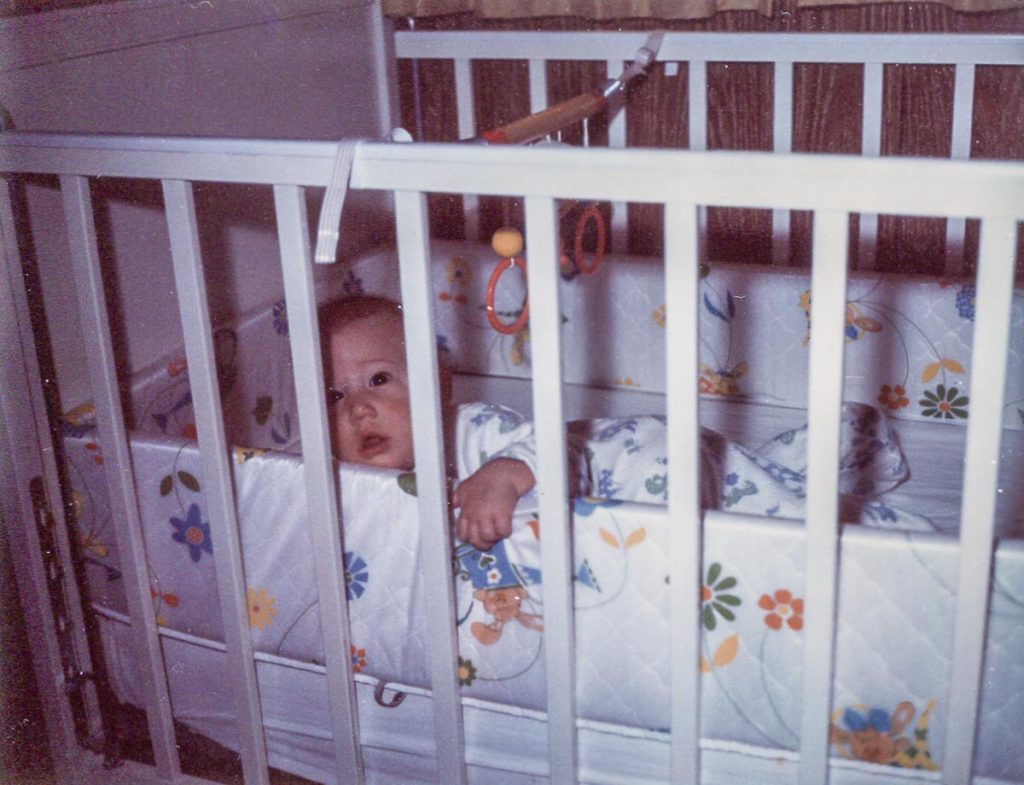
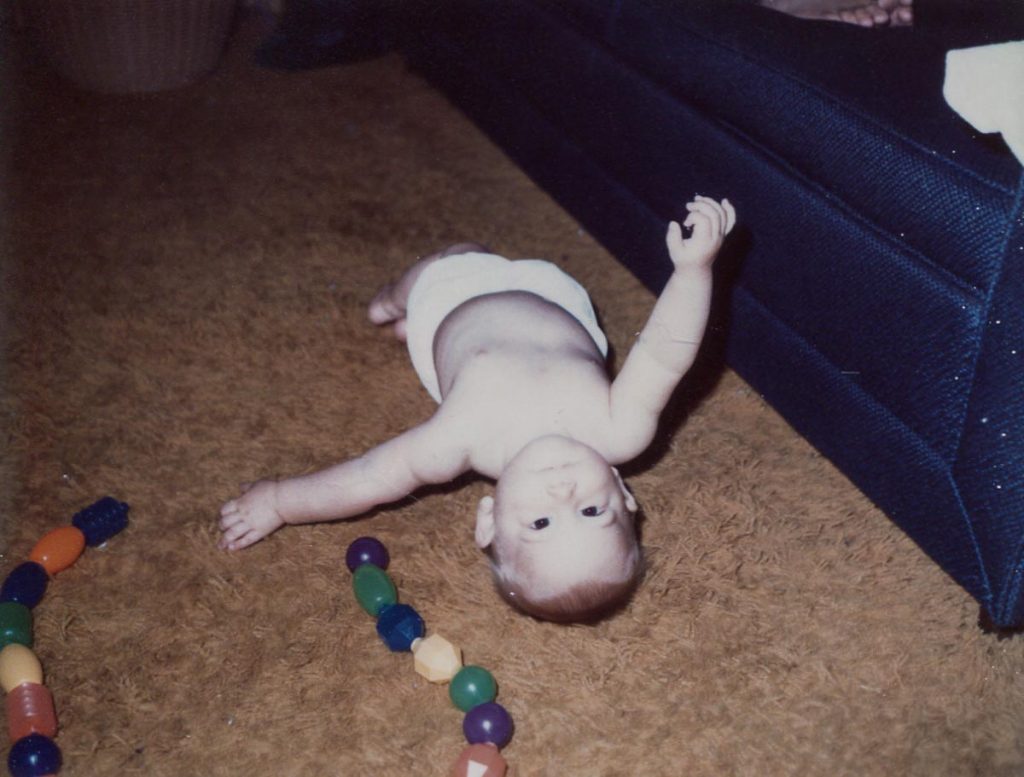
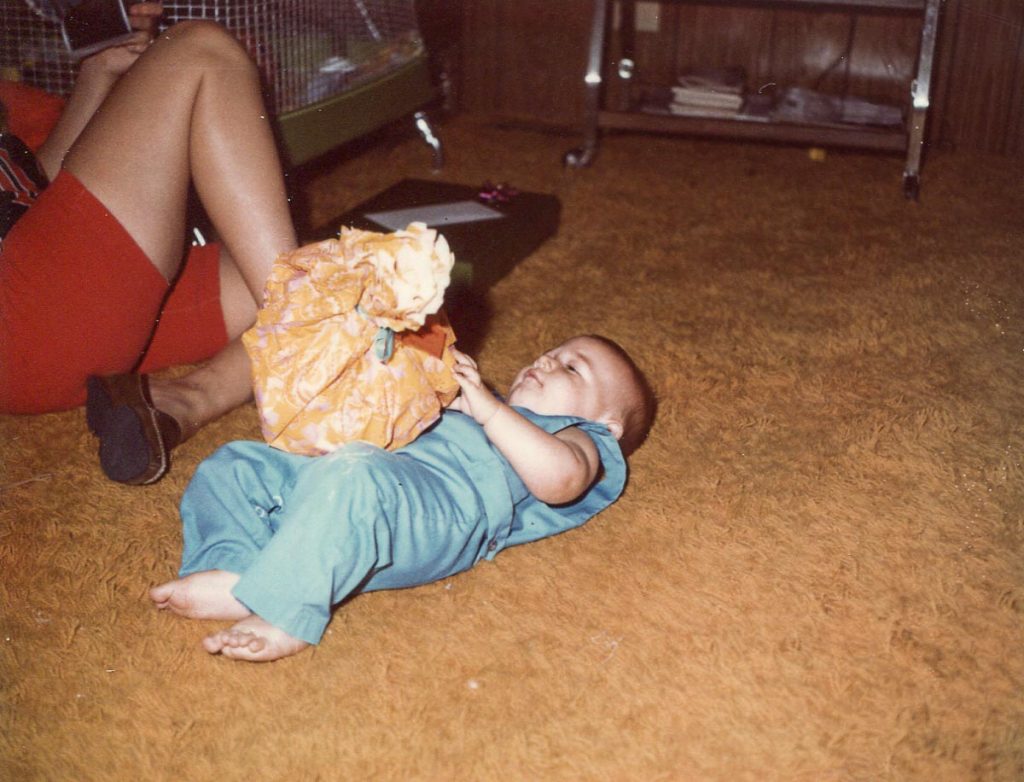
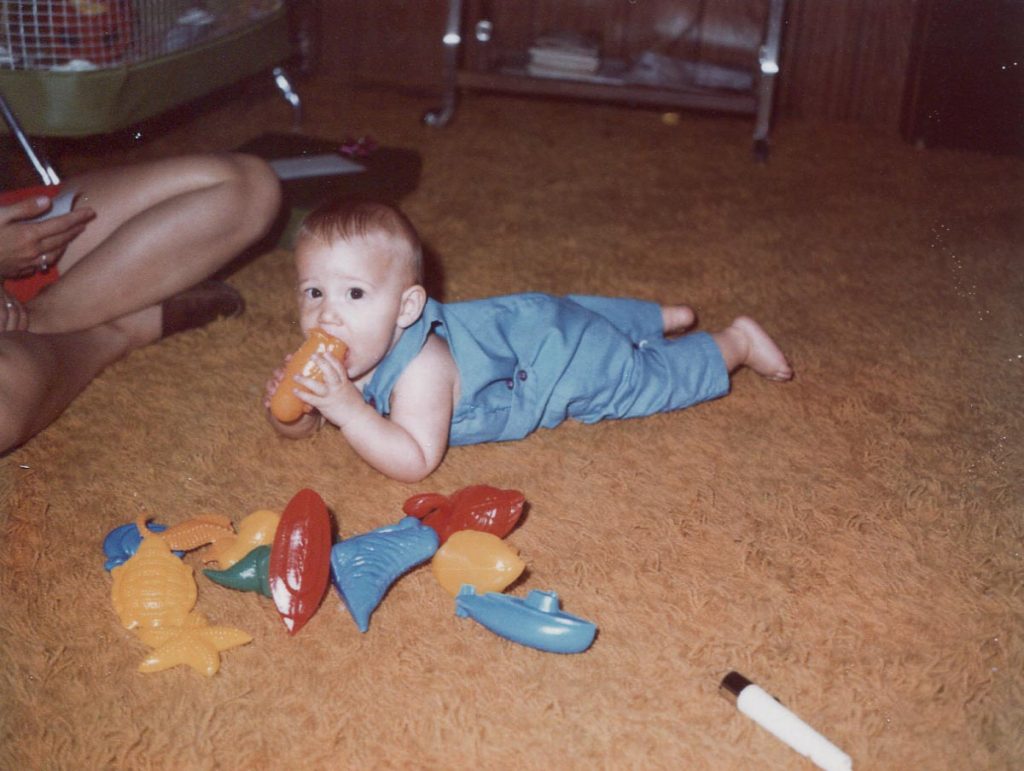
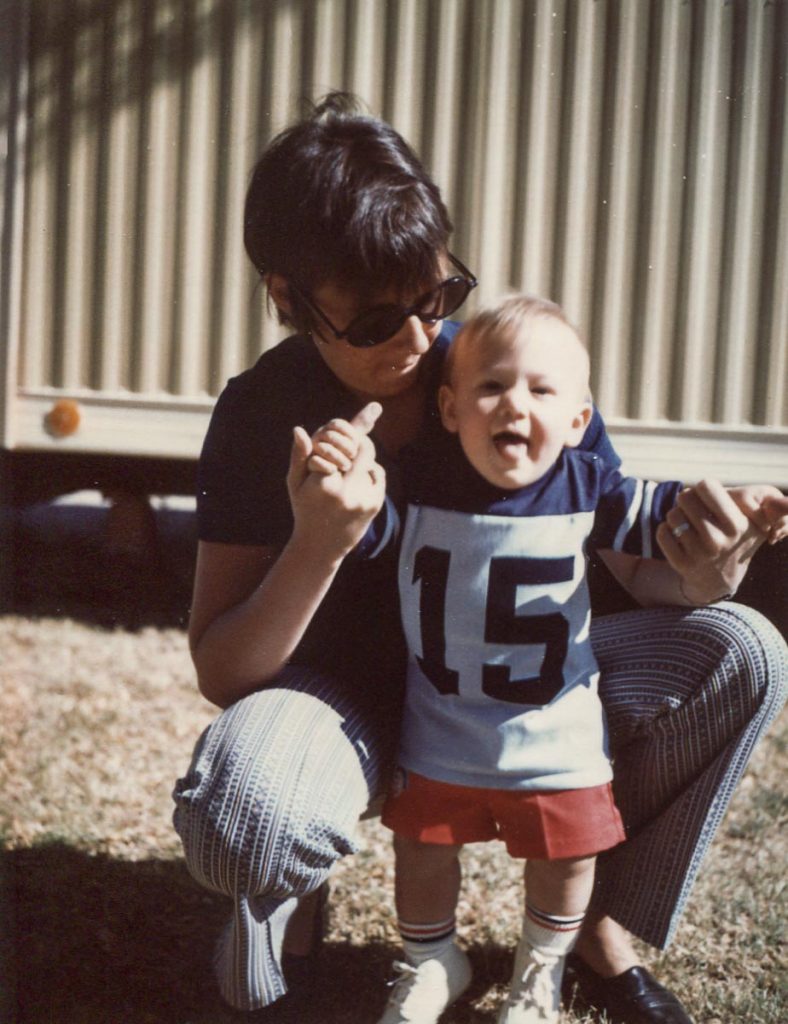
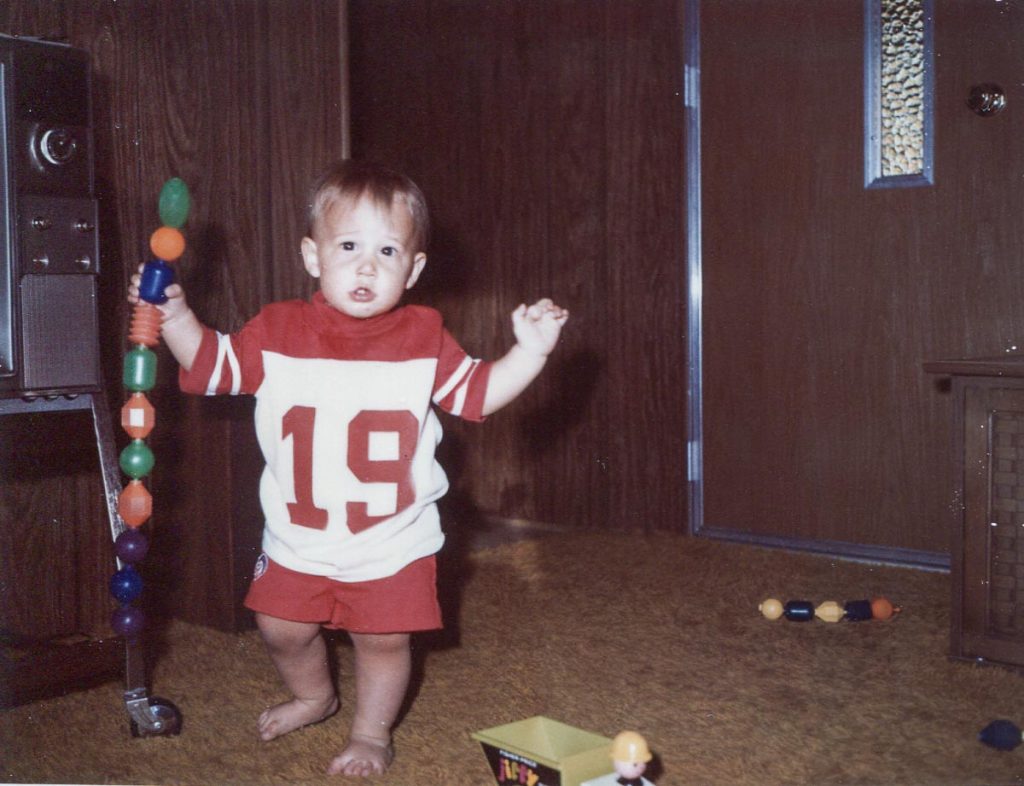
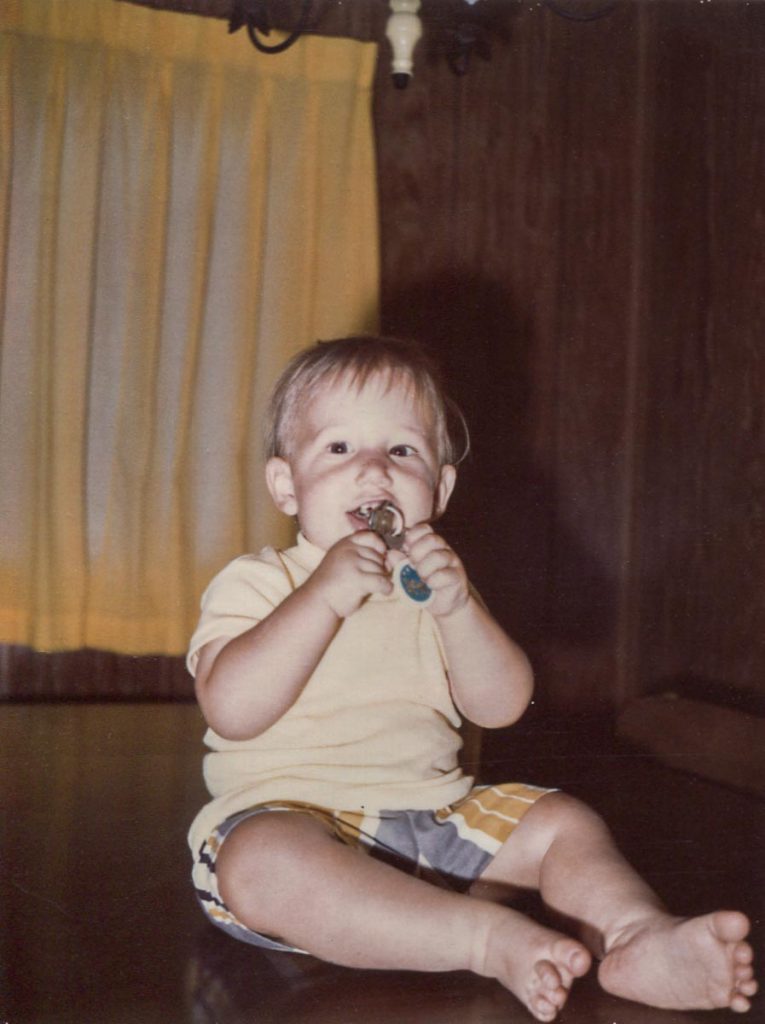
Welcome to this crazy world.Feeding in the hospital.More feeding in the hospital.Asleep in the arms of your step great-grandfather.Your great grandmother feeds you.Your father was obviously a bad influence, but they didn’t have craft beer back then.Mom spoon feeds you.Not happy being behind bars.Much happier here on the deep-pile, shag carpet.Must be Christmas.Fish and boats in the middle of the desert. Ready to walk.Those look like Kansas City Chiefs colors.Looks like teeth coming in.
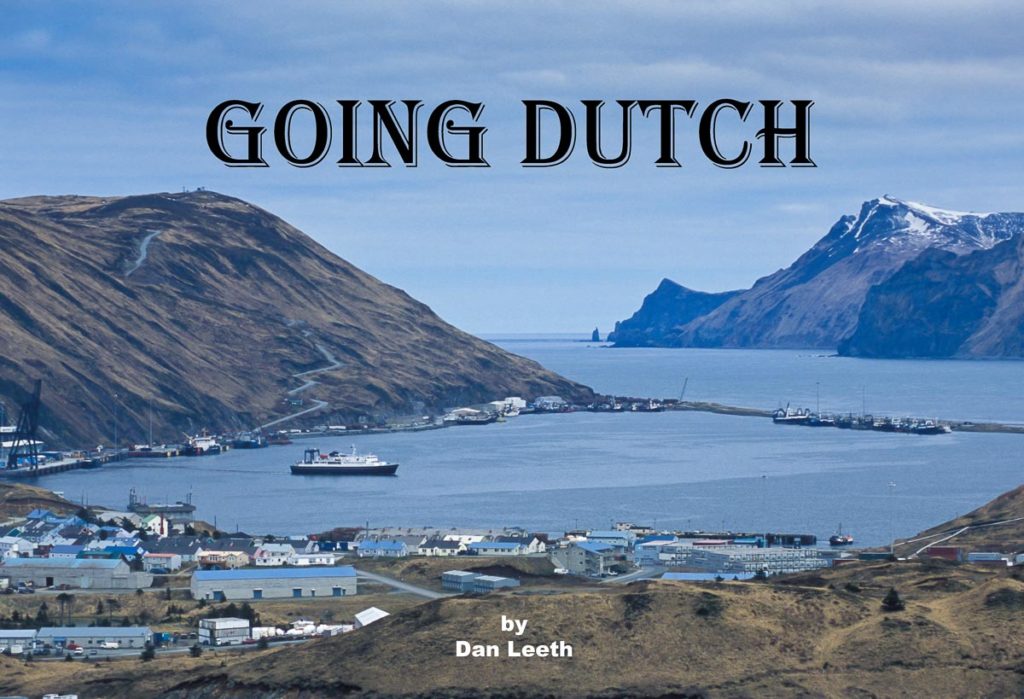
The Island may be Named Unalaska, but this Home of Discovery’s“Deadliest Catch” Offers a Real Slice of Genuine Alaska
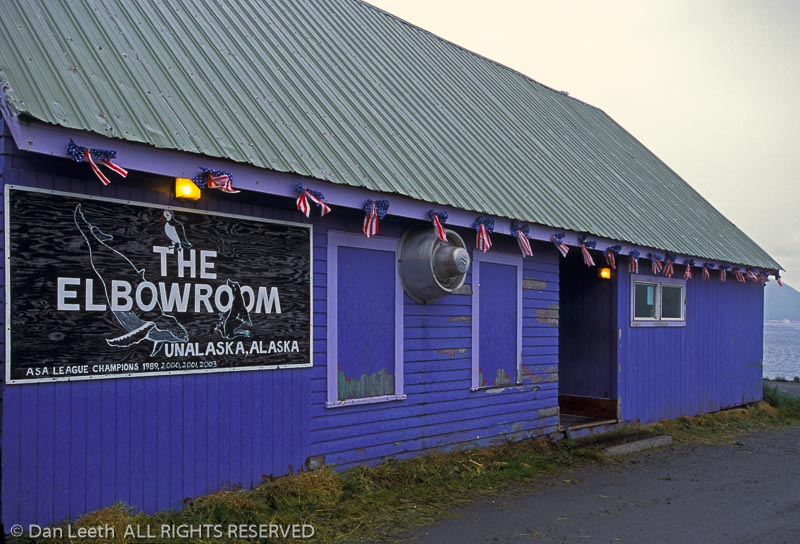
Local lore claims that in the 1970s, Playboy declared the Elbow Room on Alaska’s Unalaska Island to be one of the roughest, most notorious bars in America.
Flush with cash, Bering Sea fishermen arrived looking for alcohol and trouble. They guzzled drinks six at a time and got into more fist fights than NHL players in a hockey game. When they weren’t punching bellies, patrons slid on them.
“They would pour pitchers of beer on the floor. Everybody would strip off their shirts and slide across, seeing who could glide the farthest,” reports Rick Kniaziowski. “The town’s matured a lot since then.”
It certainly has. Known to airlines and Deadliest Catch viewers as Dutch Harbor, Unalaska is the most populated port in the Aleutian Islands. Bigger than Maui and Molokai combined, the 4,000-inhabitant isle offers business-class lodging and restaurants, an anthropological museum, nine city parks, three national historic landmarks, a national wildlife refuge and a national historic area.
Today, it sports more churches than bars, its schools rank among the state’s best, and the notorious Elbow Room, now closed, serves booze and blows no more. Located closer to Russia than Juneau, Unalaska’s remote allure hooks us off-the-beaten-track travelers.
“We’re kind of like the UnCola,” explains Mayor Shirley Marquardt. “We don’t have trees, bears, snow, moose and things like that. What we’ve got is a real working Alaskan town that’s kind of on the fringes in the middle of the Bering Sea.”
The island’s un-name comes from the native “Ounalashka” meaning “near the peninsula,” and the harbor’s Dutch moniker reflects a time when a ship from the Netherlands anchored there. While “Dutch Harbor” remains commonly used, the official name for both the island and its town is “Unalaska.”
“Calling us Dutch Harbor is kind of like calling Seattle Elliott Bay,” complains Rick. “It’s only the name of the body of water.”
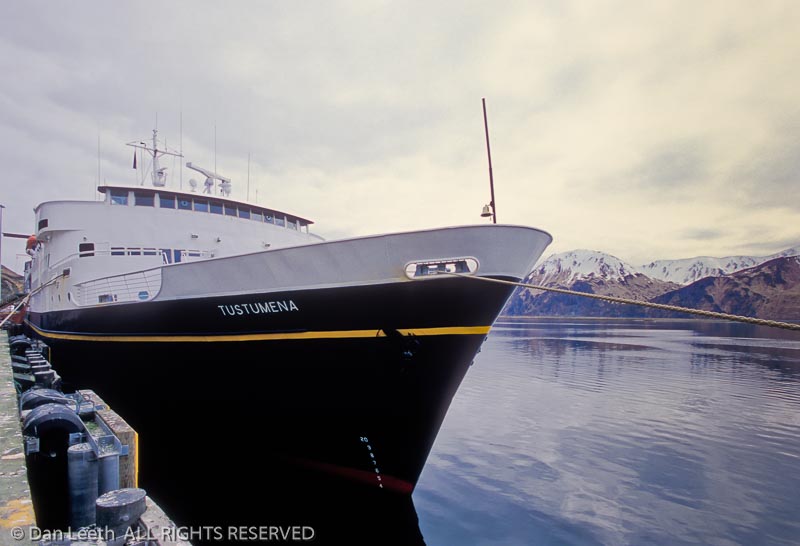
Getting here takes a bit of effort. A few cruise ships call, and Alaska Marine Highway ferries serve the island twice monthly from April through September. For most of us, however, it’s a three-hour, turboprop flight from Anchorage that gets us here.
Landing in Unalaska is like dropping onto an aircraft carrier. Water borders the runway on three sides, and a sawed-off hill rims the fourth. A pilot error here results in either a splash or splat. The Elbow Room may be closed, but the airport bar, I discover, is going strong.
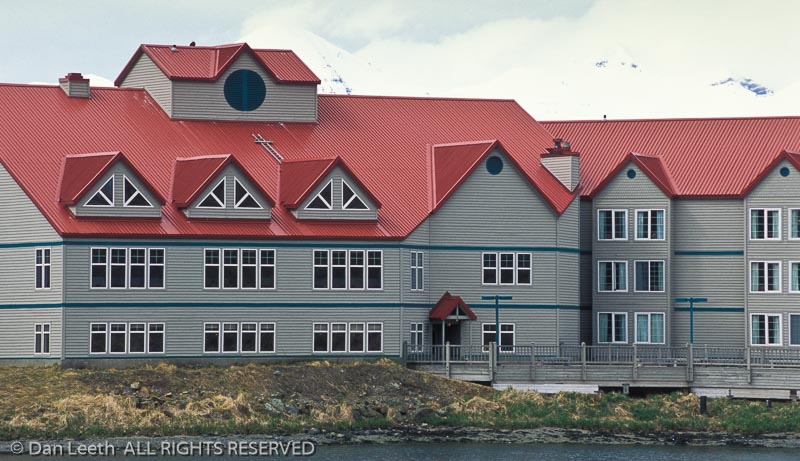
I stay at the Grand Aleutian, a 112-room, three-story hotel. Its restaurant, I’m assured, offers the best (and only) Sunday brunch in town, and its gift shop carries crafts from Unalaska’s sister city of Petropavlovsk. I may not be able to see Russia from here, but at least I can buy souvenirs from there.
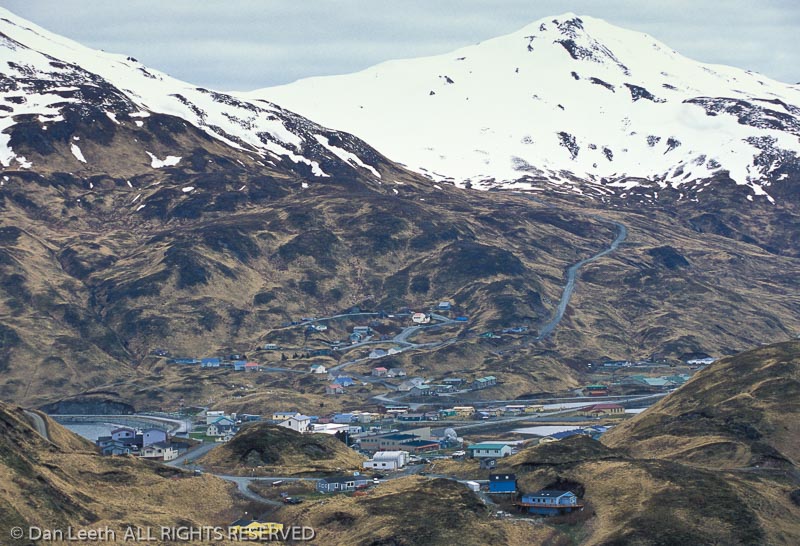
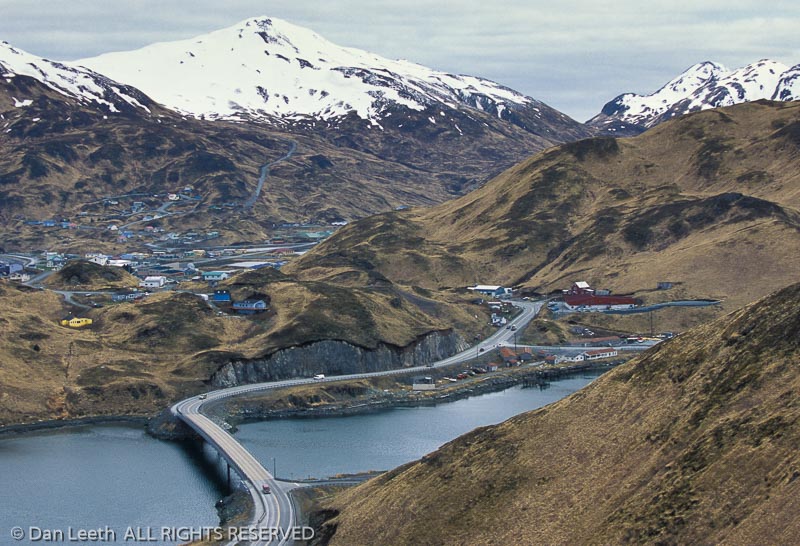
The town wraps around Iliuliuk Bay with part on Unalaska Island proper and part spilling onto a subsidiary isle. Connecting the two halves is the officially designated “Bridge to the Other Side.”
Downtown Unalaska has a last outpost of civilization look to it. Most homes seem modest with trailers, prefabs and refurbished World War II cabanas capping the real estate mix. The town sports a public library, community center, aquatic center and a staffed visitor center run by the optimistically named Convention and Visitors Bureau.
“Just how many conventions do you have here at the tail-end of Alaska?” I ask Rick, who served as executive director.
“Well, we hosted a state school board meeting once,” he smiles.
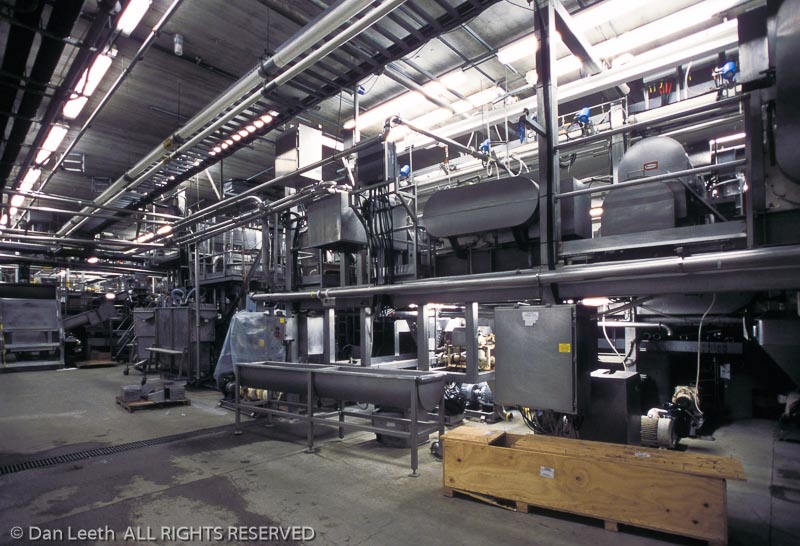
The biggest land-based employer is UniSea, which runs a highly automated pollack processing plant. Fillet from the white fish becomes sandwiches while the rest is ground into surimi that is used in imitation crab and fish sticks.
“There’s a one-in-ten chance that if it’s Alaskan pollack, it came from this plant,” Don Graves tells me on a tour. “McDonalds uses our pollack in their fish sandwiches as does Burger King.”
In addition to the commercial catch, sport fishing lures anglers to Unalaska. A replica of a 459-pound Pacific halibut hangs inside City Hall. Celebrities who have baited hooks here include Jimmy Buffett, who once performed an impromptu concert at the Elbow Room, allegedly without margarita belly slides.
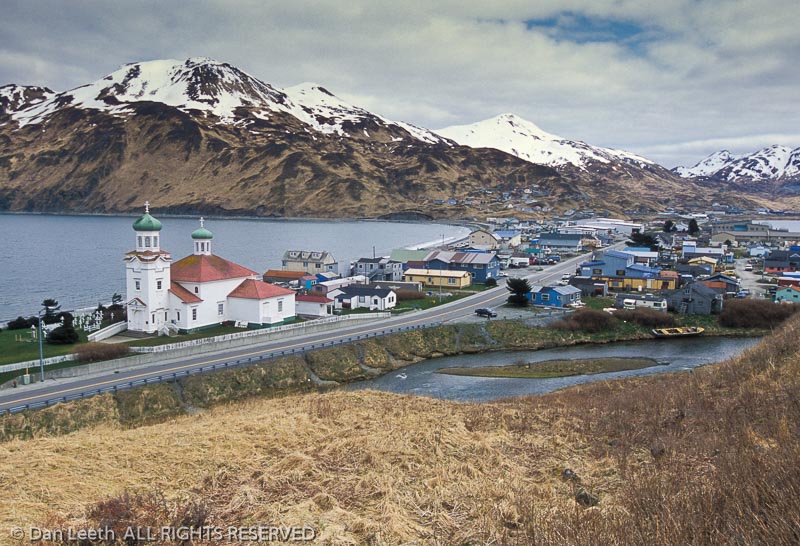
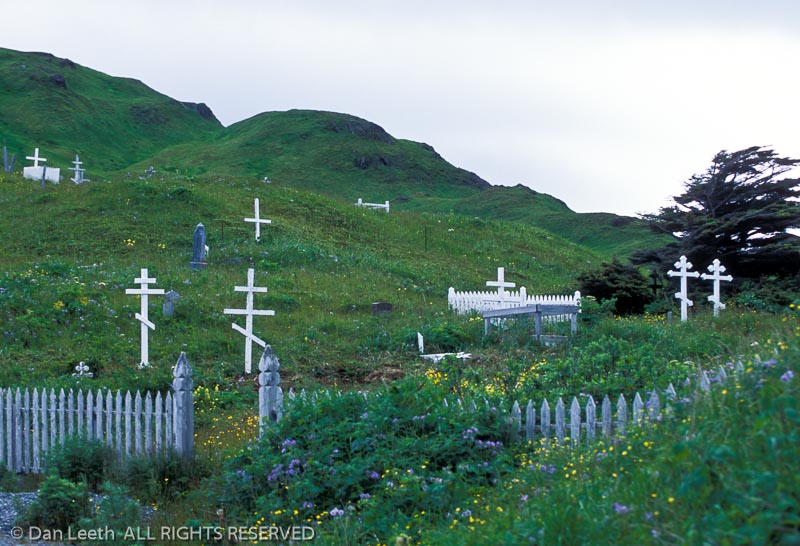
At the end of downtown, a block from that infamous bar, sits the Church of the Holy Ascension. Started in 1825, this Russian Orthodox facility remains one of the oldest cruciform-style churches in the United States. Its icon collection dates back to the 16th century.
“The icons on the back wall, a set of 12, are called calendar icons,” explains local resident Susan Lynch. “There are only three full sets from this era in the whole world, and we have one of them.”
When it comes to trees, Unalaska stands as bare as Howie Mandel’s noggin. Hoping to make their fur-trading effort more self sufficient, the Russians planted Sitka spruce seedlings here in 1805. Six original trees still stand, becoming one of the few arboreal entries gracing the list of National Historic Landmarks.
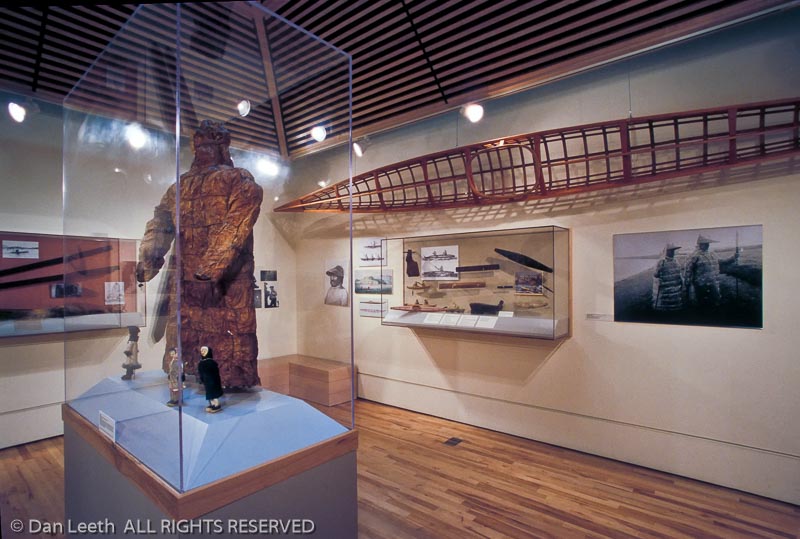
Not far from my hotel sits the Museum of the Aleutians. It presents a collection of finely woven baskets, a 1778 drawing of an Unangan woman done by crewmember of Captain James Cook and a waterproof parka called a kamleika made from sea lion esophagus tissue. There’s also a 1940’s vintage ski, a model of the Coast Guard’s USS Bear and numerous World War II artifacts. One item, a Japanese soldier’s good-luck flag, has been returned to the family of the man whose fortune was battle ended.
“His widow had been told he was killed in the South Pacific,” explains Bobbie Lekanoff, owner of The Extra Mile Tours. “The Japanese kept it a secret that they were fighting in the Aleutians.”
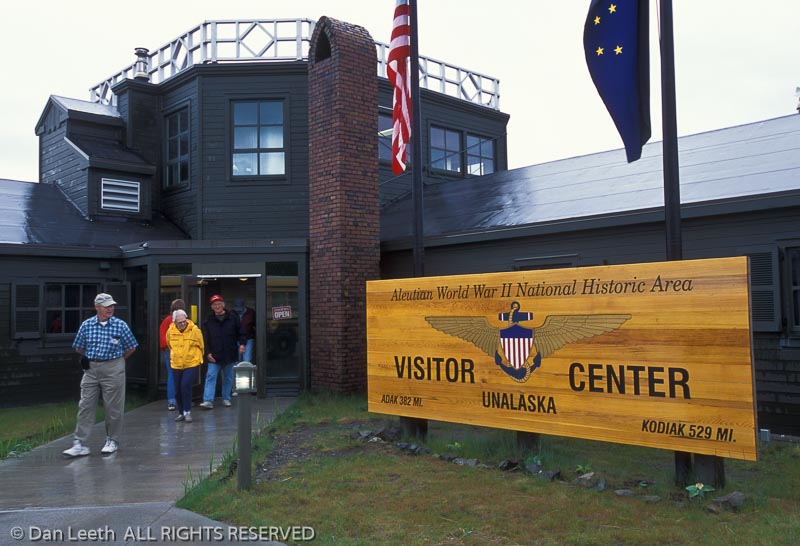
Aleutian World War II National Historic Area Visitor Center, Dutch Harbor, Unalaska, Alaska.
The Visitor Center of the Aleutian World War II National Historic Area displays information about the conflict and provides a mockup of a communications center with mannequins manning equipment. Bobbie reminds me that six months after Pearl Harbor, Japanese aircraft dropped their loads on Dutch Harbor.
“Right in front of us, you can see a dip in the ground that’s more green than everything else,” Bobbie points out. “That is a crater from where one of the bombs hit.”
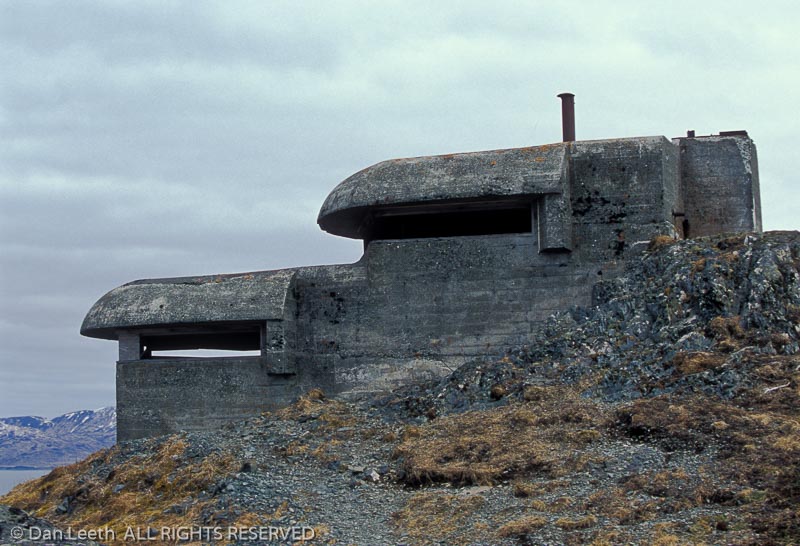
Days after the attack, the Japanese invaded Kiska and Attu Islands further down the Aleutian chain. To stifle possible advances, allied forces stationed nearly 50,000 solders in Unalaska. Abandoned bunkers, pillboxes, ammo depots and gun mounts still surround town.
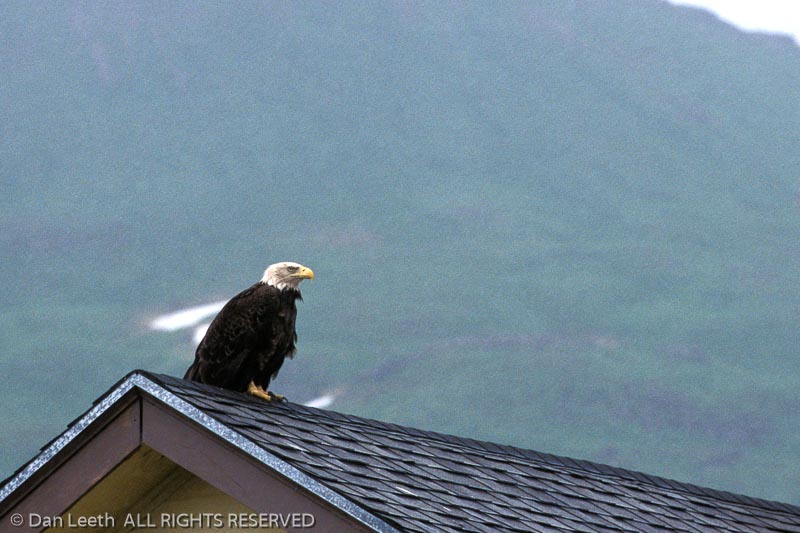
Bobbie’s tour mixes history with nature. By mid-July more than 160 species of flowering plants will carpet the mountains. Until then, bald eagles top the nature enthusiast’s interest list. With 878 spotted at a recent Christmas count, the national symbol can be seen perched everywhere around town. Bobbie monitors over 30 perennial nesting sites. The easiest nest to spot sits atop an unused construction crane in the middle of town.
“The first year they tried to build there, the sticks fell through,” she explains. “The following spring, a couple of local people climbed up and tied fishnet to the bottom. The eagles successfully completed their nest and have come back every year since.”
Another species that attracts birders to Unalaska is the rare whiskered auklet, whose range is limited to the Aleutians. To see them, I board a boat captained by wildlife biologist Tammy Peterson. We sail toward the Chelan Bank.
“The sea bottom comes up abruptly here, so there’s a big upwelling. It’s really nutrient rich, which means the bait fish are here along with whatever feeds on them,” she says. “It’s like a fast-food restaurant in the Bering Sea.”
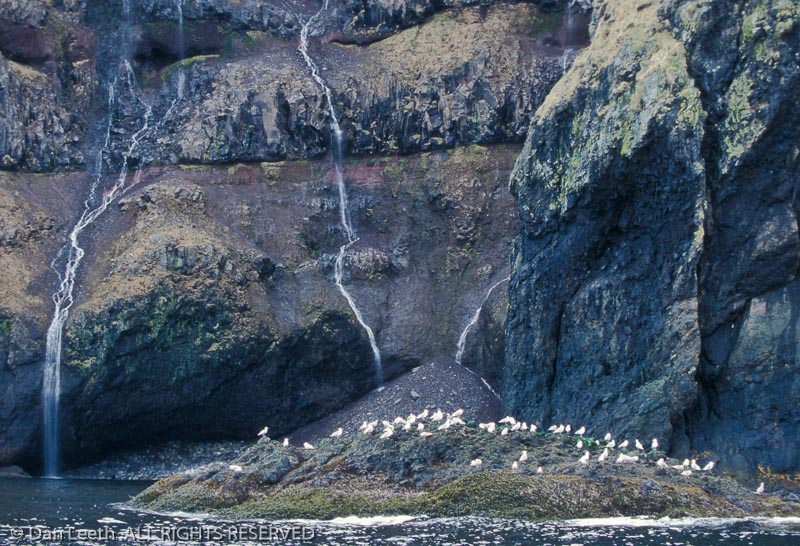
We catch a pod of orcas breaching to the starboard and white-sided dolphins porpoising to the port. A short-tailed albatross glides overhead like a white, U2 spy plane. Tammy points out sooty shearwaters, tufted puffins and various species of gulls. Best of all, we spot numerous whiskered auklets. Our route back takes us past the airport.
“Nine years ago, my brother died,” Tammy reveals. “I got the phone call saying it was time, but I got stuck here for six days because of fog. He died before I could get off the island. That’s the drawback to living out here.”
Fortunately for me, the weather dawns fog-free my departure day. I head for the airport assured that not only will the plane will arrive and depart, but it will even be reasonably on-time. Unlike some fellow passengers, I don’t even feel a need to fortify myself at the bar.
Yachting through theGreek Islands Offers Seas, Scenery and Serenity
Crowds may be fine at football games, Olympic events and yard sales. But when it comes to vacations, some of us crave getaways that truly get us away.
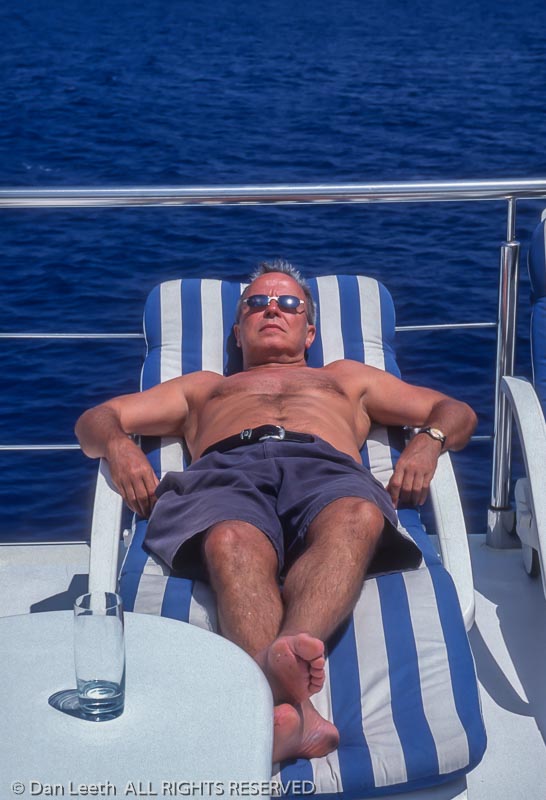
For me, an ideal escape involves a clutch of friends, a teak-decked boat and a sea garnished with picturesque islands. It’s all the better if the isles are Greek, the vessel a chartered yacht and the six chums I share it with promise not to hog the ouzo. Even Aristotle Onassis could not have asked for more.
Fortunately, one does not need Jackie O’s inheritance to rent a crewed yacht. With vessels starting around $5,000 per week, a group of cost-splitting friends can charter a craft for the price of a decent cruise. Granted, the cabins may be more cramped and shuffleboard courts absent, but these amenities pale against the freedom of experiencing the sea unencumbered by fixed itineraries.
We sail from Rhodes, largest of 12 islands in Greece’s Dodecanese chain located near the coast of Turkey. Its major city, also called Rhodes, rose as a Bronze Age kingdom. It became a Greco-Roman art center, and retreating Crusaders made it a fortified stronghold. The city ultimately fell to T-shirt vendors in the 20th century.
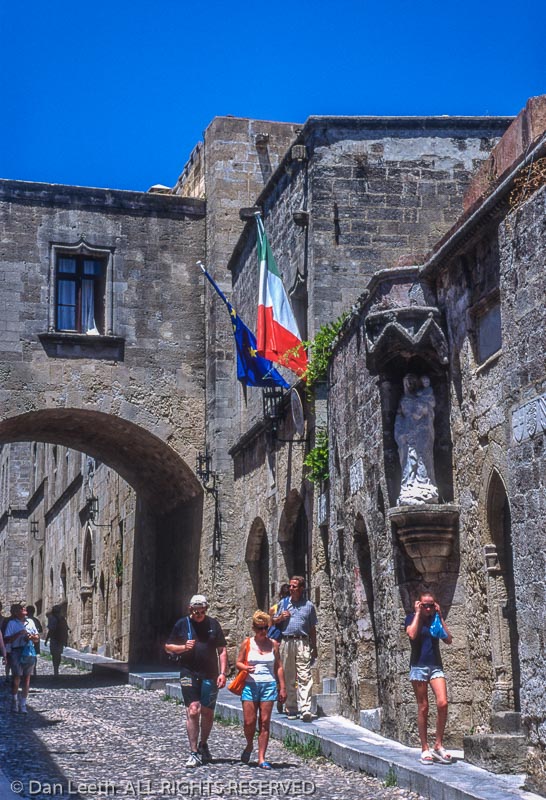
Our vessel awaits outside Rhodes’ Old Town, a city-fortress the Knights of St. John began in the early 1300s. Ponderous walls made from cut rock line cobblestone streets. Arched causeways link stone facades, thick doors fill Gothic portals and turrets tower skyward. I feel humbled by the site’s medieval power.
I also feel crushed by crowds. Waves of tourists chatter in a Berlitz sampler of languages as they follow guides lofting colored pennants. They haggle with merchants hawking wares from sidewalk shops. They queue into columns awaiting entry to the Palace of the Grand Masters. Like a salmon in a spawning run, I become trapped in the onslaught. The boat offers an escape.
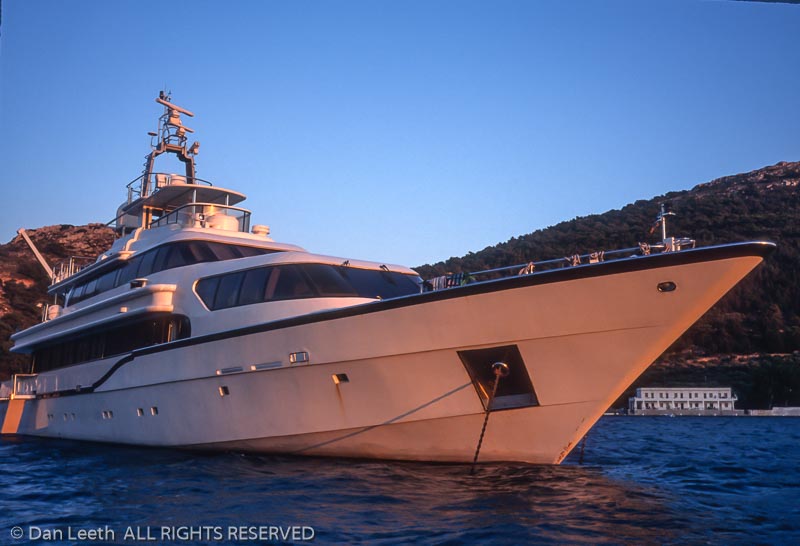
The Carmen Fontana lies moored next to the Sultan of Oman’s yacht. Our more humble craft has five cabins with beds for ten. Its refrigerator holds the beverage supply, a topside deck provides a sunning retreat, and crewmen stand ready to serve meals onboard. The captain fires the engines, and waving good-bye to an unseen Sultan, we motor into the Aegean.
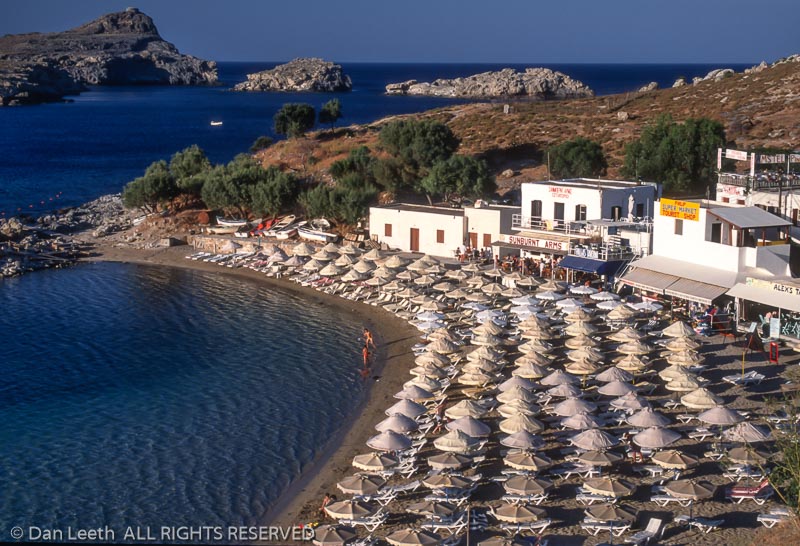
A few hours later, we anchor at Lindos, midway down the island’s eastern shore. Bluffs tower over a community skirted in whitewashed houses. Below lies a crescent of sand covered with umbrellas in such uniform rows, it looks like a military parasol parade. If the orderly Swiss had an ocean, this is what their beaches might look like.
Cars are banned from the hillside village. To reach the cliff-capping acropolis, visitors either walk or ride donkeys. Choosing beast over brawn, I hop into a saddle hard enough to bruise even Zorba’s ample padding.
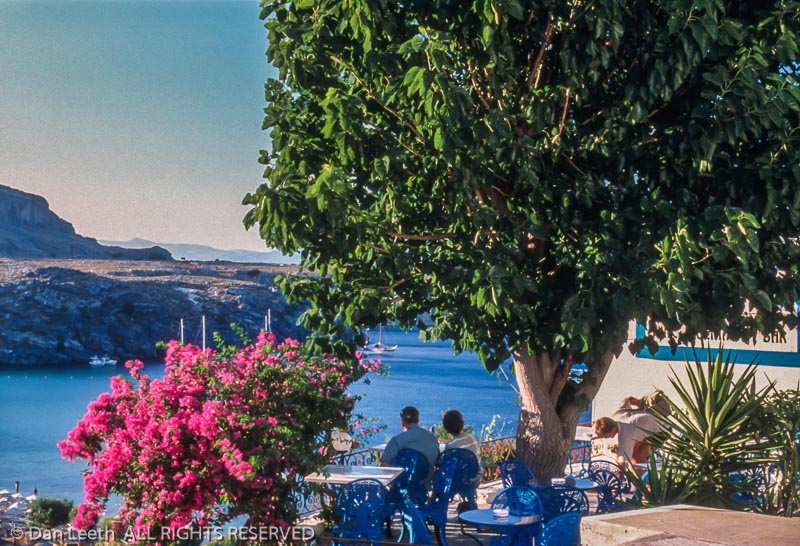
A quiet breeze brushes the summit where Alexander the Great, Helen of Troy and Hercules supposedly once stood. Columns from bygone eras point skyward. Below, narrow streets wind past homes and shops where merchants quietly await business. People sit at outdoor tavernas savoring views with a brew. Carfree and carefree, Lindos offers a serenity absent in the town of Rhodes.
Peals from the town’s bell tells us it’s late, and we need to return to our craft. A three-hour voyage separates us from our next island. The motion of the ocean rocks me to sleep on the journey over.
“Sea travel affects the thyroid differently in each sex,” theorizes my Italian-born friend Roberto Mitrotti. “It makes men more relaxed, which is why they love to sail. Women, on the other hand, get amorous,” he adds, winking at his young American girlfriend. “That’s why they love to sail.”
We dock in Symi, the main village on the island of the same name. Twelve feet from our stern, workmen sit at a taverna drinking beer. If we were any closer, the waiters could offer table service. We dine on the deck, much to the delight of staring locals.
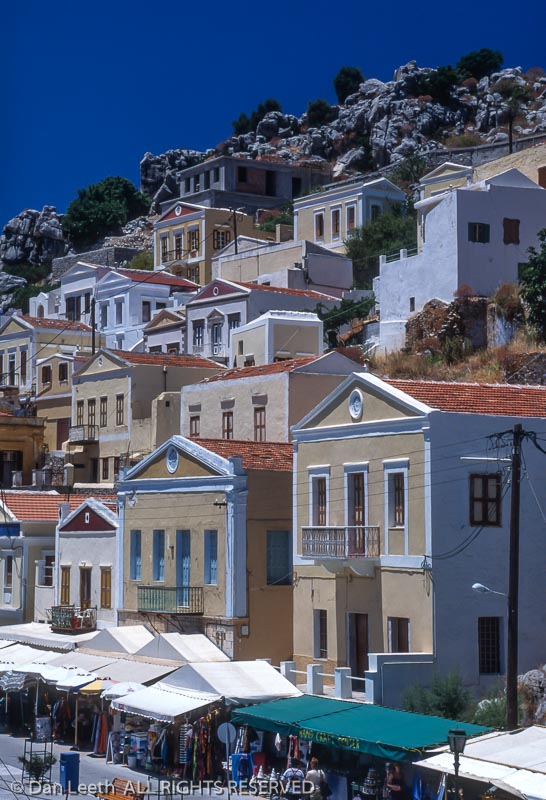
In the morning I go for a walk. Although popular, Symi seems less touristy than Lindos. Two-story pastel homes, once the residences of sponge merchants, round its waterfront. Behind, desert mountains rise toward unblemished skies. Roosters crow, chickens peck and children play while mothers watch. Men ride motorcycles and women scoot by on Vespas. Cars and trucks are few. Tranquility prevails.
Small fishing boats bob in a shallow harbor. Each looks like it was colored with the brightest crayons a child could find. The transparent water shimmers in shades of teal and turquoise. Beyond spreads a sea as blue as unwashed Levi’s. It’s like I’m walking through a virtual tourism brochure.
Our captain, Tasos Dimisetis, joins us for a late lunch. He says he has spent almost 27 years at sea. He was a cargo-ship officer for six and served as a cruise-ship master for another six. Since then, he has captained yachts. When he’s not sailing, he hunts wild boars.
“This guy’s truly a man’s man,” jokes musician Iris Brooks.
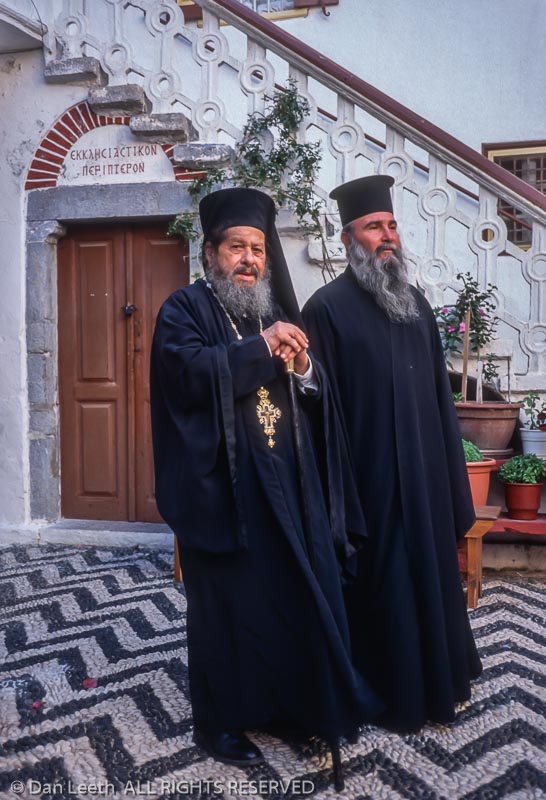
After lunch, we sail to Panormitis on the south side of the island where we visit the monastery of Archangel Michael, patron saint of Greek mariners. A pilgrimage to the sprawling enclave is a ritual for Orthodox sailors. Abbot Gabriel shows us the facilities.
“I have been here 54 years,” the black-robed man says in slow but precise English. “I came after the war.”
He tells us that when the Italians held the Dodecanese during World War II, one of their ships carried both military officers and civilians, including Gabriel. An Allied submarine torpedoed the vessel. Cast to the water, the young man prayed for St. Michael to save him. Six hours later, rescuers arrived. In mortal gratitude, Gabriel dedicated his life to the patron saint of Symi.
A grandmotherly woman serves us cookies and glasses of fig schnapps, a monastery specialty. As we depart, I hear Gregorian chants coming from the chapel. Perhaps it’s the alcohol, but I suddenly feel touched by an archangel.
Yacht life falls into a pleasant routine. We spend the days exploring. Come evening, we nap while the captain sails to new shores. Then it’s time to rise and dine.
At midnight we arrive at Nisyros, a volcanic isle northwest of Rhodes. After docking in the capital of Mandraki, we follow lights to an open-air taverna where late-dining patrons engage in lively conversations. A waiter approaches.
“Do you want your fish cleaned or uncleaned?” he asks. “You know, with the insides still inside?” Considering the options, I choose pork.
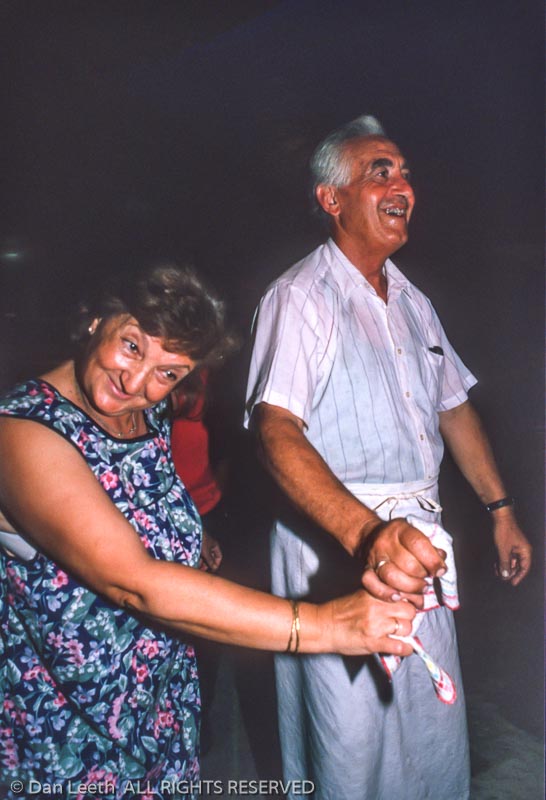
At 1:30 in the morning, dancing starts. The chef and the owner’s wife perform a traditional handkerchief dance, substituting dishcloths for hankies. The festivities continue at the island discotheque.
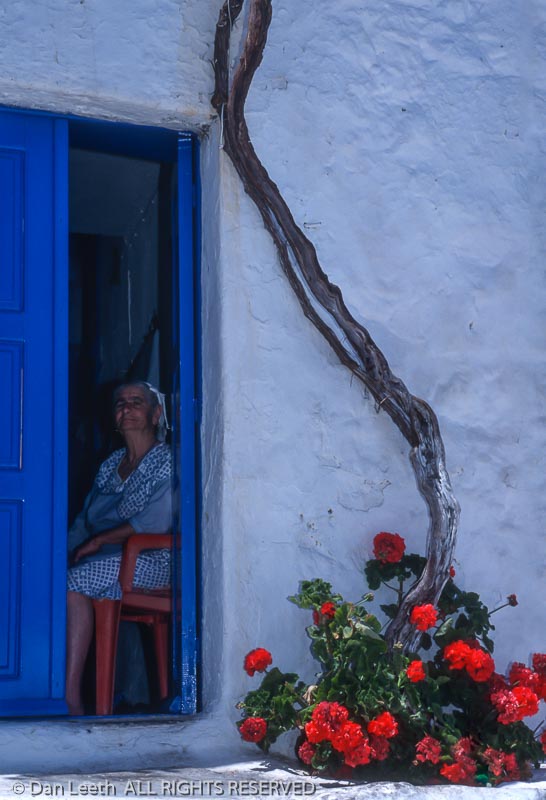
Rising at the crack of noon, the seven of us stumble out for a van tour of the island. We motor up slopes terraced with rock walls and dotted with oak and olive trees. At the top lies Nikia, a hilltop village perched on the crater rim. Its whitewashed buildings sport royal blue doors, shutters and trim. The incense of cook-stove smoke melds with the potpourri of blossoming flowers. Stairs and walkways wind in a maze of routes. It’s the classic Greek Island cliché of stucco and bougainvillea, only here we enjoy it free of shop-swarming cruise commandos.
“There are only about 40 inhabitants left in this village,” says guide Vera Sakka. “Most Niserians have emigrated to Rhodes, Athens or even the United States and Australia. But I stay. I like to open my eyes with a smile.”
Back onboard, we enjoy the advantage of private yachting and vote to overnight again in Nisyros rather than move on. In the disco, the town’s mayor shows up to try convincing us “rich foreigners” into investing in local tourist development. Bailing on the business talk, I walk back to the boat and sit alone on the deck. The night is dark and dead quiet. It’s an eerie silence seldom found in my urban world.
As we sail away in the morning, I watch Nisyros disappear into a blur of blue sky and bluer water. I’m glad I was able to see the island before multitudes overrun its shores and strangle its allure.
We head to the island of Chalki. Now home to only a handful of residents, it was once prosperous with a population of 4,000. Copper came from its hills and sponges from its waters, but the mines played out and the divers moved to Florida. Then the sea infiltrated the water table, making the once fertile landscape barren. Fresh water now arrives by tanker.
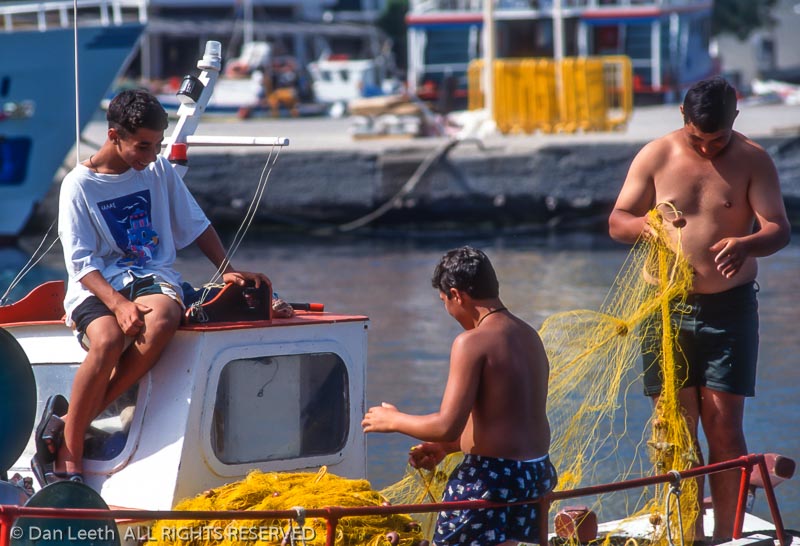
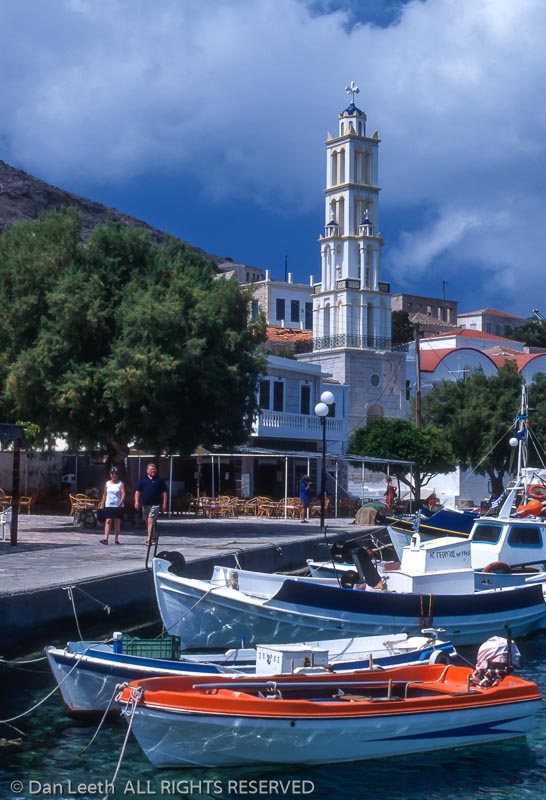
Neoclassical homes line the harbor. In their midst rises the wedding-cake tiers of a church bell-tower. Fishing boats in a rainbow of vivid hues float on water clear as a mountain lake. Their owners work on untangling nets. A quarter-mile away lies the town’s beach where neither umbrellas nor vendors mar the sand.
“My wife and I come here to do nothing,” says Chris Heather, on holiday from England. “It’s a different life. Anything important you must bring with you because there are no shops, no movies, nothing at all.”
Wading the surf, I feel content. The crowded, chaotic world of home has dropped into a distant memory. It’s as if I have been sedated for a week, living a halcyon dream of rest, relaxation and renewal.
We had planned a camping trip to Arizona, but alas, a certain nasty virus got in the way. While camping might be a good way to practice social distancing, getting there and back would involve a fair amount of social interaction. While our intended campground remains open, there’s no telling when state-wide or national quarantines might drop into place.
Problem is, by staying home we have no excuse not to finally get around to cleaning 35 years accumulation of crap out of the laundry room.
I’m a planner. When it comes to activities, I’ve always liked to plan ahead.
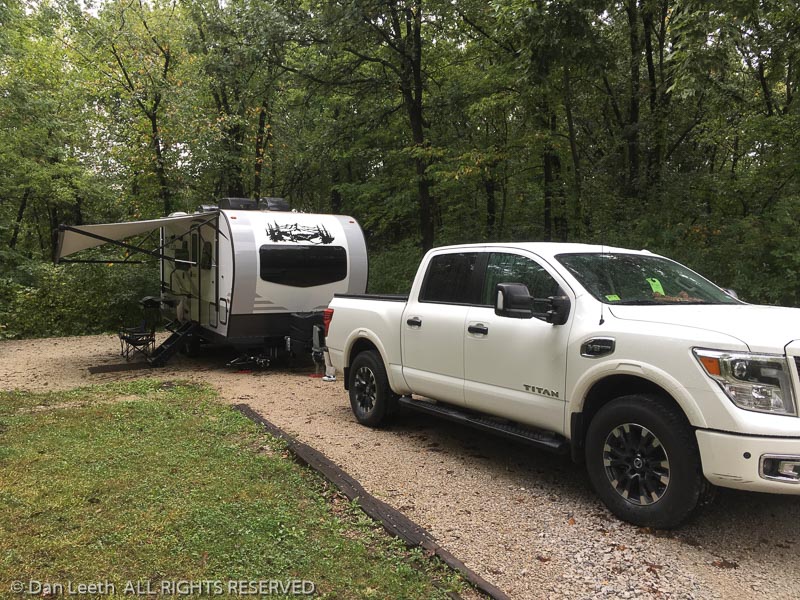
As a hiker/climber/backpacking tent-camper, I’d sit down in the spring and map out every weekend and vacation adventure through the end of autumn and beyond. The need for preplanning got worse when Dianne and I bought a trailer.
In the old days, any place we could park our truck became a potential campsite. Other than an occasional national park stay, we had no need to bunk in formal campgrounds. That’s tougher with the trailer.
These days, we need a nice flat spot to park our motel on wheels, ideally with water spigot nearby. With solar panels and/or a generator, we can go without a power hookup, but a dump station for draining the holding tanks is a handy amenity if we’re staying more than a few days.
We’re not big fans of RV parks where “campers” are parked elbow-to-elbow like cars in a Costco parking lot. We prefer state parks, where sites are typically spaced farther apart and often cloaked in vegetation. For most state parks, ensuring a site requires making a reservation sometimes up to a year in advance.
The problem with planning one’s life that far ahead is that as Forest Gump pointed out, sometimes “stuff happens.” Take the latest pandemic, for example. By the end of 2019, I had our camping for 2020 totally scheduled, with campsites reserved through late September.
We’re now rebooking things. We had a long-planned trip with friends to an Arizona state park in April, timed so that we would be there for their annual wine and food tasting event. We had to cancel one week before departure when Colorado was put on a shelter-in-place lockdown. We rescheduled our reservations for October.
This week, another trip bit the dust. We were planning to meet some friends at a trailer rally in South Dakota in mid-June with stops at a Nebraska state park on the way up and a week-long retreat in the Black Hills on our way back. That trip will now be held next year, virus-permitting. Instead of South Dakota, we found a site still open at a Colorado state park and booked it for the same time period.
A late-May trip to Robb State Park in Grand Junction, Colorado, is still on our calendar at this point, although the scope of the trip has changed. As baseball fans, we originally planned to attend a few games of the Junior College World Series while we were there, but that event has, of course, been cancelled. If the campground reopens, we’ll still go and just do a lot of hiking instead.
Beyond that, we still have campsites reserved for July in Colorado. In mid-August, we have reservations for a six-week swing down the Left Coast with stops at state parks in Oregon and California with a couple of weeks camped in the redwoods before continuing on for our rescheduled Arizona trip.
While we may not be camping in the trailer, I am taking the time to “improve” our motel-on-wheels. In the next few weeks, I’ll be installing an upgraded toilet, reinforcing the bumper, moving the spare tire to below the frame and bolting on a receiver for a bike rack. I’ll probably be replacing the refrigerator thermistor with an adjustable version, installing a pair of solar panel inputs at the rear of the trailer and adding a sliding silverware drawer.
I’m also thinking about spending our covid-incentive on upgrading my factory power center converter/charger with a Progressive Dynamics unit and replacing a pair of anemic, lead-acid batteries with a 200-amp lithium-ion unit. That will allow us to boonie-camp for longer periods without needing to pull out the solar panels or fire up the generator.
Now, if we could just solve the need for a dump station, but unfortunately, Dianne is too excited about using that new, upgraded toilet for that ever to happen.
The Most Exciting Way to Experience the Grand Canyon May be in a Wooden Boat
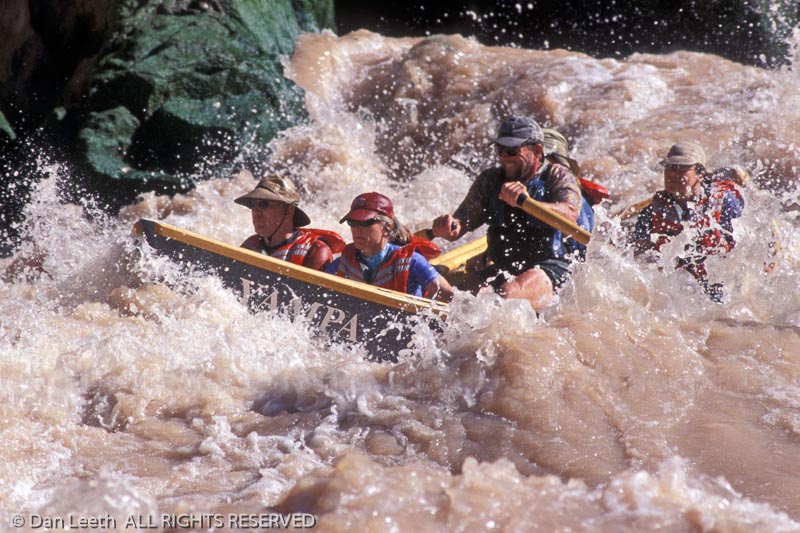
Like a liquid freight train that’s jumped its tracks, the entire flow of the Colorado River careens toward the canyon’s far wall. Beyond, it shakes and churns down a channel choked with submerged boulders. Between those rocks and the hard place froths enough hydrological mayhem to flip the Queen Mary.
Expedition
leader Bill Bruchak guides our tiny boat toward the left side of the flow. With a series of hefty pulls, he rows stern-first
into the agitated bedlam. Engulfed in
turbulence, Bruchak yanks an oar, and we pirouette to go with the current.
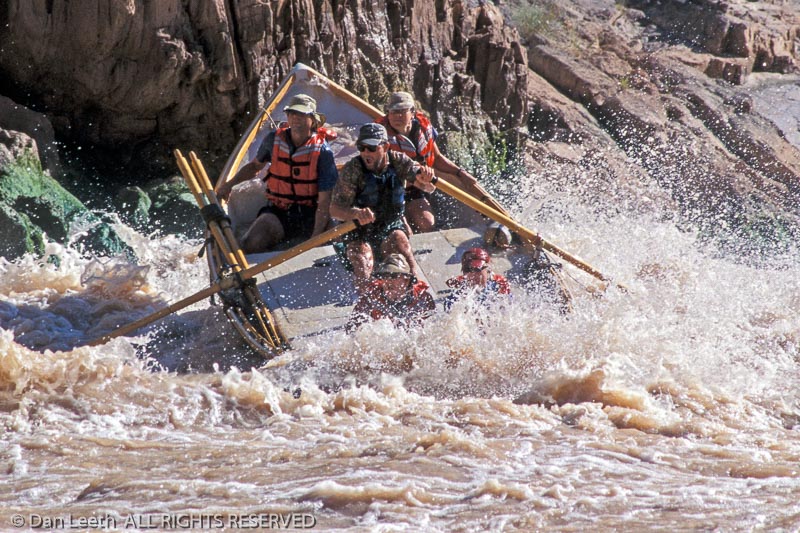
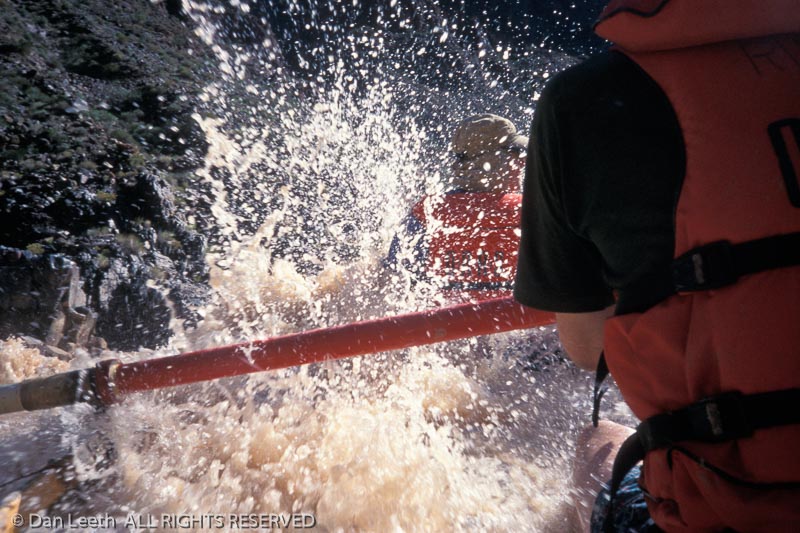
Ahead stands a wave taller than a suburban tract home. As we graze its side, water arcs down, filling the foot wells 15 inches deep. A series of rolling tail waves follow. Like the mechanical bull at Gilley’s, the boat bucks through each swell with all onboard screaming “HEE-HAW!”
We finally
reach the eddy at cataract’s end, and I’m beaming. House Rock Rapid has just given me an exhilarating
taste of how dories cruise through white water.
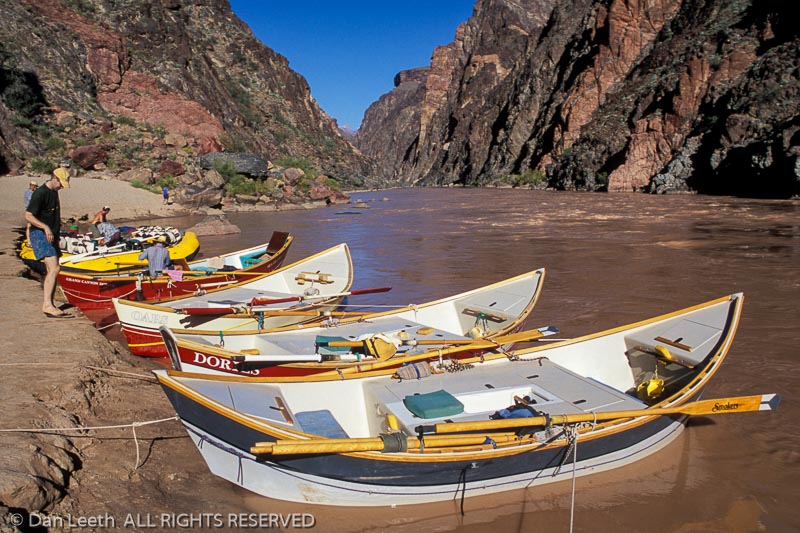
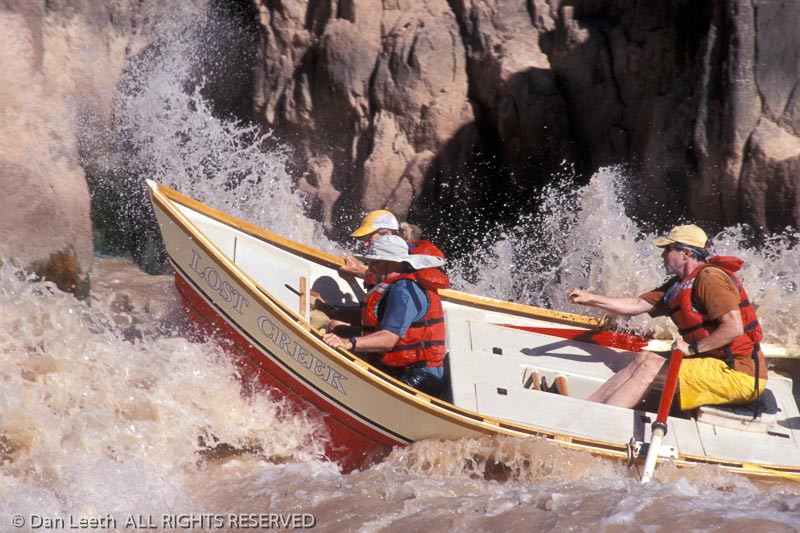
The
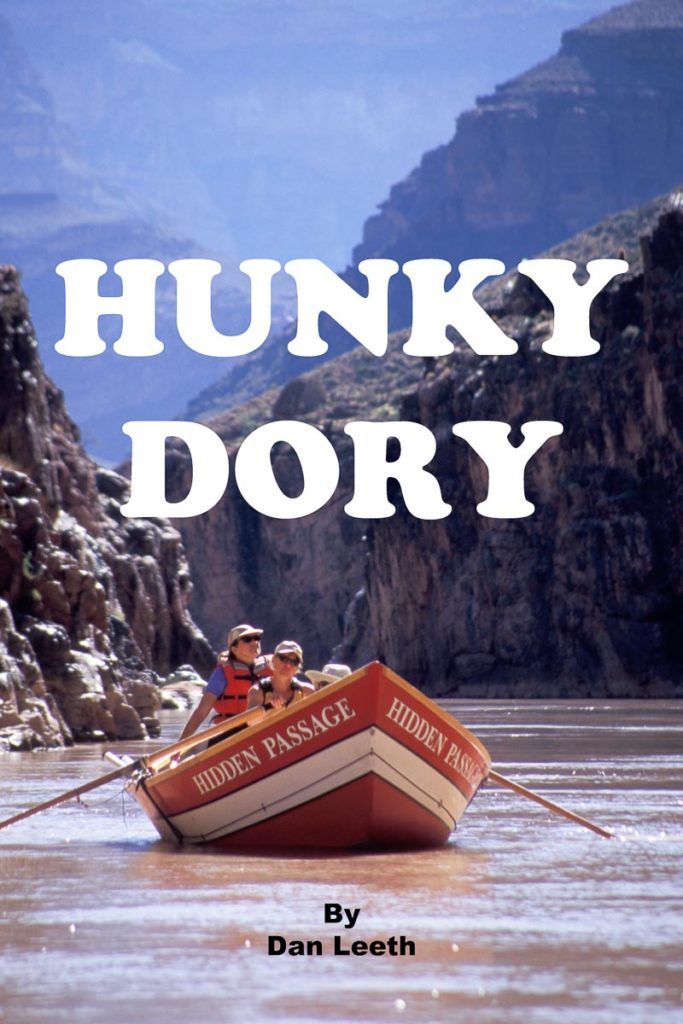
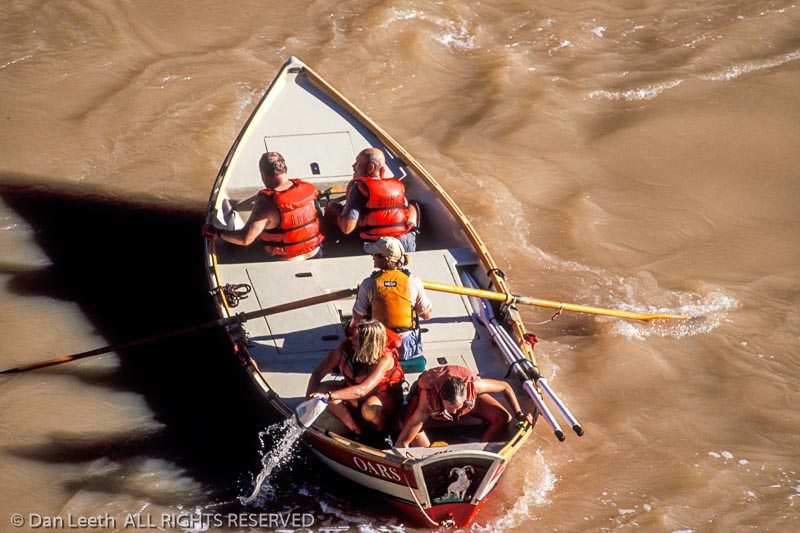
sports cars of commercial river running, dories are made from wood, foam and
fiberglass. They stand about 18 feet long,
56 inches wide and comfortably hold four passengers and an oarsman. A flat bottom and upturned ends make them
easy to steer on the river, and because they have rigid hulls, they don’t flex
with the waves as rubber rafts will.
Instead, a sharp prow splits the water in a way that makes even riffles
exciting. Unlike inflatables, however,
these rigid-walled craft can crack on rocks, so dory drivers must carefully
plot routes through rapids.
“They’re
a royal pain sometimes, but they’re worth it because of the ride you get,” says
guide Shawn Browning.
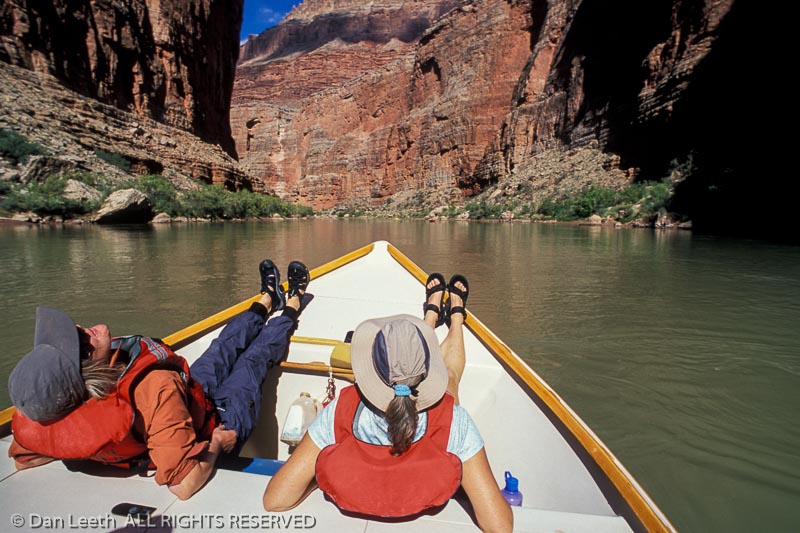
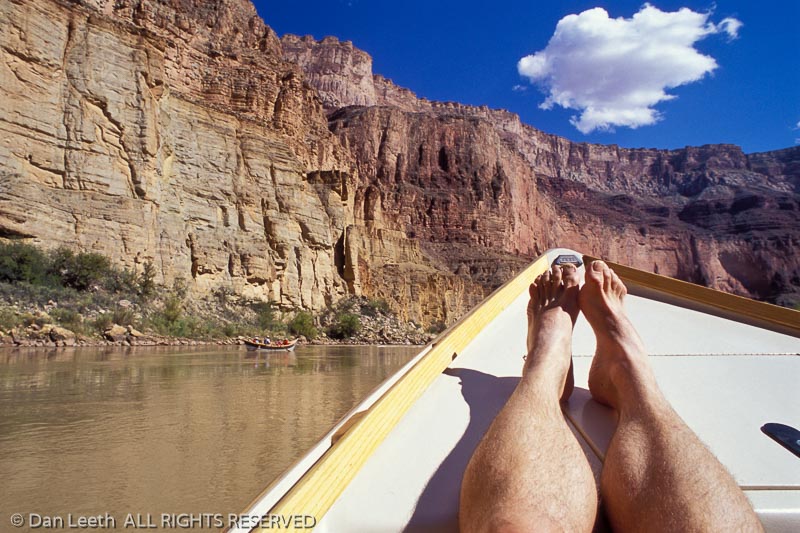
On this Grand Canyon Dories journey through the length of the canyon, we have four boats for 16 clients, rowed by a three-man, one-woman crew of seasoned guides. The bulk of our gear travels onboard a pair of oar-powered baggage rafts.
Our first
camp lies on a riverside beach two miles below the rapid. In a drill that’s repeated for 17 nights, everyone
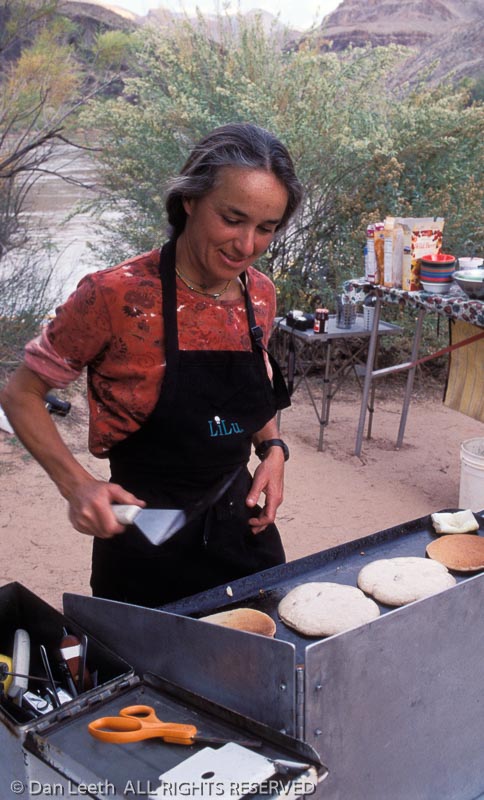
first unloads gear and waterproof “dry bags” from the rafts. While we seek sleeping sites, the cooking team
begins preparing a fresh-food dinner in a portable kitchen, complete with
propane stove and lantern. The boatmen assemble
water-purification and hand-washing stations, then find a secluded yet scenic
spot for the portable potty. Nicknamed “The
Unit,” this toilet-seat-on-an-ammo-can offers a throne with a view.
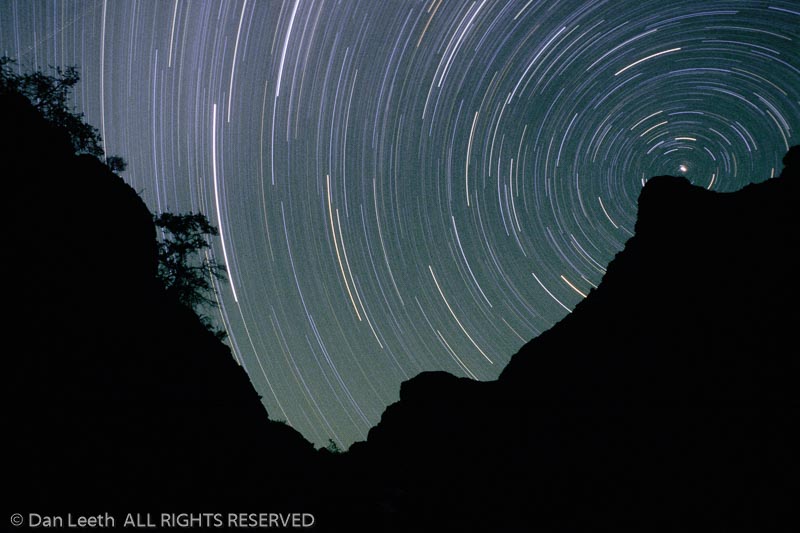
We spend evenings circled around a campfire. The Milky Way shimmers overhead, its luminescence painting the gaps between inky canyon walls. Civilization fades far away.
Most
mornings, I awaken to the descending notes of a canyon wren. After coffee and a hot breakfast, we load
boats and head downstream. Calm current and
raging white water await.
Rapids
occur near the mouths of side canyons where flashfloods have washed rocks and
rolled boulders into the river. We porpoise
through most like dolphins on pep pills.
If the boat hits waves straight on, the prow shoots high into the air with
nothing but blue above the bow.
Grand Canyon cataracts are rated on a 10-point technical scale,
with “one” being a dancing riffle and “10” a slobbering ogre ready to devour
anything floating through. I soon
develop my own “fun-factor” rating system based on how many inches of water
occupy the foot well at rapid’s end.
Although pros operate the oars, dory passengers play a part in running rapids. We are responsible for “high siding,” a weight-shifting maneuver that helps keep the boats from tipping.
“If a big
wave’s coming right at the side of the boat, you want to lean into it,” says guide
Elena Kirschner. “That means you’re
going to get wet and cold, but it’s a lot less wet and cold than swimming in
the river.”
Fortunately,
dories seldom flip, and unlike rafts, they are easy to turn right-side up. None of ours tip over, but a private raft
trip that launched the same day we did experiences several upsets.
“There’ve
been some deaths on the river by drowning and being hit,” says Martin Litton,
the man who introduced dories to the canyon.
“Nearly all of them have occurred in inflatable rafts.”
In 1869,
Major John Wesley Powell led the canyon’s first float trip in wooden boats. Built for straight-line speed, his craft proved
unwieldy in rapids. Other river runners followed,
each generation improving its predecessor’s designs. It took almost a century for dories to reach
the canyon.
“I’d seen
these McKenzie boats in Oregon
made out of plywood,” explains Litton. “We
got a builder to craft a couple of hulls, and in 1962 we made the first trip in
dories.”
Litton
soon began annual river-running vacations, taking along friends, friends of
friends and people he’d never seen before.
To keep from going broke, he started charging $180 for his 21-day
trips. In late 1968, he quit his senior
editor job at Sunset magazine.
“I just
walked out,” he says. “From then on, I
was in the business of running river trips.”
His company, Grand Canyon Dories, became a leader in the burgeoning industry of white-water river running. In the late 1980s, Litton sold the operation to O.A.R.S., which continues to offer a full schedule of trips.
If rapids
provide the river’s caffeine, flat stretches are its herbal tea. In the calm between the cataracts, we relax
as oars stroke the water in metronome rhythm.
Great blue herons stand by the shore watching our passage. Bighorn sheep gaze down from above. Rock walls reach upward, their colors and
textures revealing the canyon’s geological history. We float through nature’s gallery, displayed
at its artistic best.
“If this
was all flat water, I’d like it just as much,” admits baggage-boat oarsman Kurt
Brooks.
Although
we stop at the canyon’s famous spots, it’s not the guidebook highlights that prove
most memorable. It’s the secret places. We climb to overlooks and hike side canyons
to waterfall grottos. We see where
geologic faults have bent rock as if it was made of taffy. We examine prehistoric petroglyphs,
pictographs and Indian ruins, as well as remains left by miners, railroad
surveyors and would-be dam builders.
Conventional
civilization lies in abeyance. Only on
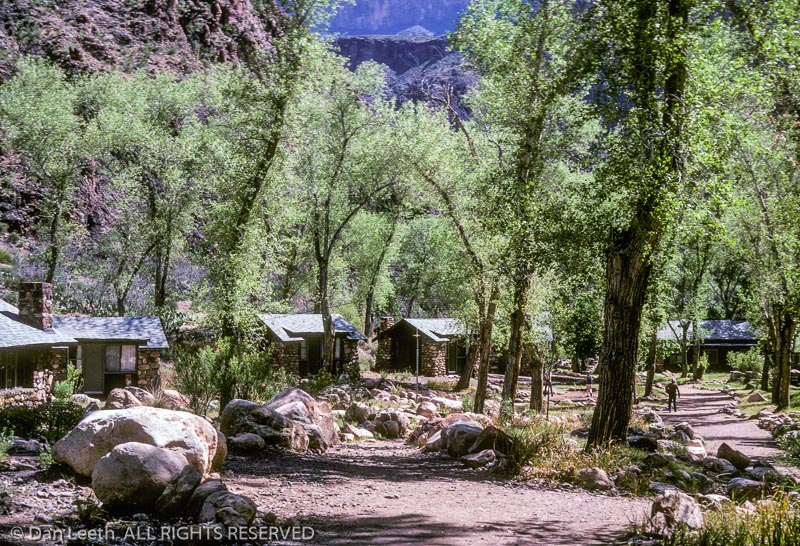
day eight when we reach Phantom Ranch, an inner-canyon lodge, is our wilderness
interrupted. There, surrounded by hikers
and mule riders, we buy lemonade, T-shirts and postcards. Escaping back into the wild, we camp for the
night below Horn Creek Rapid, one of the canyon’s more challenging cataracts. The worst lie ahead.
The next
day, we cover what Bruchak claims is “the biggest navigable water for a dory in
North America.” In 23 miles we navigate 16
named rapids that include several of the canyon’s gnarliest. I ride with Browning.
After breezing through Salt Creek Rapid, we hit Granite, a boiling pot of froth and turbulence. Browning aims down the tongue, but misses the line by a few inches. Nipping “the crasher,” he spins around. Suddenly, we’re rushing stern-first toward a very hard wall.
“Schist!”
I shout, naming the rock strata lying dead ahead.
Browning
pulls the oars with every adrenaline-packed ounce of energy he can muster. But the river is stronger.
WHAM! We hit with an impact that would make a demolition
derby driver wince. The collision spins
us again so we’re now moving forward. Browning
catches the current, and we finally jolt out the bottom of the rapid. Opening the stern hatch, I expect to see a
Titanic-size hole, but it’s dry. We’re
only bruised, not busted.
“Yikes, that was close,” Browning says in what
may be the understatement of the day.
Downstream,
we ride Hermit’s 35-foot-tall wave train without incident. After an inconsequential run through Boucher,
we arrive at Crystal. Once, this was little more than a riffle, but
a 1966 flashflood choked the river with debris, forming one of the canyon’s most
gut wrenching cataracts.
“At high water, Crystal is a difficult rapid with dire consequences if you blow it,” says Browning. “We’re at medium-low water, so we’re going to do what is called the left run. It’s big.”
We
pull into the current, nipping the edge of a gaping hole. Water crashes down. Like Niagara
Falls hitting a teacup, the boat fills from gunwale-to-gunwale
rendering it too heavy to maneuver. Boat-shredding
boulders loom below.
“BAIL!” Browning
cries. “BAIL! BAIL!”
We begin
madly flinging water over the sides. Our
compatriots say it looks like hoses spraying from a fireboat. We lighten the craft enough to safely negotiate
the final white water. At the bottom, we
mercifully say our ABCs – Alive Below Crystal.
After
lunch, we plow through a succession of cataracts, missing walls, rocks and
holes. It’s a repetitive cycle of
anticipation and anxiety followed by jubilation and relief. If the dories are sports cars, this is their Le Mans.
I fall asleep, confident that our spunky guides and spritely craft can handle anything the canyon throws at it. That’s good, because the most feared rapid lies three days downstream.
Once, molten
magma dammed the Colorado, but the relentless river eroded away the impediment,
leaving only a surging drop called Lava Falls in its wake. While not the most technically upsetting
rapid, it’s the one that drives more boatmen to hit the Maalox.
“Every
time I make that turn and hear the roar, my heart jumps 15 beats faster,” says Bruchak,
with whom I ride today.
The
cataract looks like a blender churning milkshakes in the river. We slowly approach the lip of the cataclysm
like condemned prisoners on a gurney.
“Hang
on,” he says. “We’re getting close. Get ready!”
We teeter
at the brink, then swoop into the Cuisinart chaos. A ledge to the left has formed a gaping maw
in the river. Bruchak pulls the dory to
the edge of it, gaining momentum.
“Get
ready! Big one!”
We sever
a lateral wave and slice down to where two currents rush together to form a bulging
V-wave. The bow rises. Water flies.
We bounce like an ice cube in a martini shaker.
“Bigger
one coming! Hang on! BIGGER ONE.”
We plow
through a second, larger V-wave. Torrents
crash by the boat’s bow. I grip the
gunwales so tightly, I expect to leave indentations in the hardwood. We bound, bounce and bash through the rapid’s
gut, finally exiting through the tail waves.
Nine seconds
after it began, it’s over. Bruchak pulls
into the eddy and everyone breathes a triumphant sigh of relief.
“There’s
no place on the river like that,” he exclaims, grinning.
I look at the bottom of the boat. Only four inches of water slosh in the foot well. Maybe Lava Falls isn’t so bad after all.