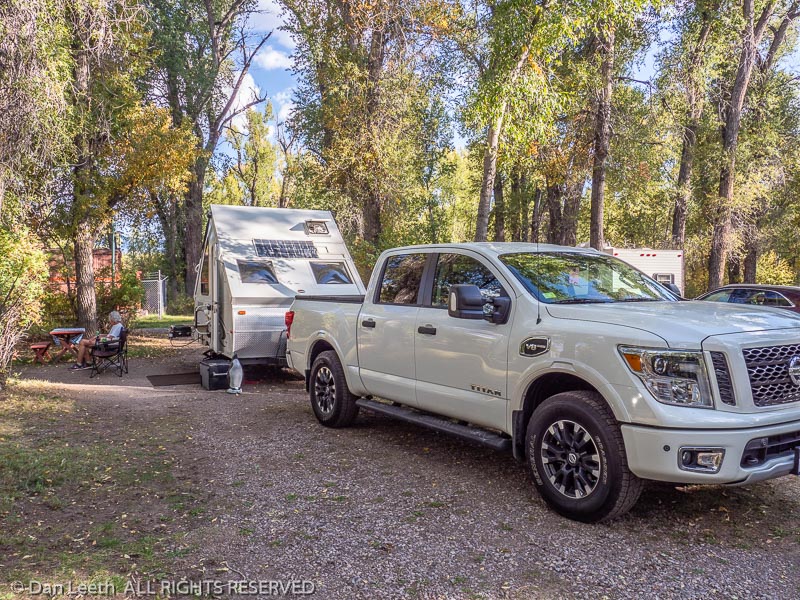
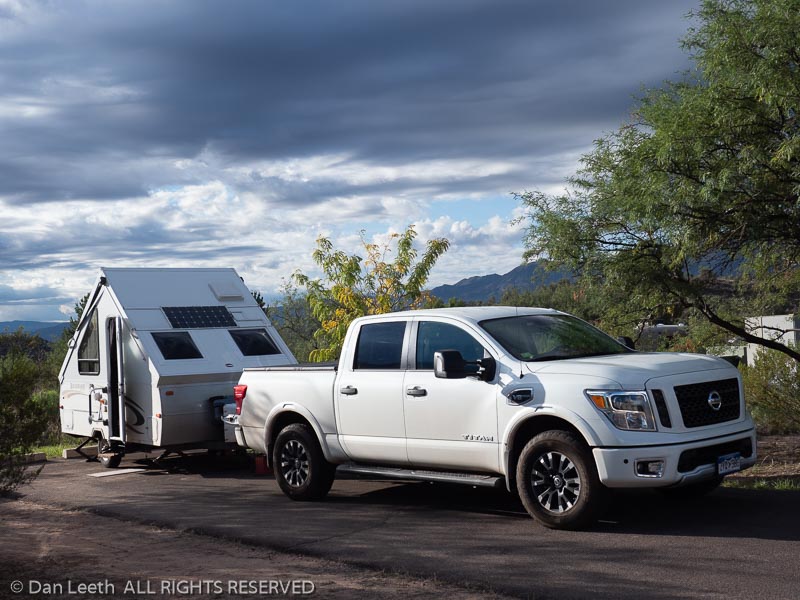
We’re off on what should be our final journey in our A-frame trailer.
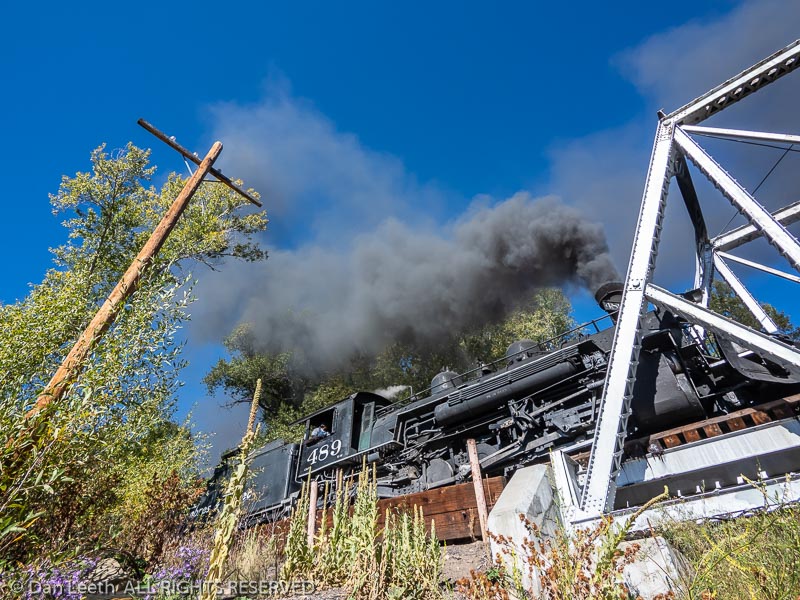
Our first stop is in Chama, New Mexico, where we will be photographing the Cumbres & Toltec Railroad trains in brilliant fall color. Then it’s off to Homolovi State Park, Arizona, which lies near Petrified Forest National Park and the Painted Desert.
From there, we head north to Capitol Reef National Park, Utah. After a few pies there, we’ll be off to the North Rim of the Grand Canyon with a two-night stopover at Coral Pink Sand Dunes State Park on the way.
From the Rim, it’s south to Dead Horse Ranch State Park in Arizona’s Verde Valley. After that, we head for two weeks at our favorite Arizona state park, Lost Dutchman, near Apache Junction.
Then it’s home by way of my favorite KOA in Bernalillo, New Mexico, which has a brew pub next door.
When we get back home, we’ll have a new Flagstaff Micro Lite box trailer waiting for us. Unlike our A-frame, it will have a big refrigerator/freezer, a bathroom with a Motel 6-worthy corner shower and holding tanks for wastewater. No more camping! We’ll become members of the mobile-motel crowd.
Dianne says no, we will still be “camping.” She just won’t have to crawl on the floor to get into the refrigerator and I won’t have to crawl over her comatose body to get out bed in the middle of the night.
One thing for sure – unlike other members of the mobile-motel crowd, we won’t be walking poodles and we won’t be sitting in front of a TV at night!
So, you might wonder, after six seasons and 400 nights spent camping in our trusty A-frame trailer, why will we soon be swapping it for a conventional box trailer. Let me explain.
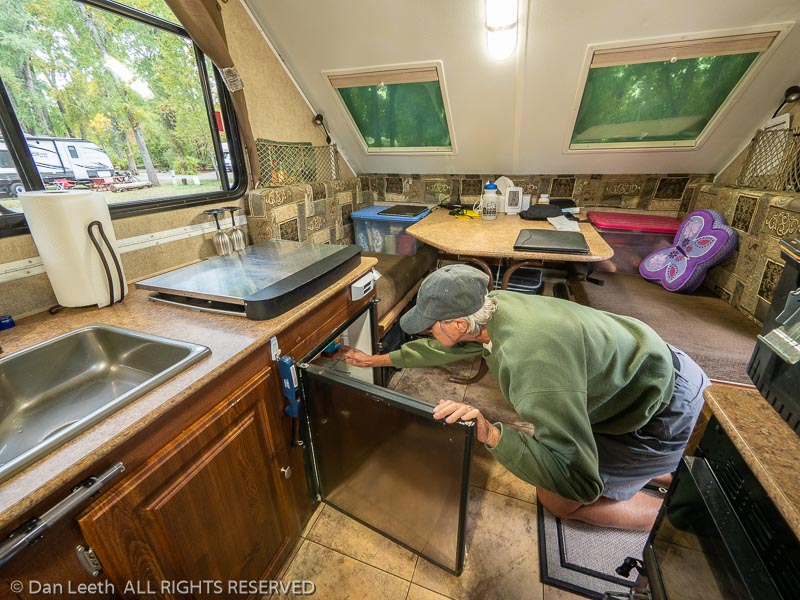
It’s all my wife’s fault. Because the trailer folds down, the refrigerator is only of half height. And Dianne has bad knees. She can’t kneel. To get anything out of the fridge (like fetching another beer for her loving husband), she has to drop to her knees and crawl to the refrigerator door. “That’s getting old”, she says.
Then there’s the bed. It goes crossways across the back of the A-frame trailer. To get up in the middle of the night, he who sleeps on the back side has to crawl over she who sleeps on the front. “That, too, is getting old”, she says.
And then there’s the time it takes to get moving in the morning and setting up in the afternoon. Erecting the top takes 90 seconds. Moving boxes of food and luggage around (and everything else that is required to set things up) takes Dianne an hour or more. “That’s fine if we’re staying in one place for a longer period. It’s not great, however, for traveling when we’re staying in one spot for only a night” she says.
Yes, we might claim it’s because we need more room and storage space for our travels, but when all is said and done, the truth is that my loving wife just wants a new trailer.
We’re on day six of a 12-day camping journey to Chama, New Mexico, where we’ve spent every day chasing trains. It’s all for an upcoming story on the Cumbres & Toltec Scenic Railroad for Colorado Life Magazine.
Our camping spot is the Rio Chama RV Park, which lies next to the tracks. Every morning, we campers gather and wave to (and photograph) the outbound train. Every afternoon, we gather and wave to (and photograph) the incoming train. Starting Tuesday we’ll be on the trains waving to the campers as we ride past on four consecutive journeys.
Yes, it’s a tough job, but as they say, somebody has to do it.
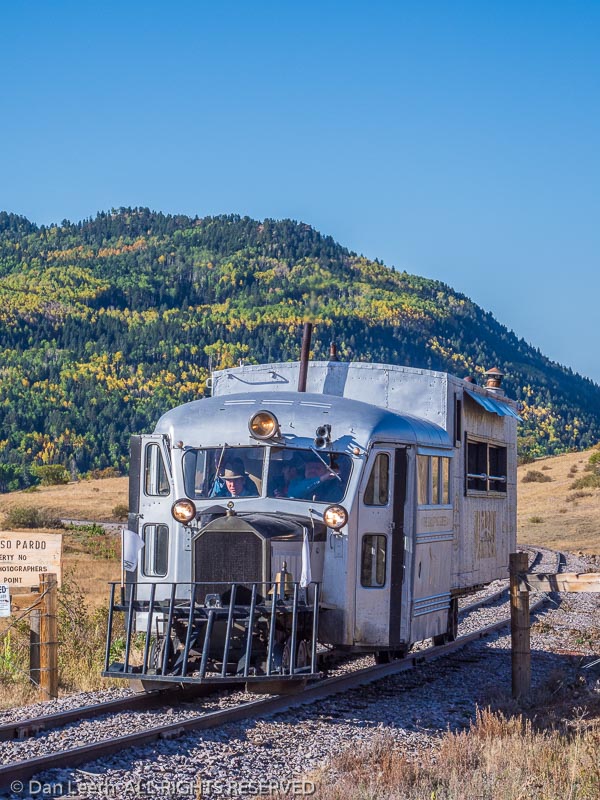
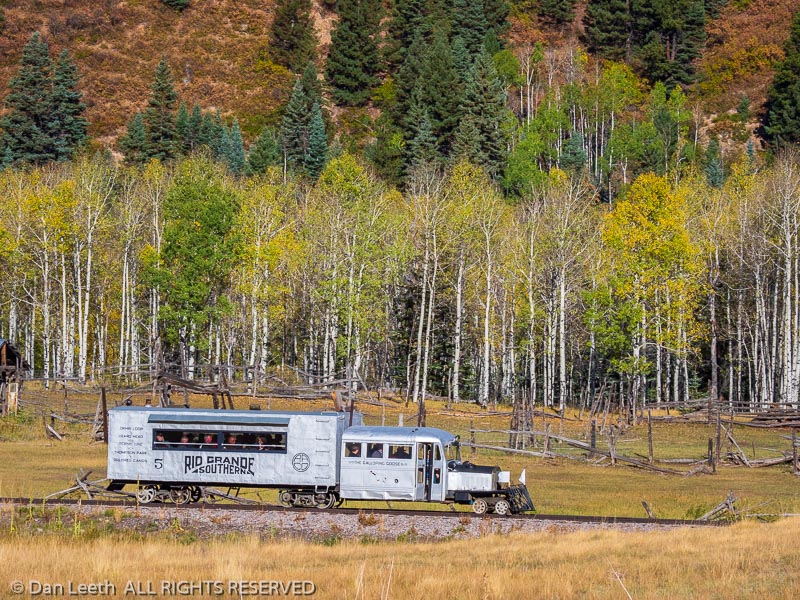
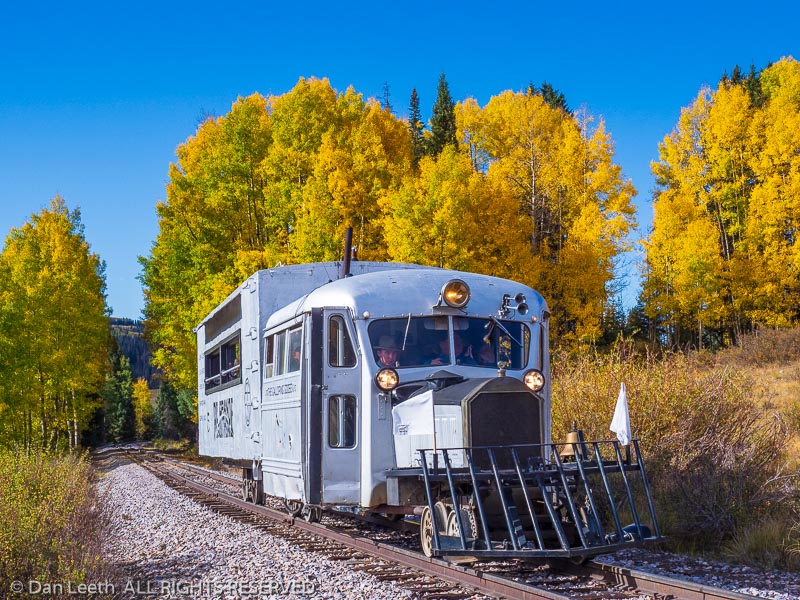
We’ve spent the last week photographing the steam trains of the Cumbres & Toltec Scenic Railroad out of Chama, New Mexico, for an upcoming Colorado Life Magazine story. Today our photos went fowl as we began shooting recently arrived Galloping Goose Number 5.
For folks not aware of these birds on rails, let me explain. The Galloping Goose is a car-on-rails contraption cobbled together in the 1930s. It and a half-dozen of its nest mates kept the Rio Grande Southern Railroad (RGS) in business during the Great Depression and beyond.
Running from Durango to Ridgway, the RGS served the mining communities of Rico, Ophir and Telluride. The railroad was the most effective way to get mail, cargo and people to those remote communities, but with the economy sputtering, the cost of running steam locomotives over the mountains often exceeded income earned.
RGS employees in Ridgway came to the rescue. They converted an old car body into a rail-mobile sporting an auto frontend and a truck bed in back. Burning cheap gasoline and needing only one person to operate, their Frankensteinish creation immediately proved profitable. Six more were soon hatched.
Waddling down the tracks with engine covers flapping and horns sounding like goose toots, the machines quickly garnered their waterfowl nickname.
The galloping flock kept profits aloft for two decades. While other railroads experimented with gasoline-powered rail cars, none ever served so long in revenue service.
When the RGS finally lost their mail contract in 1949, they tried to operate as a scenic passenger line. The plan failed. The railroad folded and the Geese flew the coop.
Surprisingly, all but Goose #1 (which was scrapped in the ‘30s) remain today. Goose #4 rests in downtown Telluride and Goose #3 winged its way west to Knott’s Berry Farm in California. Geese #2, #6 and #7 all nest at the Colorado Railroad Museum in Golden, and a faithful recreation of Goose #1 now occupies the Ridgway Railroad Museum.
Goose #5 resides at the Rio Grande Southern Railroad Museum in Dolores when it’s not on the road. For the rest of this week, it will be plying the Cumbres & Toltec tracks. Our ride, which will mark the third time we’ve ridden the Goose, comes tomorrow.
Galloping through glades of golden aspen should be pretty spectacular.
We just completed a dozen nights in Chama, New Mexico, doing research and taking photos of the Cumbres & Toltec Scenic Railroad for an upcoming Colorado Life Magazine feature.
Lesser known than its Durango & Silverton counterpart, the Cumbres & Toltec runs on 64 miles of narrow-gauge tracks between Chama, New Mexico, and Antonito, Colorado. From Chama where we camped, the first part of the route ascends a four-percent grade to the top of Cumbres Pass. From there, it’s a long descent through Toltec Canyon to the San Luis Valley and on to Antonito.
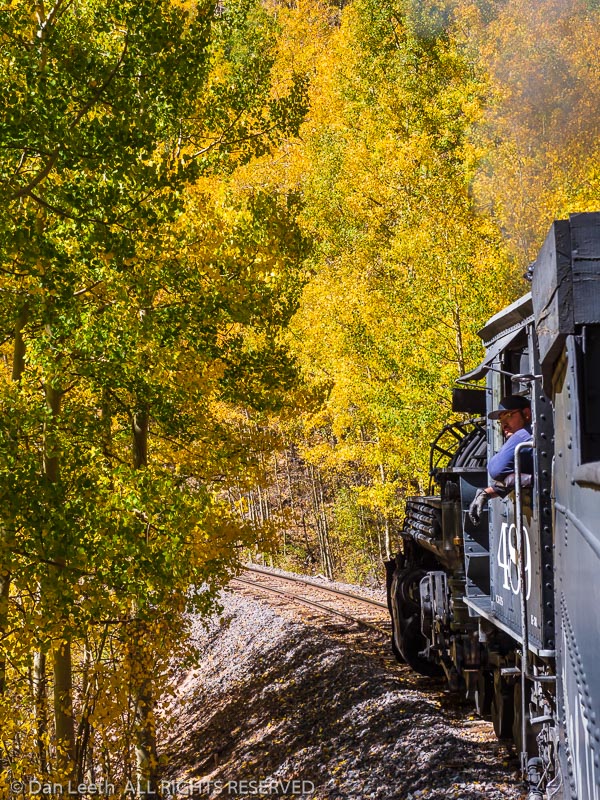
Where the D&S traverses a wilderness canyon, the C&T stays high, offering panoramic views of aspen-cloaked hillsides studded in brilliant gold at this time of year. It rivals the best fall color we’ve ever seen in the Rockies.
The train ride takes 6+ hours to ride from end to end, with an hour-long bus ride to the starting or from the ending point. A full lunch is provided at Osier, an old station house located in the backcountry. Best of all, beer is available for purchase onboard.
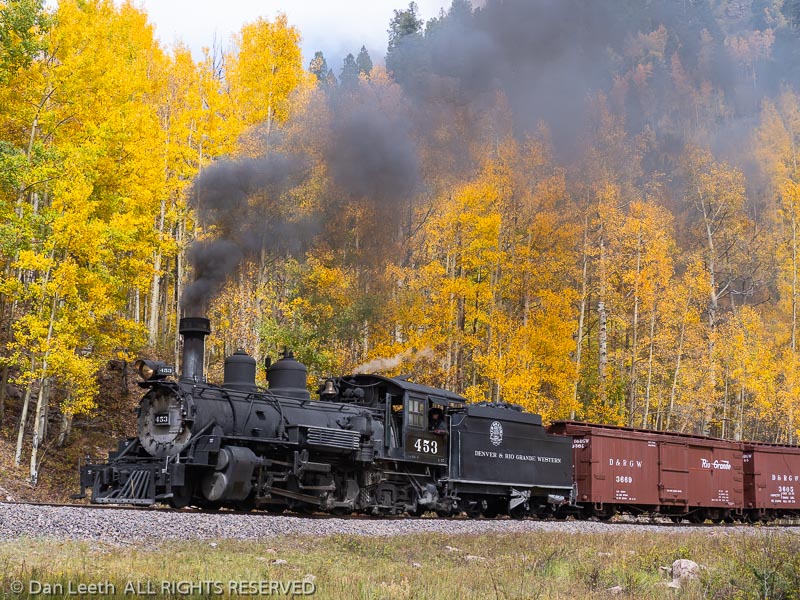
We spent several days chasing the train, taking photos from sites we could reach by car or short hikes. We then enjoyed two days riding the train from end to end and one day riding Galloping Goose #5 from end to end. Our final day was on a Friends of the Cumbres & Toltec photo-shoot featuring freight-train cars being pulled by a steam locomotive still bearing the old Denver & Rio Grande Western name.
We just celebrated our 365th night of camping in our trusty Rockwood A-frame camper. That’s over six seasons. Not bad when you consider that over the first year and a half, my wife, Dianne, was still afflicted with the curse of full-time employment.
Here’s a breakdown of the types of spots we parked for the night:
119 nights in U.S. state park campgrounds
33 nights in Canadian provincial park campgrounds
55 nights in U.S. national park campgrounds
29 nights in Canadian national park campgrounds
42 nights in Forest Service campgrounds
17 nights in Corps of Engineers campground
6 nights in BLM campgrounds
2 nights in county park campgrounds
2 nights boonie camping in the forest
3 nights parked on the curb in front of Dianne’s sister’s house
57 nights in commercial RV parks
We’re outdoors people, so spending a third of our camping nights in state parks was not surprising, nor was the number of nights spent in national parks/monuments.
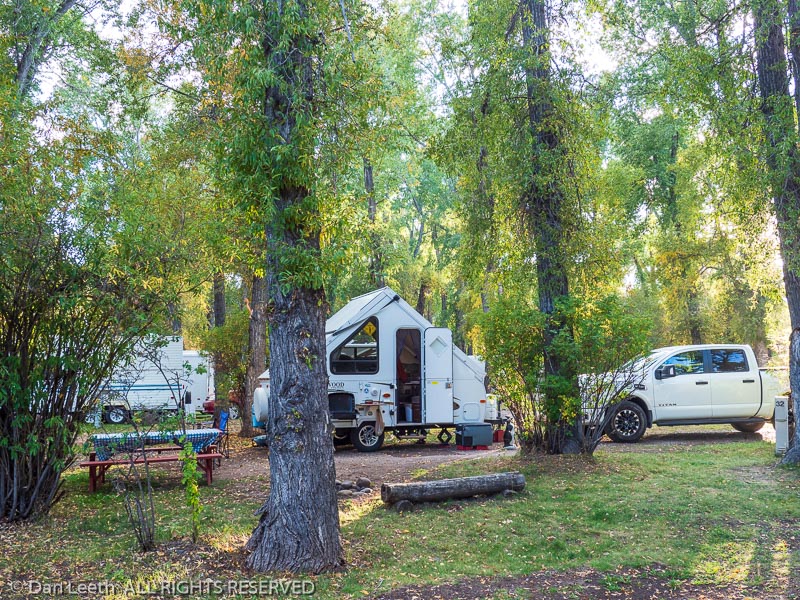
What was sobering were how many nights we overnighted in commercial RV parks. They’re not our first choice of places to camp, but some have been quite nice. We just spent a very pleasant dozen nights at the Rio Chama RV Park (see photo) in Chama, New Mexico, and in the springtime enjoyed a five-night stay at the View RV Park and Campground near Dolores, Colorado. A pair we stayed at in Canada were formerly wooded city park campgrounds.
And then there’s our favorite KOA in Bernalillo, New Mexico, which lies adjacent to a nice little brew pub. We’ll hit that again on the way home from this trip.
After a dozen nights camped in Chama, New Mexico, it was time to head west to Homolovi Ruins State Park near Winslow, Arizona, where we’ll be camped for a week.
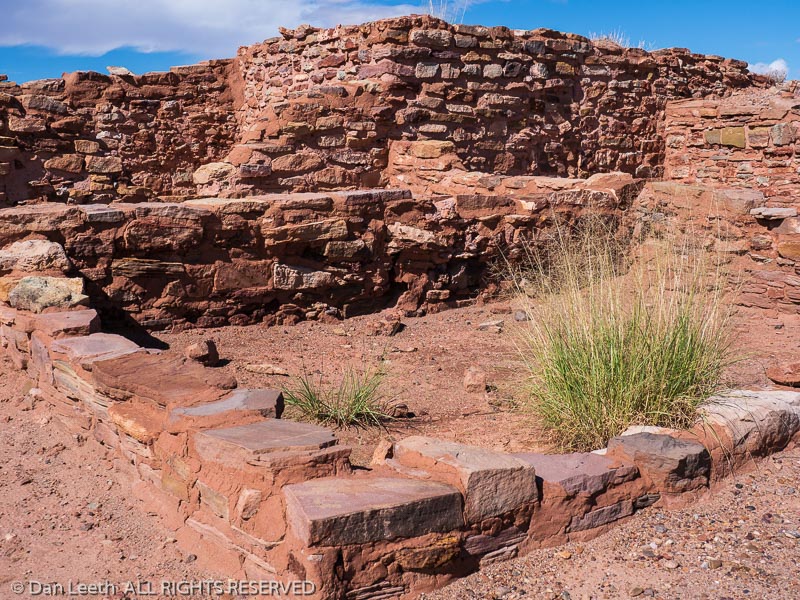
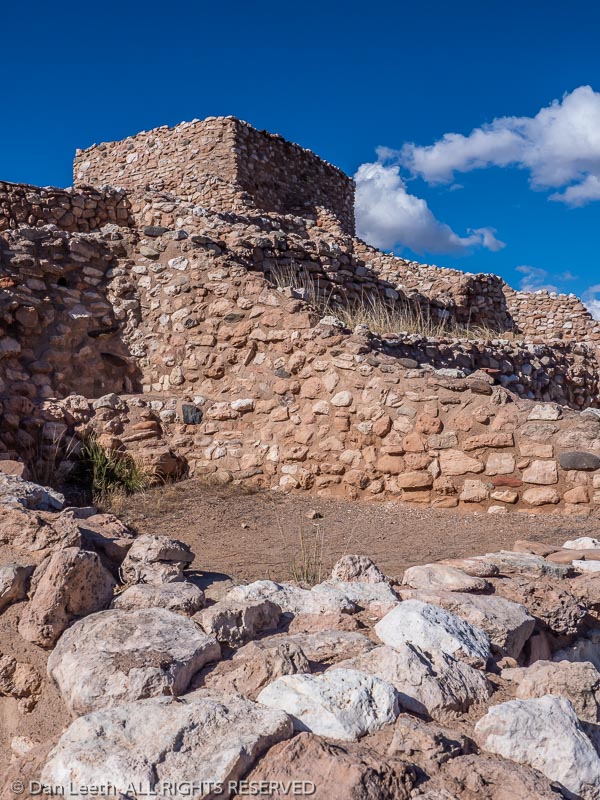
The park houses the remains of some Hopi settlements dating back to the 14th century, only a few walls of which have been reconstructed and stabilized. Beyond that, there’s little more than a handful of interprettive signs telling us what once stood there.
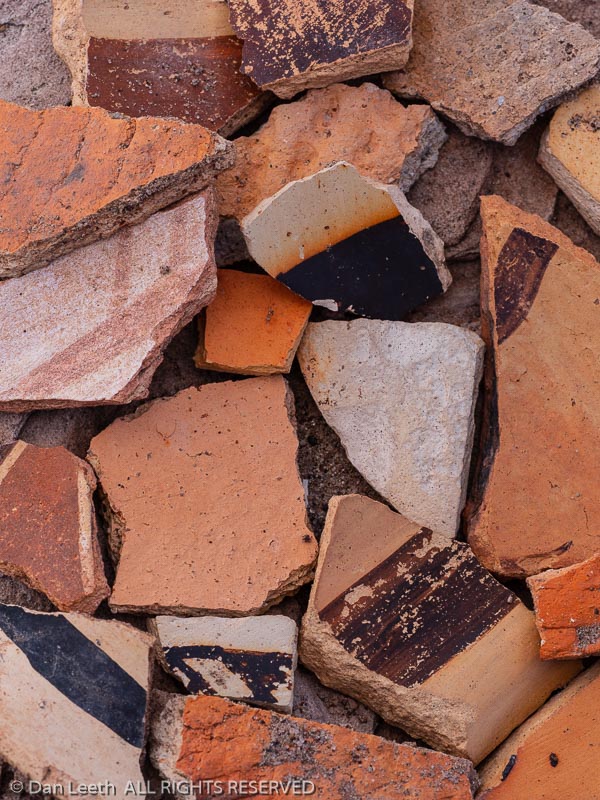
The most surprising thing about the site were the number of pottery sherds littering the ground. While it’s illegal to remove them, people (who must believe the rules do not apply to them) still do so. I’m sure the best pieces are long gone, but there’s still plenty of sherds left on the ground for us non-thieves to admire.
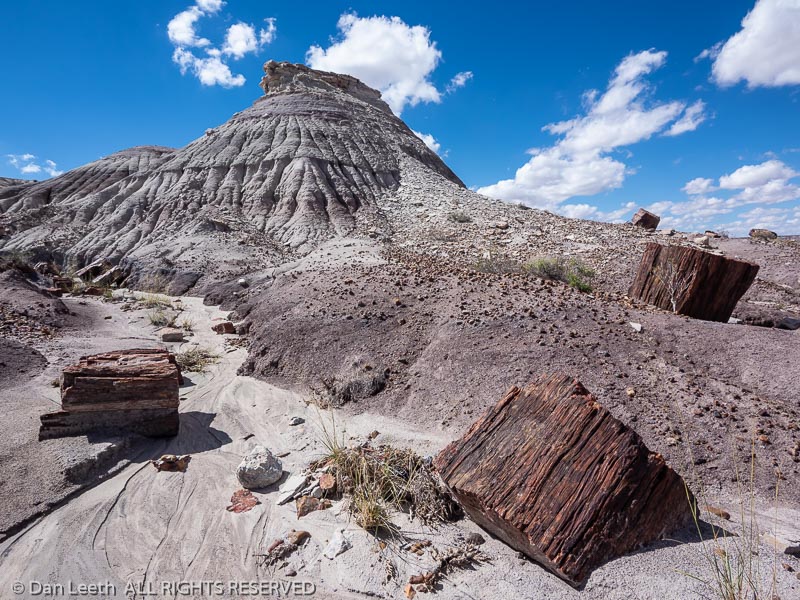
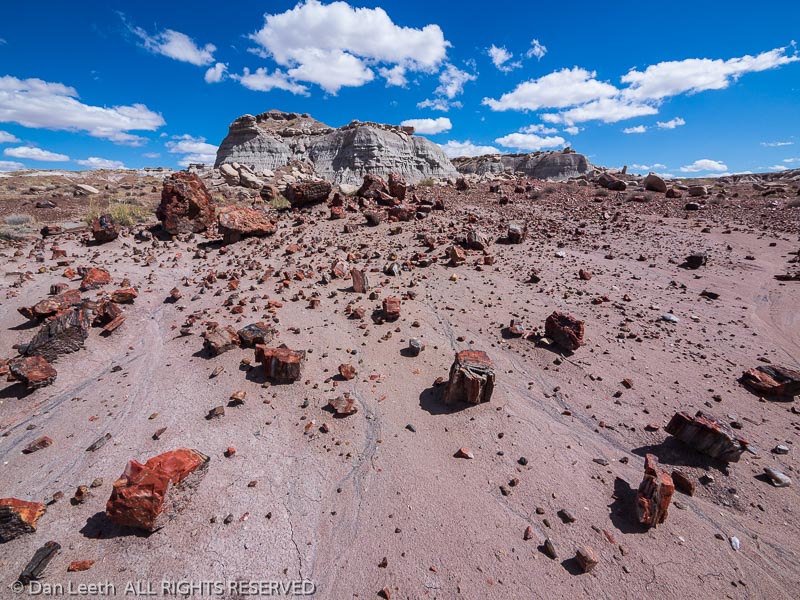
The main reason we’re camped at Homolovi (pronounced ho-MOLE-lo-vee) is because it’s the closest public campground to Petrified Forest National Park. The park houses not only thousands of acres studded with petrified tree trunks, but it also contains some of the most colorful Chinle “badland” slopes around. Some of these barren hillsides form what Arizona tourism folks have dubbed the Painted Desert. We were eager to get there and photograph both petrified wood and painted wonderland.
After enduring 2½ days of rain in camp, we finally made it to the rocky forest. The first day, we stopped at nearly every one of the park’s slew of scenic overlooks and hiked nearly every one of its tourist trails, the longest of which was a whopping mile in length. The following day, after strolling the final tourist trails, we set out on a three-mile, off-the-grid hike through the backcountry.
One big difference between our cross-country hike versus the tourist trails soon became apparent. Our backcountry route was rife with small pieces of petrified wood. It would have been so easy to pick one up and take it home as a souvenir. (We absolutely did not do so.) Virtually none of those pocketsize pieces can be found beside the tourist trails these days.
It’s a pity, but beside the park’s popular pathways, petite pieces of the petrified plants have apparently been previously pilfered.
After leaving Homolovi Ruins State Park, we headed north to Bluff, my favorite town in southeast Utah. We had planned to camp at a BLM campground on the banks of the San Juan River, but rain, rain and more rain had turned the site into a quagmire of mud and muck. So instead of cheap, off-the-grid camping we ended up at the Cottonwood RV Park in downtown Bluff.
Being in Bluff meant that dinner would have to be Navajo tacos, which consist of beans, salad fixings and cheese atop a fry bread bed. There are two places in the neighborhood to get decent Navajo tacos. The closest choice, the restaurant at the Twin Rocks Trading Post, was closed. There was a big Navajo event in Shiprock, so the owner gave his Indian staff the day off so they could attend.
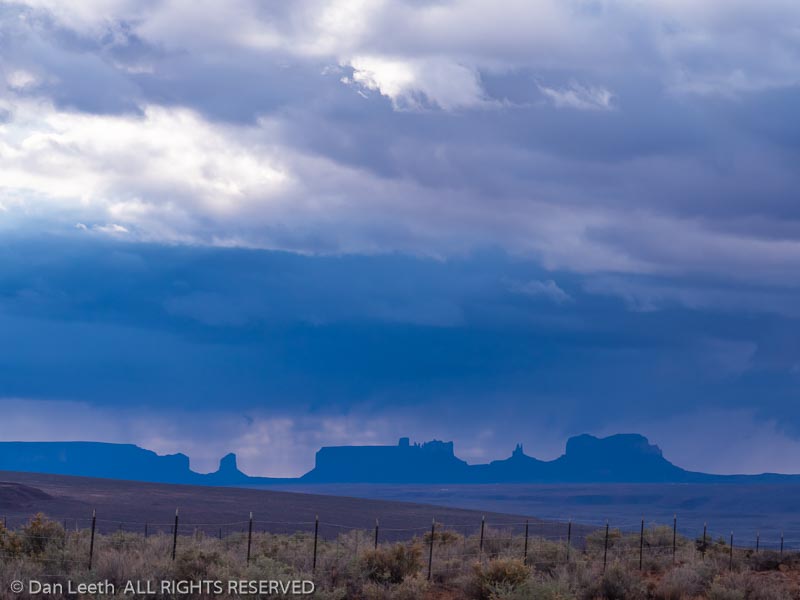
That meant we would have to drive 20+ miles down to Mexican Hat and get dinner at the Olde Bridge Grille located in the San Juan Inn. The commute gave us the opportunity to photograph the cliffs and clouds as the storm broke.
The next morning, as research for a Utah Life story, we talked to and bought a t-shirt from the folks about the Bears Ears National Monument at the Friends of Cedar Mesa information center.
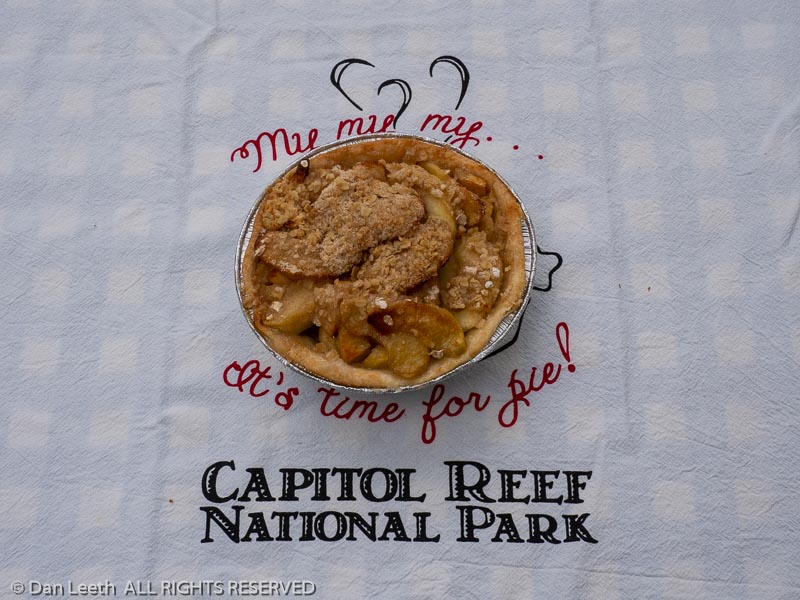
From there we headed north for a four-night stay in Capitol Reef, my favorite Utah national park. I needed to do some final research about the pies the Natural History Association sells for an upcoming Utah Life story about the park. Eating pies for as story research is tough work, but I do it because my readers need to know.
Besides pigging out on pies, we had hoped to drive south along the length of the Waterpocket Fold through the park, but the road is dirt and the rangers advised us that it would not be a good thing to do after the rain. So we stayed in the main Fruita area and squeezed in a few short hikes.
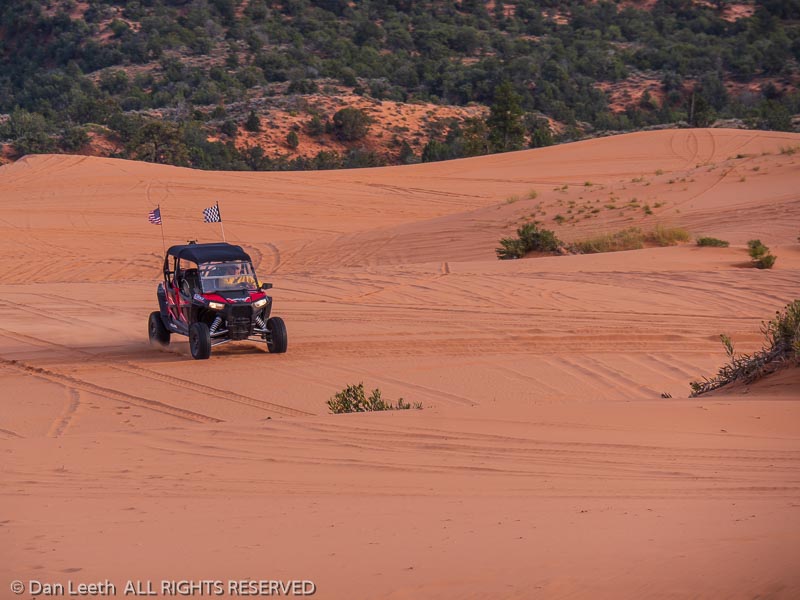
Our next destination is the Grand Canyon North Rim where we have a premium, rim-side campsite for four nights. On the way there, we stopped for two nights at Utah’s Coral Pink Sand Dunes State Park. I envisioned a nice, quiet state park formed to protect the sand dunes. That’s not what we got. Ninety percent of the park is open to ATVs, and they were out buzzing around the dunes like a swarm of locusts devouring a wheat field.
To escape the dune drivers, we fled to Zion National Park and hiked a few miles up the East Rim Trail where we saw only a handful of fellow trail traipsers. It was then back to camp where we followed dinner up with yet another Capitol Reef pie we brought out with us, all in the name of research.
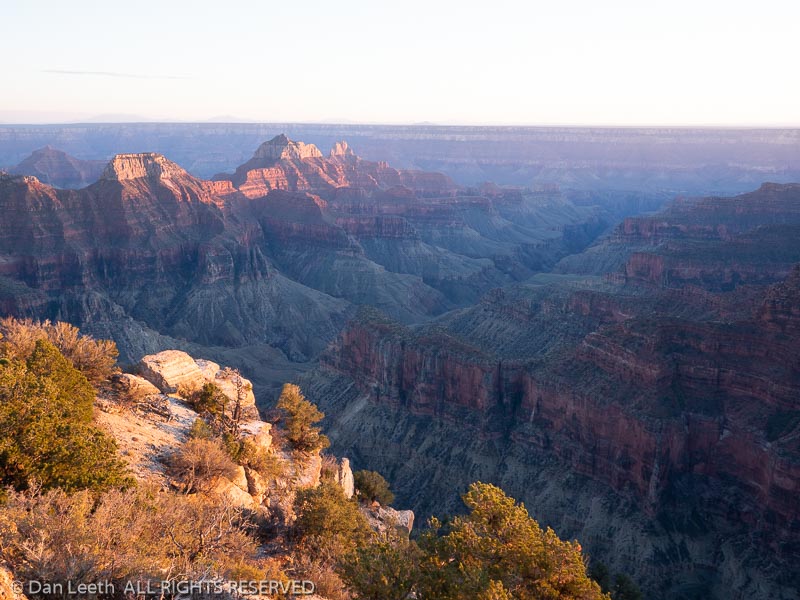
There’s a great debate going on in our household. Does the Grand Canyon’s grandeur look more impressive from the rim or from the river? Our next stop was the canyon’s North Rim where the controversy ensued.
The female contingent of our household believes this monument to erosion looks more impressive from the rim where one can look out over a network of chasms and sub-chasms ten miles across and more than a mile deep. Knobs and buttes rise like temples from the abyss, each sculpted with cliffs cut by side-streams.
The problem, her male counterpart contends, is an absence of scale. With no reference points, one has trouble appreciating how large and deep the thing really is. The problem is magnified by the human-caused haze than now lingers over the canyon. When the first explorers gazed into its depths, they estimated the river to be no more than six feet across.
Sitting beside the river, which is more like 300 feet from bank to bank, one can better appreciate the scale. Canyon walls can tower a thousand feet or more, frequently straight up. The sky is often little more than a slot in the heavens, and when one can see the rims, they seem impossibly far away. To me, that is the epitome of Grand Canyon Grandeur.
Both Dianne and I have seen the Grand Canyon from nearly angle possible. We’ve spent countless nights bunking on the rim, we’ve hiked from rim to river and back again countless times (sometimes twice in one day) and we’ve floated the river twice, once in motorized rafts and once in hard-sided dories.
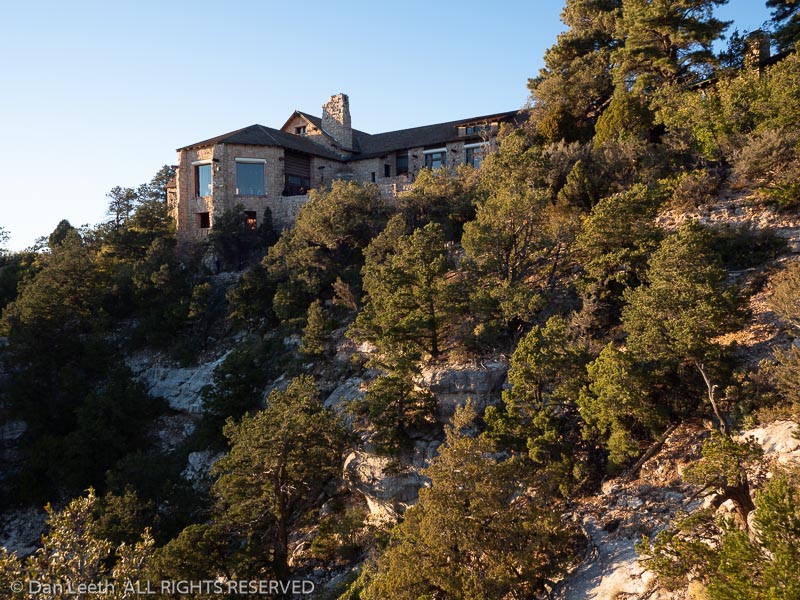
On this trip, we would spend four nights camped at the North Rim, and because of the weather, only see the canyon from the top. Our first day in the canyon we indulged in one of our favorite Grand Canyon pastimes. We had lunch at Grand Canyon Lodge staring out into the canyon. That was followed by a sunset drive to Point Imperial and Cape Royal, the North Rim’s prime viewpoints.
The next day we hiked the Widforss Trail along the rim followed by the short hike to Bright Angel Point behind the lodge before heading once again to the Lodge’s dining room, this time for dinner.
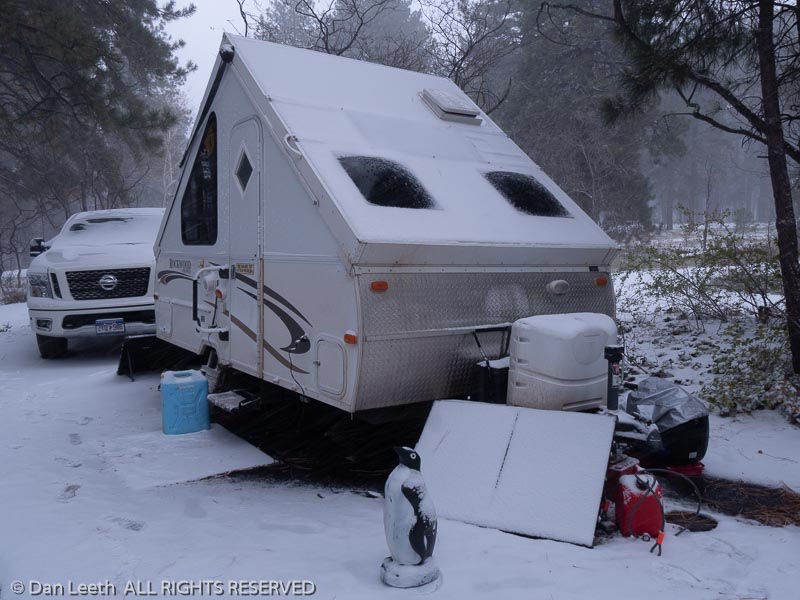
The following morning, we found that temperatures has plummeted, and our campsite was covered in snow. Our attack penguin, Adelle, was happy, but our solar panels were not. The campground Walley came around door-to-door to tell the dozen or so remaining campers that we could use our generators longer than the prescribed time. That was handy because our trailer furnace burned constantly throughout the day and night.
The next day was cold but clearing. We hiked the Transept Trail from our campsite to the Lodge, which was now closed for the season. Snow plastered the hillsides, occasionally illuminated by the sun poking through clouds. It was a pleasant day, but the rim versus river debate would have to wait.
We were definitely looking forward to the drive to lower altitudes and warmer temperatures at Dead Horse Ranch State Park in Arizona’s Verde Valley.
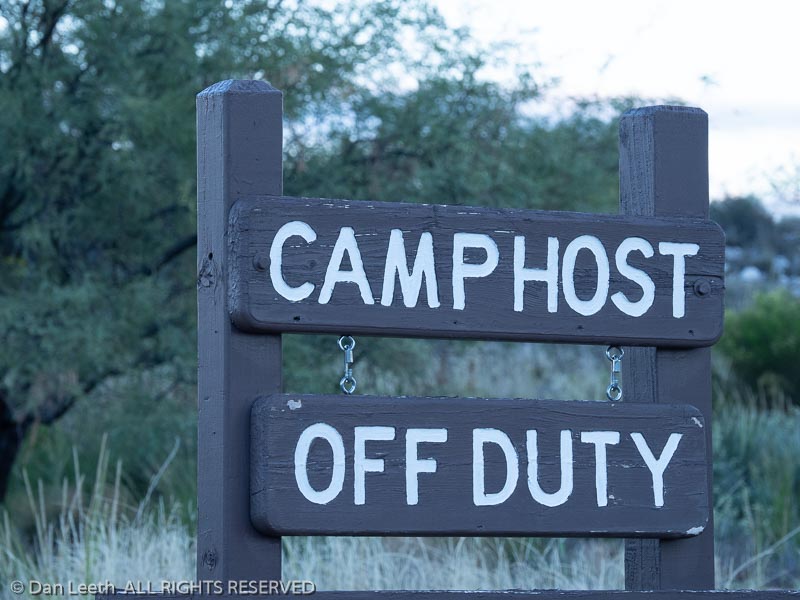
We’ve camped just under 400 nights over the past six seasons, nearly every one of which was in some sort of formal campground. Nearly every one of them had a “campground host” on duty. The only places we’ve ever had issues with these park volunteers (we call them “Wallys”) have been in Arizona state parks.
Two years ago, we were camped at Kartchner Caverns State Park in southern Arizona. Our site had water and electric hookups, but no sewer. That’s not a problem since we don’t have a bathroom in the trailer. But we do wash dishes in the trailer sink, which produces “gray water.” We catch the sink runout in an 11-gallon tote, which we can wheel to a drain site.
Our Kartchner campsite was across from the campground restrooms. It had an outside sink where folks could wash dishes and dump their dirty dishwater. We used similar sinks at a national park to drain our tote of dishwater, so we figured that would be the proper thing to do there.
Not so, said the Wally who intercepted me on my way to the sink. You must dump your dishwater at the trailer dump station. We discussed the issue and I agreed to tote my tote across the campground to the RV sewer dump.
I thought the issue was settled, but apparently it was not. She had one of the park rangers drive over to tell us that if we were to so much as even thinking of dumping our sink water anywhere but the RV dump station, we could be subject to a $5,000 fine.
“Why are you telling me this?” I asked. “I already told the lady we’d wheel it to the dump station. Did she think we might smuggle our dishwater into the dishwater sink when she wasn’t looking?”
The second incident occurred on our current visit to Dead Horse Ranch State Park located in the Verde Valley near Sedona. The park is beautiful, the restrooms clean, the hiking trails plentiful and the ranger staff at the Entrance Station/Visitor Center friendly and helpful. We hiked an eight-mile loop trail from our campsite and explored and photographed three nearby national monuments preserving centuries-old Sinagua Indian sites.
On our way back from one of the sites, we decided to take a look at the park’s group campsite facilities. We belong to the Aliner Owners Group (yes, ours is a Rockwood but the club graciously lets SOBs–Some Other Brands—join). They are always looking for regional rally sites, so we thought we’d scope out the group site here.
There were no signs, cones, closed gates or anything else saying the group site was off-limits. We drove in, made a quick loop through the area and headed out. An angry Wally flagged us down as we were leaving.
She told us we were not welcome in the group site and began scolding us for violating some unwritten, do-not-enter protocol. We explained why we were there, apologized profusely and promised never to ever enter the group campsite again. Her scolding and our apologizes continued for a good five minutes. Finally we were allowed to exit. I half expected to receive a ranger visit that evening, but fortunately none followed.
I’m sure the two volunteer hosts were just ordinary people trying to do their job as they best saw fit. Maybe we were the 15th incident in a stressful day and suffered accordingly. I love Arizona State Parks and will continue to visit them.
I will just make sure to never enter a group campsite or tote my dishwater to the dishwater sink.